






Looking for an alternative to Cognigy? This guide compares the top 10 Cognigy competitors for customer support, including Capacity, Kore.ai, and Zendesk. We’ll cover their:
- Features
- Pros
- Cons
- User reviews
Whether you need no-code chatbot builders, advanced voice automation, or unified knowledge management, you’ll find the right tool to streamline your operations and elevate customer satisfaction.
| Alternative | Best for | Rating |
| Capacity | External and internal support automation, and knowledge management | 4.8/5 |
| Synthflow | Best for voice automation | 4.5/5 |
| Retell AI | Best for conversational AI call automation | 4.8/5 |
| Zendesk | Best for large enterprises | 4.3/5 |
| Kore.ai | Best for enterprise-grade conversational AI | 4.7/5 |
| Sierra.ai | Best for user-friendly interface | 4.3/5 |
| Voiceflow | Best for no-code chat assistants | 4.6/5 |
| Yellow.ai | Best for enterprise-grade chatbots | 4.4/5 |
| Haptik | Best for AI-powered virtual assistants | 4.5/5 |
| Gupshup | Best for text automation | 4.4/5 |
With as many as 67% of customers preferring self-service, you have to meet them where they are. That means introducing self-service support options like automated website chatbots, email, social media interactions, and call automation is key to keeping customers happy and loyal.
A popular option to achieve this is Cognigy and its AI agents for customer support. The tool offers many features to help companies across industries automate their customer experiences. However, if you’re looking for a solution with more advanced automation, in-depth analytics, and features that cut costs and reduce response time, then you can’t miss the Cognigy competitors we’ve gathered in this article.
Keep on reading to find out:
- What Cognigy is
- What to look for in Cognigy competitors
- The best Cognigy competitor for unified internal and external customer support
- The best Cognigy alternatives for voice automation and text support
Let’s begin!
What is Cognigy? Strengths and weaknesses explained
Cognigy is an enterprise conversational AI and automation platform that enables organizations to build, deploy, and manage virtual agents like chatbots, voice bots, and AI agents across multiple channels, with deep integrations into backend systems.
It blends conversational AI and natural language understanding (NLU) with generative AI and agentic AI capabilities so that bots not only follow scripted flows but can also reason and “think ahead.” This way, you get a tool that works seamlessly behind the scenes.
Cognigy was recently acquired by NiCE, a customer experience platform provider, turning it into a comprehensive customer experience automation tool—NiCE Cognigy.
Main Cognigy features
Cognigy AI offers many of the features you’d expect from an agentic platform, such as omnichannel support and generative conversational AI. But those are just a few of the benefits you’ll get after integrating this solution. Let’s take a closer look at how Cognigy’s main features work.
- Omnichannel support enables the deployment of agents over voice, chat, messaging apps, web, and other channels, so your AI and human agents can maintain context and stay on brand in every conversation
- Low-code and visual flow editors allow less tech-savvy teams to design conversational flows via a visual interface
- Prebuilt integrations let you connect the tool to common systems such as CRMs, ticketing tools, voice gateways, etc., to fetch context, take actions, and complete transactions
- Natural language understanding (NLU) and support for multiple languages enable the tool to parse user intents and entities, supporting around 100 languages
- Generative and agentic AI capabilities add reasoning and dynamic response capabilities beyond rigid scripts so that every interaction feels natural and human-like
- Voice and telephony features allow you to record, trace, and route calls
What are typical Cognigy customers?
NiCE Cognigy works best for large enterprises and mid-to-large organizations with significant customer service and contact center operations.
Industries with high-volume, multilingual, and multichannel support needs, such as:
- Airlines
- Automotive
- Retail
- Utilities
- Financial services
- Healthcare
benefit the most from integrating this platform into their processes.
What are some Cognigy use cases?
Cognigy AI use cases depend on the industry. For example, self-service features allow retail customers to ask common questions about their orders and products, such as order status, product information, or returns.
Call centers can benefit from ticket deflection, using AI customer service bots to offload simpler queries and escalate only complex ones to humans. Teams across industries can also benefit from agent-assist features that help employees during live calls or chats.
Cognigy pricing
Cognigy AI pricing is custom and depends on your company size, number of employees, and needs. However, they offer a demo to try out their solution.
3 main pros of Cognigy AI
Cognigy has many great features that can help you speed up service, improve customer experience, and save time spent on repetitive, simple FAQs. Let’s go over some of the main pros they promise their customers.
- Strong focus on omnichannel customer support: Cognigy supports deploying conversational chatbots and voice bots across multiple channels, such as: web chat, mobile messaging, social media and phone
It also unifies customer experiences and data from each platform into one system for easy access and clear insights.
- Easy to use: Many agentic AI tools we’ve reviewed on our blog share a similar limitation—they’re hard to set up and use. But Cognigy is designed to lower the barrier to building bots and AI agents, even for non-developers or business users.
- Large integration library: Cognigy offers a built-in marketplace of connectors and extensions that allow you to easily plug into external systems like CRMs, databases, APIs, and back-office systems. You can also build custom integrations using open-source libraries or your own logic via the extension framework to augment Cognigy’s standard features.
4 main cons of Cognigy AI
Like every other agentic tool, Cognigy isn’t perfect and might not be the right choice for you, depending on your needs or industry. After checking their customer reviews, we concluded that these are the four main cons of the platform.
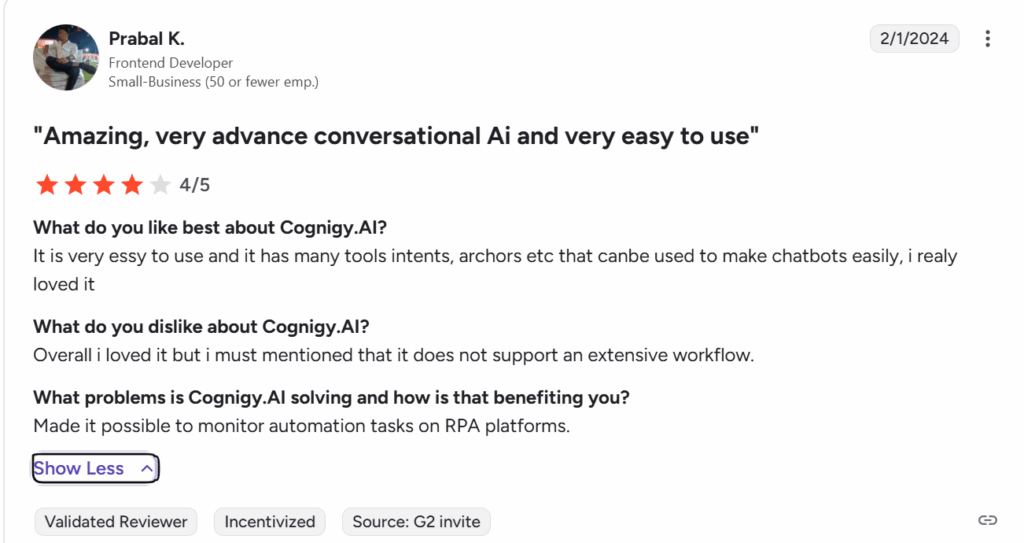
- Doesn’t support extensive workflows: Cognigy is sometimes viewed as less strong when it comes to handling very complex, deeply branching, multi-stage workflows with lots of conditional logic, loops, cross-flow orchestration, fallback handling, and cross-step state dependencies.
- Limited capabilities: Some advanced features, like adaptive reasoning, dynamic orchestration, and highly flexible generative behavior, might not be as mature compared to more advanced platforms. Again, it depends on your industry and business needs.
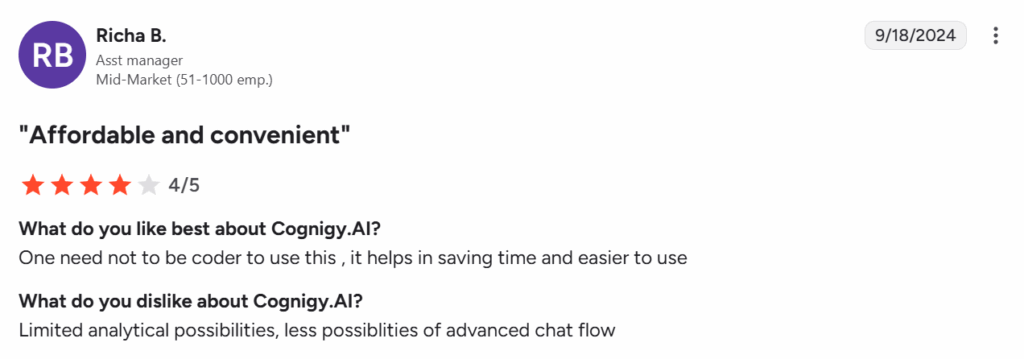
- Not fully low-code for maximum ROI: As we mentioned earlier, Cognigy offers visual, low-code tools to build conversational flows, but to use more advanced behaviors, you’ll often need to write code, create custom extensions, or build supporting services.
- Limited analytics: Several users mention “limited analytical possibilities” or that the “reporting dashboard is a little outdated.” The built-in analytics and conversational insights may not be enough for very deep, custom metrics, advanced user-journey correlation, or long-term trend analysis.
Why should you trust us?
We’re dedicated to helping businesses choose the tools that are right for them. As a SaaS provider, we know better than to try to match a client with a solution that’s not going to work for their business. While we think Cognigy AI can be a great addition to many companies, we want to give you options to consider so you can make a well-thought-out decision for yourself.
We also checked SaaS product review pages like G2, Capterra, and Gartner to gather an honest overview of Cognigy and its competitors and alternatives. With that being said, let’s go over the features to look for when choosing an alternative platform.
What to look for in Cognigy competitors
When you try to find an alternative to enterprise AI agent software like Cognigy, you have to look for certain features to ensure you get your money’s worth. Features like easy setup and integrations, unified knowledge management, voice customization, and advanced automation are important when picking a tool that will likely be part of your business for years.
Advanced features while still being low- to no-code
We’re not going to sugarcoat this: agentic platforms with advanced customization might require more than just drag-and-drop features. But the platform you choose should offer hybrid UI + coder paths, which include:
- A drag-and-drop visual builder for flows, branching, fallback logic, etc.
- The ability to inject custom logic through scripts, nodes, or functions where needed
- A toggle between “design mode” and “advanced mode”
- Prebuilt intelligent “actions” and building blocks
- Predefined actions, like “look up order,” “initiate refund,” “call API,” “send email” you can drag in
- The ability to chain these actions into workflows
This way, your team doesn’t always need to rely on tech support to fix or change every little detail. Such tools offer something for every department in your business—for example, if your marketing team wants to adjust email automation for a new campaign, they should be able to make these changes themselves without heavy coding.
Native knowledge management
When dealing with customer support automation, every detail in your corporate knowledge base matters. And we’re not only talking about your FAQ page—unified data should include information from:
- Knowledge base
- Document sources
- FAQ content
- Website content
- Internal chats and documentation
- Third-party integrations
Once it gathers this information, it should have the ability to author, edit, version, and structure content directly within the platform. Only this way can you ensure that the tool responds with up-to-date information and doesn’t mislead your customers or your team.
Voice customization
If your solution needs to handle voice interactions, you’ll want strong voice and speech customization capabilities. This ensures that when a customer calls, they receive natural and human-like support from your AI voice agent rather than a robotic-sounding, scripted interaction.
If voice customization is your priority, look for features like:
- Voice engine and text-to-speech flexibility
- Support for multiple voices, accents, and languages
- Control over prosody: pitch, speed, and tone
- Ability to use custom and branded voices
- Speech recognition (ASR) quality and customization
- Ability to adapt ASR models
- Noise robustness, real-time latency, and streaming support
10 best Cognigy competitors for customer support
The best Cognigy competitors for 2025 and the years to come depend on your personal needs, such as:
- Customer support goals: Consider whether you need to automate text and voice interactions and which channels they should include. Do you serve thousands of customers daily or handle just a few queries per day? Do you need to improve agent support for better CX? Do you also aim to optimize your call center knowledge base? This will determine the features and capabilities you should look for in a tool.
- Budget: Look for a platform that offers a clear pricing structure you can plan for at least a few months—or even a year—in advance. Make sure to calculate the final cost after discounts and free trials end.
- Audience: Does your audience engage more through website chat when they need help? Or do they prefer calls and emails? In either case, look for a tool that has strong capabilities in the channels your customers are most likely to choose.
Now that you know what to look for, we present 10 agentic tools worth your while. We analyzed them based on what they’re best for, main features, pros, cons, and public ratings. Let’s take a look!
1. Capacity
Best for: Customer support and internal team operation automation, and knowledge management

Capacity is an internal and external support automation platform that blends conversational AI with workflow automation and knowledge management. It aims to unify knowledge across systems and let bots, agents, and workflows draw from the same “single source of truth.”
Main features
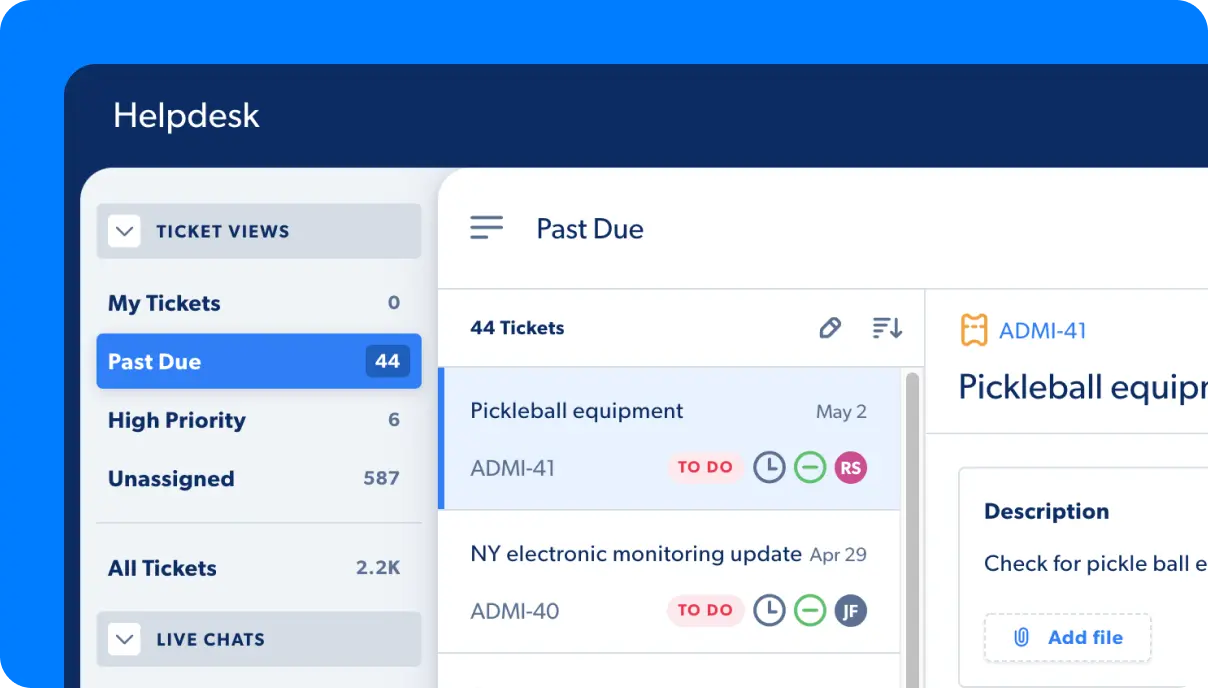
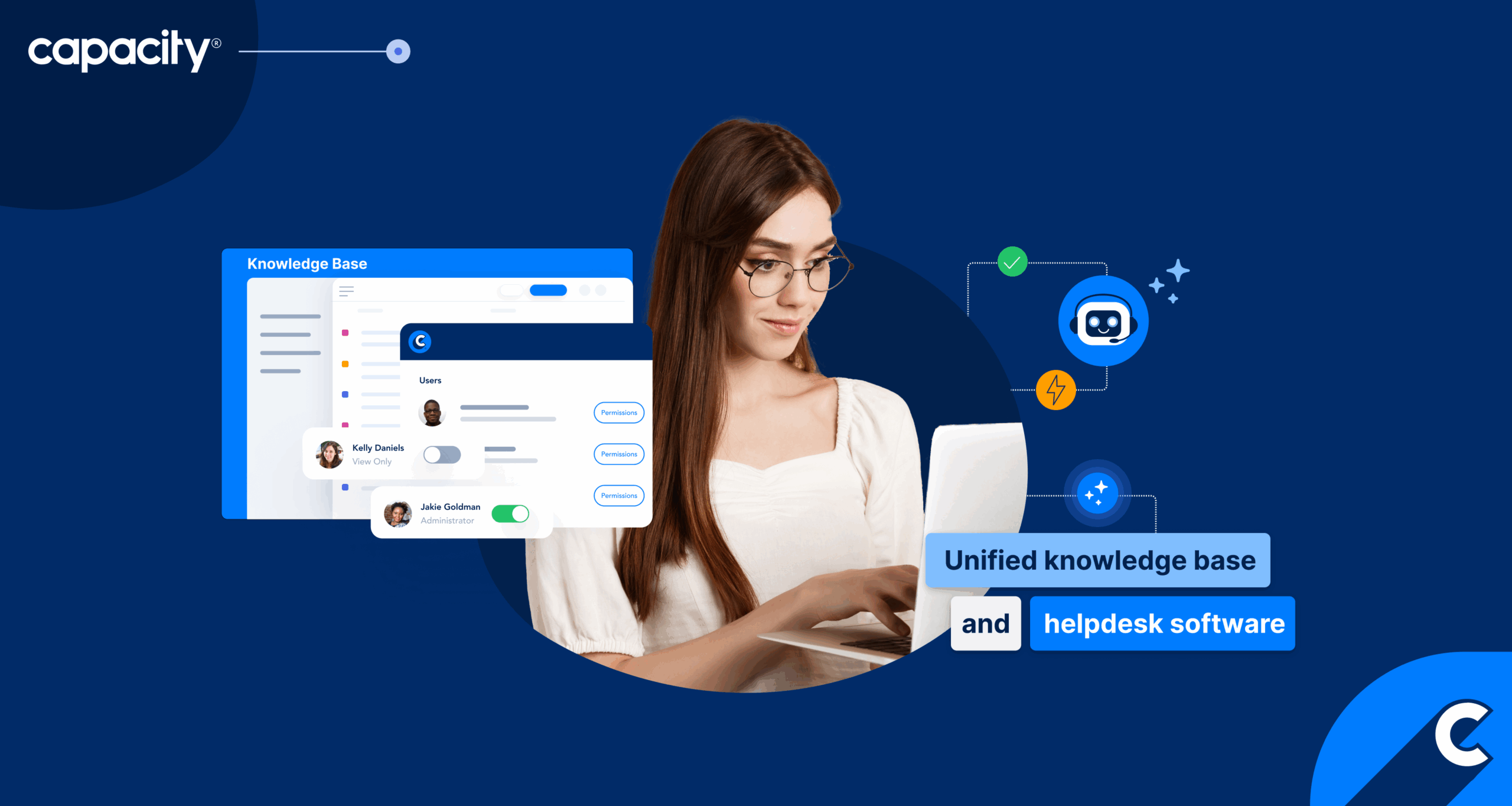
- Unified knowledge base and helpdesk software: Capacity offers a central knowledge base with helpdesk that bots, agents, and workflows all tap into whenever your team or customers need a quick answer. The tool integrates AI-powered helpdesk software with a knowledge base and features like Answer Engine®, which works like an AI chat assistant.
- Low-code workflows: If you’re looking to build logic, triggers, and actions without heavy coding, Capacity has you covered. It offers a user-friendly drag-and-drop tool, so everyone—from your marketing team to accountants—can build conversational workflows.
- Conversational AI across channels: Capacity maintains context and stays on-brand when interacting with customers across web chat, email, voice, SMS, internal chat, and other channels. It detects customer sentiment and adjusts its tone. If a customer switches to another channel, the platform authenticates them easily and keeps the conversation flowing without unnecessary repetition.
- Analytics and insights: Capacity tracks data across all interactions with its virtual agents so that you can measure usage, knowledge gaps, performance, and trends.
- Agent assist: True automation isn’t just about deploying AI agents—it’s also about giving your team the tools they need to be more productive and efficient. Capacity’s agent-assist features offer real-time suggestions, agent coaching, and conversation summaries after each interaction with a customer.
- Intelligent virtual agents: One of Capacity’s standout features is its advanced intelligent virtual agents, which can be deployed across every customer channel. They can deflect over 90% of customer tickets, assist with daily operations, and reduce the number of repetitive and simple inquiries.
Capacity use cases
Capacity offers many use cases across industries, like:
- Healthcare
- Finance
- Retail
- CPG
- Beauty
- And many more
Choice Hotels, a leading hospitality company with over 7,000 locations, offers a great example of how Capacity works in real life. Before integrating the platform, the company’s goal was to automate and personalize its customer experience so guests could enjoy faster, more tailored assistance.
They integrated Capacity’s AI-powered Virtual Agents to handle FAQs, repetitive tasks, and more complex inquiries such as bookings and cancellations. As a result, Choice Hotels has saved nearly $2 million in support costs and now automatically routes 97.4% of calls. If this sounds good, learn how AI virtual agents and AI chatbots work.
Pros
- Unified and automated knowledge base
- Good balance of low-code and developer extensibility
- Supports over 250 integrations
- Clear focus on both internal and external support use cases
Cons
- Some edge or complex workflows still require custom coding
G2 rating: 4.8/5
Interested in seeing it for yourself? Book a demo!
2. Synthflow.ai
Best for voice automation
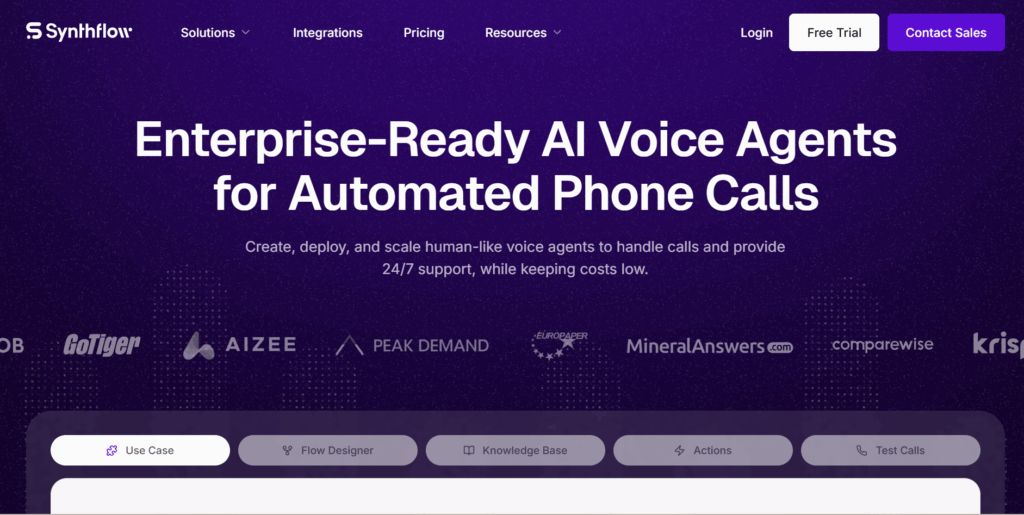
Synthflow AI is a voice-first conversational AI platform specifically tailored for automating phone calls and voice-based interactions while also integrating with digital channels. It markets itself as “enterprise-grade voice AI.” It’s a strong option if your customer support heavily relies on call interactions for both inbound and outbound campaigns.
Main features
- True conversational voice agents and voice AI customer service bots that understand intent, navigate dialogues, and adapt in real time to customer sentiment
- Multilingual compliance support that enables secure and compliant conversations in multiple languages, with compliance standards like SOC 2, HIPAA, and GDPR
- Integrations that allow you to connect Synthflow with backend systems for seamless information exchange
- Voice AI “bundles” with minute-based pricing make it easier to calculate your budget based on your average call volume
Pros
- Strong voice-native features
- Good compliance and enterprise readiness
Cons
- For heavy multichannel bots, it might require supplementing with another system
- Latency, recognition quality, and edge-case handling limits
G2 rating: 4.5/5
3. Retell AI
Best for conversational AI call automation
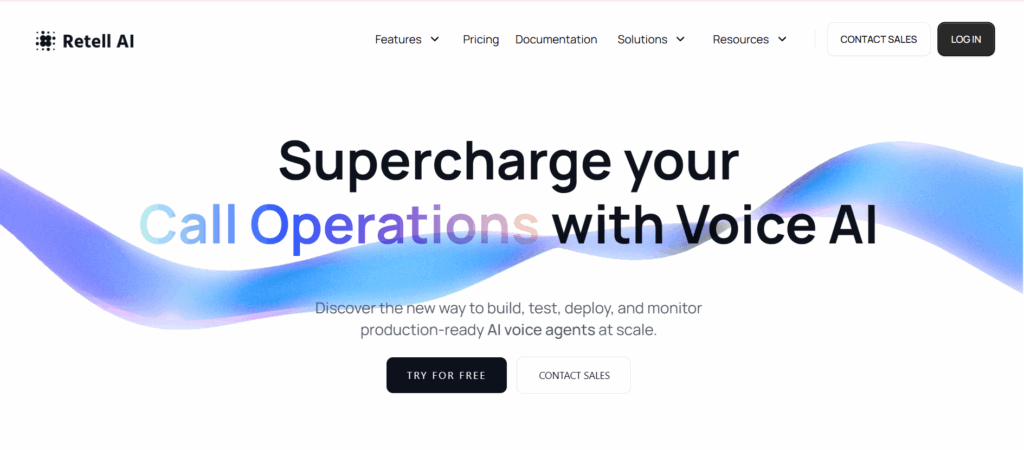
Retell AI is another strong option for call automation with conversational AI. It’s a newer, AI-native, no-code voice agent platform designed to spin up natural voice bots that can answer, act, and integrate seamlessly with your systems.
Main features
- Auto-sync with your knowledge base that keeps voice agents updated with current content
- Warm call transfer and routing support that provides smooth handoffs, so human agents can pick up with full context
- Telephony integration that allows you to connect existing phone systems
- Call analytics and performance metrics that offer dashboards for latency, success and failure rates, user sentiment, and conversation summaries
Pros
- No-code voice automation
- Good latency and responsiveness (around 500 ms)
Cons
- As a newer product, it may have less field maturity for complex cases
- Text features are more limited
G2 rating: 4.8/5
4. Zendesk
Best for large enterprises

Zendesk is a well-established platform that offers a full customer support and helpdesk suite. In recent years, it has added AI agents and conversational automation capabilities to help automate resolution across chat, email, ticketing, and voice. It’s a great option for large companies already familiar with Zendesk’s features and integrations.
Main features
- AI agents and generative resolution that can reason, act, and resolve issues—not just reply
- Seamless integration with ticketing: since Zendesk originally was a ticketing platform, its new AI features integrate deeply with the helpdesk and offer fallback to human agents, ticket handoff, record linking, and more
- Omnichannel support across voice, chat, and email
- Built-in analytics that let you track scoring interactions, quality assurance, and performance dashboards
Pros
- Excellent fit if you already use Zendesk
- Strong analytics and QA are baked into the support ecosystem
Cons
- AI features may be less flexible or customizable than a standalone conversational AI system
- For highly custom workflows or voice flows, you may encounter limitations
G2 rating: 4.3/5
5. Kore.ai
Best for enterprise-grade conversational AI
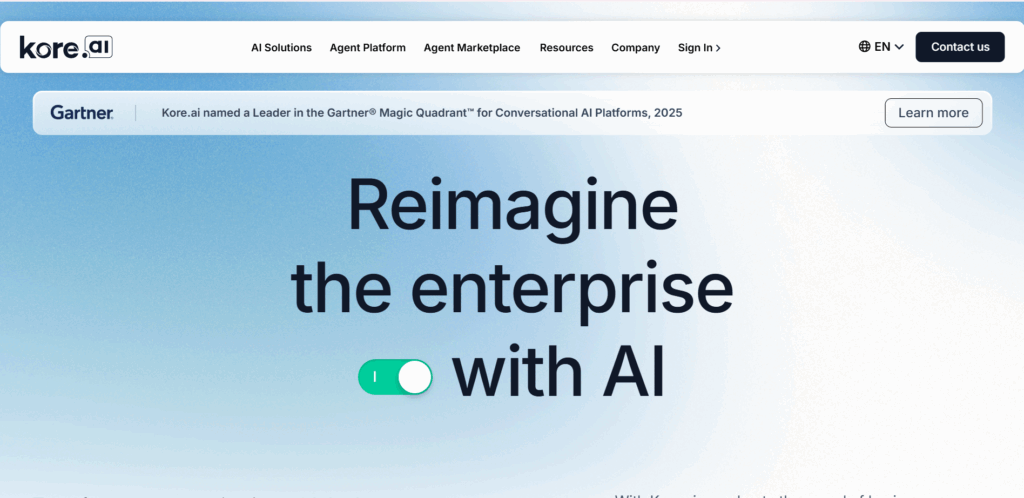
Kore.ai is a mature conversational AI and virtual assistant platform built for enterprises. It addresses both customer experience and employee experience use cases, offering robust conversation orchestration, omnichannel support, and deep enterprise integrations.
Main features
- Omnichannel deployment that runs bots across voice, chat, messaging, web, and IVR
- Advanced conversational capabilities enable your AI agents to have multi-turn dialogues and equip them with fallback logic, context management, and subflows
- The integration and extension framework connects the system to CRMs, backend systems, APIs, and custom logic
- Analytics, monitoring, and governance provide clear access to usage analytics, conversation logs, versioning, and control features
Pros
- Very flexible and enterprise-ready
- Good support for customer-facing and internal bots
Cons
- Has a steeper learning curve
- Voice features might be limited
- Cost and complexity can escalate quickly
G2 rating: 4.7/5
6. Sierra.ai
Best for user-friendly interface

Sierra.ai is a conversational AI agent platform that emphasizes outbound voice and chat automation, bridging intelligent conversations with action. It aims to let agents “take action” in backend systems. It’s a strong Cognigy alternative—and if you’re interested in exploring more about Sierra AI, don’t miss the top Sierra AI competitors.
Main features
- Action capabilities let agents update records and interact with systems deterministically
- Inbound and outbound support ensure you can cover both sides of customer conversations; however, Sierra AI is currently stronger on the outbound side
- Security and compliance offer advanced guardrails, supervision, log access, and transparency
- Conversational grounding and constraints make sure that agents align with policy, identity, and business rules
Pros
- Focus on control, supervision, and correctness
- Strong outbound capabilities
Cons
- Complicated pricing that can scale up quickly
- Steep learning curve
G2 rating: 4.3/5
7. Voiceflow
Best for no-code chat assistants
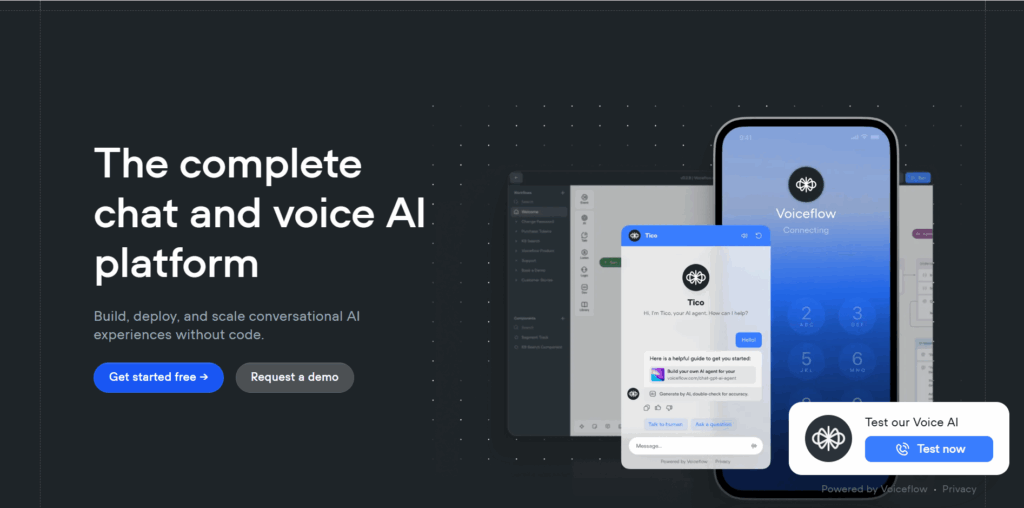
Voiceflow is a conversational voice UX builder, great for designing dialogue, voice experiences, and now also omnichannel chat through a visual interface. It’s used by designers, product teams, and developers building conversational “apps” or bots.
Main features
- Visual drag-and-drop conversation builder allows you to design dialogue maps, branching, and conditions
- Voice and speech support enables you to specify voice behaviors and integrate TTS/ASR in flows
- Integrations and API connectors let you connect to external services, data sources, and webhook calls
- Deployment across channels allows you to push designed flows to voice platforms, chat platforms, and more
Pros
- User-friendly
- Great for prototyping
Cons
- Might not suit growing or enterprise businesses
- Limited features for deep customization and advanced use
G2 rating: 4.6/5
8. Yellow.ai
Best for enterprise-grade chatbots
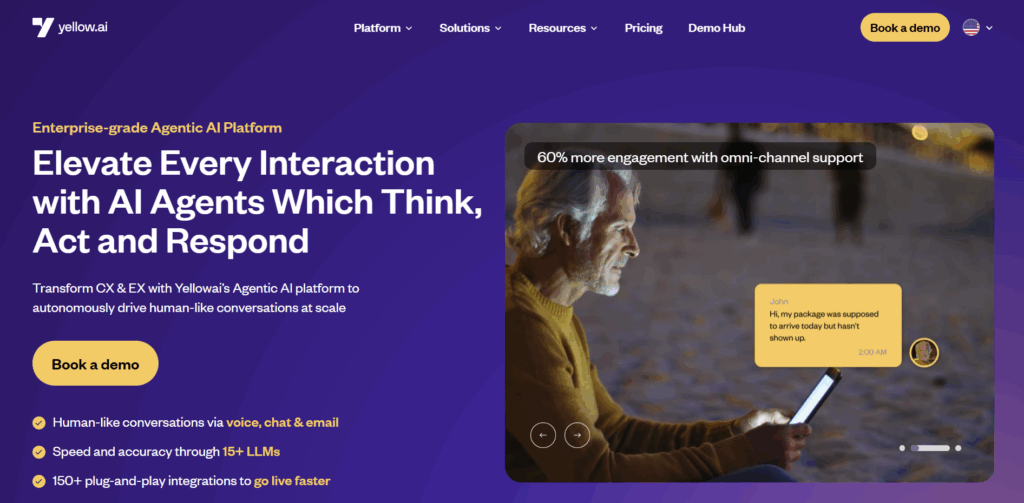
Yellow.ai is an agentic AI conversational platform that positions itself as enabling bots that not only converse but also think and act autonomously. It aims to reduce trade-offs between scale, cost, and quality in enterprise CX and EX automation. It’s a solid option for enterprise-sized companies. However, some users report integration and setup issues.
Main features
- Agentic AI fallback combines deterministic flows with generative responses, allowing the bot to handle unexpected inputs more fluidly
- Omnichannel orchestration supports voice, chat, email, visual media, and multiple channels with seamless context continuity
- Conversational knowledge base integrates your business information repository with auto-generation of articles, embeddings, and semantic retrieval
- Conversational design and no-code builder offer dynamic conversation design tools, drag-and-drop flows, and generative assistance in designing conversations
Pros
- Strong multilingual and global deployment support
- Native knowledge base integration compared to many orchestration tools
Cons
- Unpredictable pricing
- Complex integrations
G2 rating: 4.4/5
9. Haptik
Best for AI-powered virtual assistants
Haptik is a conversational AI and virtual assistant platform that emphasizes low-code agent creation, multilingual support, and enterprise system integration. Originally popular in Asia, it has grown to serve global enterprise use cases.
Main features
- Drag-and-drop bot builder lets you build workflows, intents, and decision logic without heavy coding
- Multi-language support covers many languages, with features for domain-specific translations and bulk FAQ uploads
- Integration ecosystem and connectors allow connecting to CRMs, APIs, payment systems, and other internal tools
- Omnichannel handoff supports messaging, chat, and voice, with escalation to human agents when needed
Pros
- Strong multilingual capabilities
- Robust integration support
Cons
- Limited real-time voice capabilities
- At a very large scale, performance and governance may become challenging
G2 rating: 4.5/5
10. Gupshup
Best for text automation
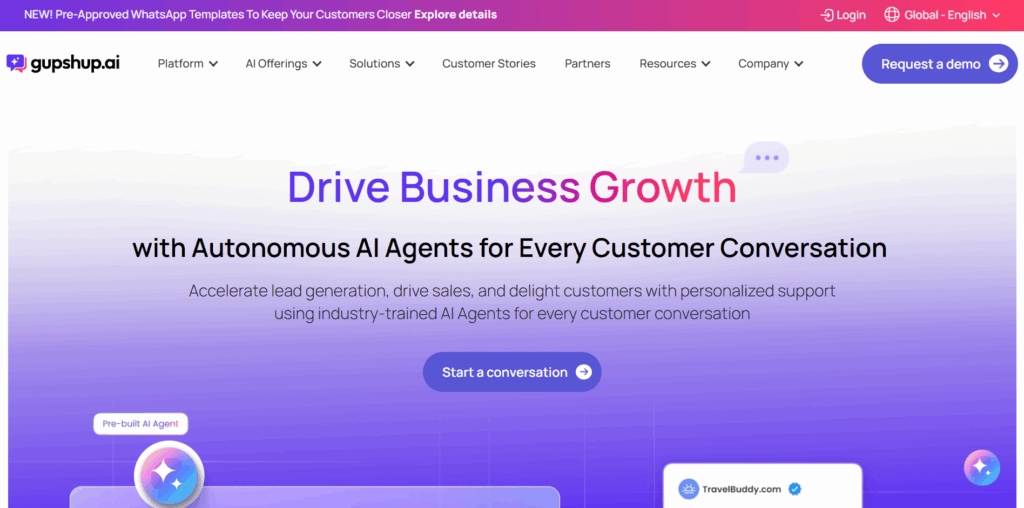
Gupshup is a conversational engagement and messaging platform that has evolved to include AI agents and generative capabilities. It supports building conversational journeys across many channels with no-code and low-code tools.
Main features
- Conversational AI agent builder lets you build journeys, integrate with backend APIs, and define fallback logic
- Omnichannel messaging support covers WhatsApp, SMS, web, social, chat, and other customer channels
- Integration with LLMs and hybrid models combines structured flows and generative fallback for robust automation
- Analytics and customer journey monitoring provide real-time metrics, drop-offs, top paths, and optimization insights
Pros
- Excellent foundation in messaging and text channels
- Strong support for hybrid flows and generative AI fallback
Cons
- Voice and telephony capabilities are secondary
- More complex workflows may require technical involvement
G2 rating: 4.4/5
The verdict: What alternative to Cognigy should you pick?
Advanced customer support automation, omnichannel reach, and happier customers after every interaction with your business are just some of the results you can expect when you implement an AI-powered agentic platform in your processes. We hope this guide to Cognigy competitors has given you a clearer idea of what to expect and what to look for when choosing an agentic platform to automate your customer support.
Let’s recap the top Cognigy alternatives:
- Capacity
- Synthflow.ai
- Retell
- Zendesk
- Kore.ai
- Sierra.ai
- Voiceflow
- Yellow.ai
- Haptik
- Gupshup
All these tools are worth your attention. However, if you’re looking for features like unified customer and team support, easy knowledge base management, and advanced corporate search, then Capacity is the clear winner.
But don’t just take our word for it—see it in action by booking a demo. No fuss, just true automation that works. Book a demo!
FAQs
Cognigy is an enterprise conversational AI platform that enables organizations to build and manage AI agents for customer and employee interactions across multiple channels. It helps companies automate conversations and deliver consistent, intelligent experiences in customer service, sales, and internal support.
Cognigy AI is another name for Cognigy, and it’s the company’s flagship product. It’s a low-code automation and conversational AI platform that combines flow-based logic, integrations, and generative AI capabilities. The platform is designed to automate conversations in:
– Contact centers
– Helpdesks
– Enterprise systems
Cognigy allows users to build omnichannel bots that work across:
– Voice
– Chat
– Web
– Messaging platforms
It integrates easily with CRMs and backend systems, enabling end-to-end automation of service, sales, and support processes.
Several platforms offer real-time voice capabilities, but HIPAA compliance varies. For example, Capacity provides robust voice and chat orchestration and is HIPAA-ready, making it suitable for healthcare and other regulated industries. Synthflow.ai focuses on voice-first automation, including live calls and routing, and claims enterprise-grade security. Retell AI offers real-time voice agents.
Some of the top open-source alternatives to Cognigy are Rasa and Botpress. Rasa offers a powerful framework for building custom chatbots and virtual assistants with full control over data and architecture. Botpress, on the other hand, provides a more visual and modular approach to conversational AI while remaining open-source and developer-friendly.