






- Balto AI is strong in agent guidance and QA, but it lacks full automation, outbound capability, and unified knowledge management.
- Many customers cite inaccurate AI, limited features, missing outbound functionality, and buggy performance as key reasons for switching to competitors.
- This guide breaks down the 10 best Balto AI competitors that offer more complete contact center automation, better performance, and higher ROI, including platforms like Capacity, Talkdesk, and Cresta.
You want to automate your call center, elevate the customer experience, track every productivity metric, and keep your team motivated, especially with AI-powered automation expected to handle 50% of service cases by 2027, up from 30% in 2025. You’ve explored countless call center automation tools and have likely come across Balto AI.
Balto AI is a reliable way to step into call center automation, offering both virtual agents and advanced agent-assist features. However, a closer look reveals that it falls short in areas like:
- Knowledge management
- Advanced real-time agent assist
- Deeper automation
- Outbound virtual agents
when compared with other leading platforms.
If that sounds familiar, you’re in the right place. This guide to Balto AI competitors will walk you through what Balto AI offers, why many teams look for alternatives, and which call center automation tools deserve your attention in 2026.
Let’s begin!
What is Balto AI?
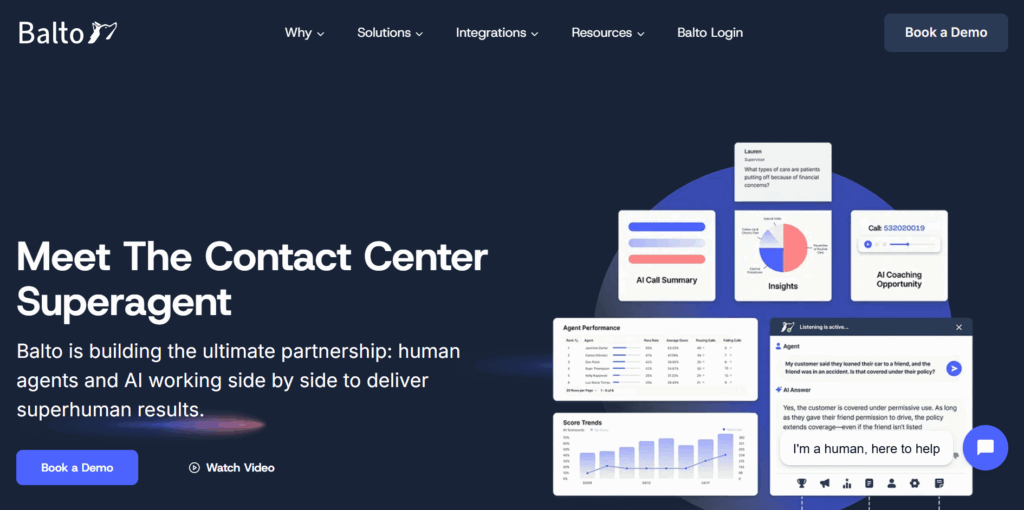
Balto AI is an AI-powered conversation intelligence platform designed for contact centers. It monitors live calls and text interactions between agents and customers, delivering real-time guidance, analytics, and coaching. In short, Balto AI promises to empower your agents with powerful AI tools.
Some of the main features of Balto AI include:
- Real-time agent support: It provides dynamic prompts, checklists, and coaching alerts during live calls so agents can stay on script, handle objections, and maintain compliance.
- Automated quality assurance: It automatically scores calls, flags compliance issues, and surfaces QA trends, reducing the need for manual review.
- Insights and analytics: Balto AI generates dashboards and natural-language reports from conversation data so you can see your team’s performance trends, agent behavior, and answers to business questions.
- Training and coaching tools: The platform identifies coachable moments from calls, helps create coaching materials, and supports the onboarding of new agents to improve performance.
Balto AI pricing
Balto AI offers custom pricing but allows potential customers to book a demo to try the platform.
G2 rating: 4.8/5
Why you should trust us
We’ve done the research to help you make the best choice for your business. Many companies thrive on using Balto AI for their contact center operations, but if you’re looking for more advanced and ample features, then it’s a smart move to have options.
To give you a clear picture, we analyzed Balto AI reviews on G2, Capterra, industry blogs, and community forums. We summarized what real Balto AI users are saying and examined reviews of the competitors featured in this guide. All sources are linked, so you can dig into the details yourself.
With that groundwork in place, let’s look at the four main reasons users consider switching to Balto AI alternatives.
Why look for Balto AI competitors?
Voice AI that sometimes misses what’s been said, a difficult setup, and missing features are some of the top reasons why customers switch to Balto AI alternatives. We analyzed Balto AI reviews and gathered four main issues users mention the most. Let’s take a closer look.
Inaccurate AI
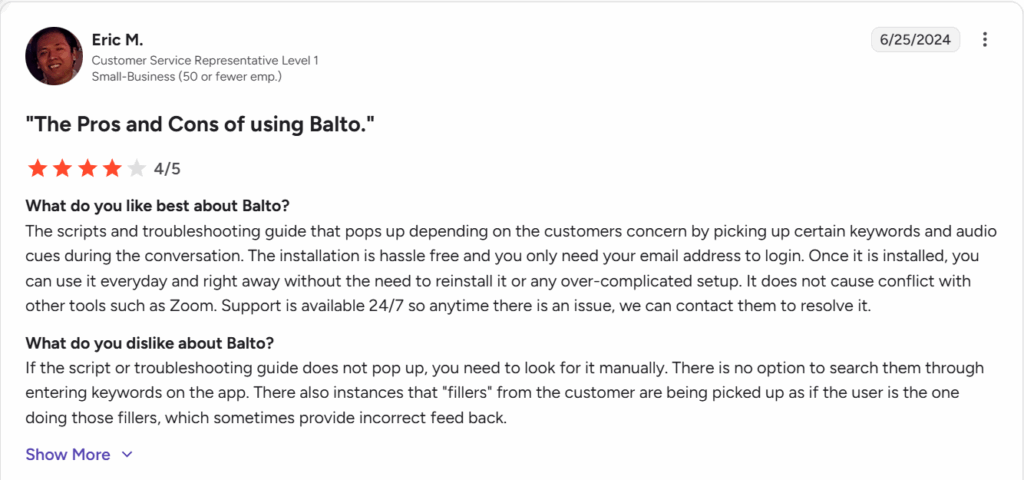
If the AI guidance isn’t consistently accurate, it can do more harm than good. Agents lose trust, supervisors waste time double-checking insights, and “real-time guidance” becomes real-time confusion. Balto AI reviews claim that the platform can provide inaccurate information and hallucinations. This can be tricky for companies in highly regulated industries where security and compliance are of utmost importance.

Not a full platform
Balto covers part of the workflow but not all of it. For example, you might miss features and functionality like knowledge management, in-depth automation, and outbound virtual agents. If you prefer one platform that handles coaching, QA, analytics, call handling, and automation instead of stitching together different tools, Balto AI competitors are worth considering.
Limited outbound capability
If your team handles outbound sales, collections, or proactive customer outreach, Balto AI isn’t the best option to support those workflows. While it supports outbound agent-assisted calls—like live agents making outbound calls and getting guidance and support—it doesn’t offer full-scale automated outbound capability.

Buggy performance
Slow, glitchy, or unreliable software kills productivity and destroys user adoption. If the AI freezes, lags, or misfires during live calls, agents tune it out, and you end up paying for a system no one uses. Some Balto AI reviews mention performance bugs that disrupt workflows.
Vendor Really Stack Up?
What to look for in Balto AI alternatives: 4 main features not to miss
You want flawless performance and to focus on both inbound and outbound capabilities, so you’re in the right place to look for Balto AI alternatives. But what exactly should you look for? As a call center automation platform, these are the features worth your attention.
1. Integrated knowledge management
To automate customer and employee support operations, you must have sufficient data to train automation systems. Most tools on the market connect to your existing FAQs and web content, but very few provide a full, integrated knowledge management experience.
More advanced platforms connect to more than just website information. They unify data across web content, first- and third-party integrations, documentation, internal chats, and other sources to provide a personalized customer experience and speed up your team’s work.
Look for:
- A unified knowledge base that incorporates articles, FAQs, policy documents, third-party integrations, internal chats, and past conversational transcripts
- Real-time access so agents are able to pull relevant knowledge during live calls or chats
- Smart search, auto-tagging, version control, and the ability to update content easily
- AI-driven retrieval instead of forcing agents to manually dig through documents
2. Outbound capabilities
Most contact and call centers provide both outbound and inbound services. For this reason, you can’t rely on tools that provide only one of these or have limited features. Without full outbound capability, you’ll need another vendor or tech stack, increasing cost and complexity.
Look for:
- Predictive or automatic dialers, SMS or chat campaigns, and list management for outbound contacts
- The ability to integrate outbound with inbound workflows
- Compliance and regulatory tools if you operate in regulated markets
3. Backend automation capabilities
Look for platforms that can integrate into your backend systems and automate your business from the inside out. Automating behind-the-scenes tasks in a system, such as data processing, updating databases, generating reports, scoring calls, or triggering workflows, makes your and your team’s work far more efficient.
Look for:
- A workflow or orchestration engine with the ability to automate handoffs, updates, and follow-ups without human intervention
- Trigger-based logic, for example, “if sentiment is negative, route to a senior agent and send an alert”
- Integration with CRM, ticketing, and data systems so that actions go beyond the call itself
- Scalability that works not just for 10–20 agents but for hundreds or thousands
4. Full contact center platform
If the alternative you pick is only partially capable, then you’ll need other systems to fill the gaps, which means higher costs, more integrations, and potential data silos.
For example, you might adopt a tool that offers AI-powered webchat agents to deflect customer inquiries, but it doesn’t connect well to your ticketing or CRM platforms and doesn’t offer an alternative.
Or, if a customer makes a purchase through one of your self-service options and it doesn’t communicate seamlessly with billing and payments, you have a problem. A full platform makes it easier to manage, scale, and future-proof.
Look for:
- Not just a bolt-on AI tool, but a fully featured contact center as a service (CCaaS) with inbound and outbound voice, chat, SMS, omnichannel routing, analytics, QA, and workforce management
- Unified reporting and dashboards across channels
- Strong scalability, high availability, and security and compliance
- A clear vendor roadmap and ecosystem
Top 10 Balto AI competitors in 2026: main features, pros, cons, and ratings
Now comes the fun part. After looking at multiple options, we condensed the top 10 Balto AI competitors in the USA, Europe, and other regions for 2026. You’ll find the main features for call centers, pros, cons, and user ratings.
1. Capacity

Think of Capacity as a Swiss Army knife for agent support and automation. It’s built to reduce manual effort, arm agents with instant information, and automate FAQ-type interactions so your team can focus on the harder stuff.
It offers features for agents and customers to unify your corporate knowledge and use it for seamless support optimization. It’s a strong Balto AI competitor for 360-degree automation, advanced agentic features, and many user-friendly integrations.
Main features:
- Unified knowledge base and instant access for agents during calls, so whenever your team has a question or needs to clear up doubts, they can quickly enter a prompt and the unified Answer Engine® will give them a concise answer—no fluff.
- Automation of repetitive support across channels like voice, chat, email, SMS, and anywhere your customers engage with your business. Capacity automates over 90% of repetitive inquiries, making your team’s job easier and cutting costs.
- Real-time call transcription and agent assist help agents before, during, and after communication with customers. Capacity coaches new agents and helps them learn on the spot. It also offers real-time suggestions and tips during calls, so whenever your team has a question, Capacity has their back—no awkward silences. When a call is done, the agent-assist features continue working by providing quality assurance, suggesting improvements, and summarizing interactions to your CRM system.
- Integrations with many CRMs, helpdesks, and stack tools. You can integrate Capacity with more than 250 tools, making it feel familiar and easy to incorporate into your processes.
- Intelligent virtual agents that can be deployed across channels to offer prompt and accurate assistance to your customers. They handle repetitive queries like FAQs but also tackle more complicated tasks like password resets, bookings, cancellations, and more.
- Outbound campaigns that can handle outreach across channels to ensure a consistent brand experience and streamlined customer journeys.
Pros:
- Strong for reducing agent effort and speeding resolutions
- Good for omnichannel support and knowledge-driven workflows
- Strong knowledge management features
Cons:
- Might be more oriented to support automation rather than full dialer capability
- As with many similar tools, you may need to spend some time configuring the system to tailor it for your specific workflows
G2 rating: 4.8/5
See it for yourself—book a demo!
2. Cresta
Cresta positions itself as an enterprise-grade generative AI platform built for the modern contact center—both supporting human agents and deploying virtual ones. It’s about elevating interactions and insights across your contact-center workflows.
Main features:
- AI agent assist provides real-time guidance for human agents during live calls, with knowledge and behavioral prompts
- Conversation intelligence allows you to capture what’s going on in calls and chats to surface what drives performance
- Automation of routine interactions with virtual agents across channels
- Enterprise-grade governance supports data and training guardrails, brand, and compliance for large operations
Pros:
- Suitable for large-scale, complex operations with both human and virtual agents
- Strong focus on real-time assist and automation
Cons:
- Costs and complexity are on the higher side
- If you’re a smaller operation, you may not leverage the full breadth of capabilities
G2 rating: 4.3/5
3. Gong
Gong is more revenue- and sales-oriented than focused on pure contact center operations. It records and analyzes calls, emails, and meetings to help sales teams understand what’s working, what’s not, and coach accordingly.
Main features:
- Call and meeting capture and transcription across phone, web, and conferencing allow for smooth sales interactions
- AI-powered insights that turn into sales conversations show what behaviors correlate with wins vs. losses
- Coaching and follow-up give you the ability to highlight snippets, share insights, and train reps
- Integration with CRM and revenue workflows lets you link conversation data to the pipeline and outcomes
Pros:
- Excellent at giving sales teams visibility into what’s happening in calls and deal cycles
- Strong coaching capabilities and insight generation for revenue teams
- Good for improving rep behavior and aligning on key strategies
Cons:
- Less focused on inbound and outbound contact-center routing
- If you’re running a full-scale contact center, you may need complementary tools
G2 rating: 4.8/5
4. Observe.ai
Observe.ai is built for contact-center excellence via AI-powered conversation intelligence: listening, analyzing, supporting live agents, and offering post-interaction insights. It’s about turning every interaction into improvement.
Main features:
- Real-time agent assist provides live prompts, alerts, and scripts during calls, so your agents can succeed at their work
- Post-interaction analytics analyze transcriptions, scoring, and trends across all interactions
- Conversation intelligence detects sentiment, intent, and topic extraction to identify patterns and coaching needs
- Full interaction capture across voice and digital channels, so you can monitor more than just voice
Pros:
- Strong at giving managers visibility across agent performance, interaction quality, and coaching opportunities
- Good fit for contact centers that want to elevate QA, compliance, and training
Cons:
- May need other tools if you also require heavy outbound dialing, campaign management, or full CCaaS
- Some reviews indicate that transcription accuracy sometimes isn’t the best
G2 rating: 4.6/5
5. AmplifAI
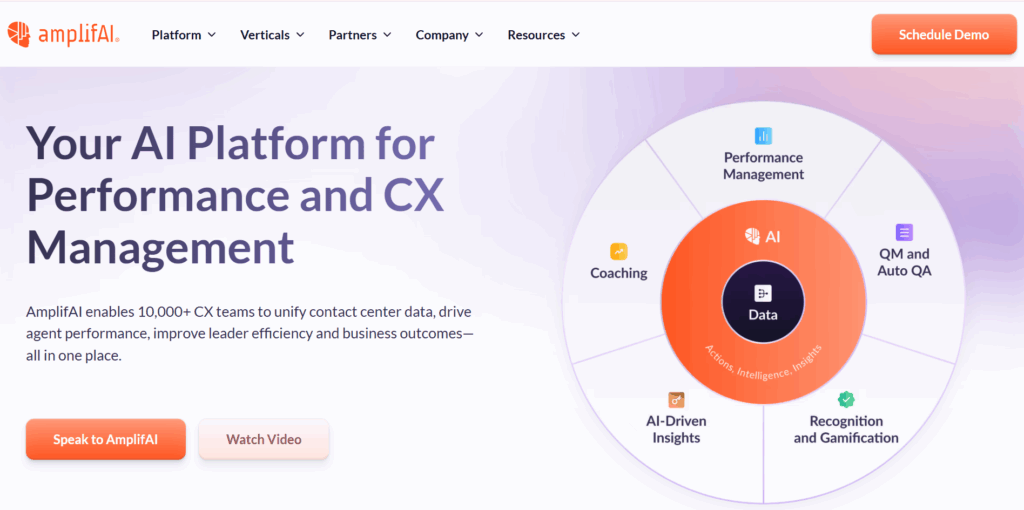
AmplifAI zooms in on the “people performance” side of the contact center: unifying QA, coaching, performance management, and analytics into one system. Think of it as the “engine room” of agent performance.
Main features:
- Auto QA reviews and scores all calls, removing the need for manual work
- Unified performance tracking across internal teams, BPOs, and outsourcing allows mapping every contributor in one view
- Coaching and next-best actions provide insights into what behaviors to coach to improve agent productivity
- Data unification brings disparate CX, QA, WFM, and other data into one system for holistic measurement
Pros:
- Good for organizations wanting to raise their agent performance and coaching maturity
- Especially valuable if you have distributed teams, BPOs, or complex operations
Cons:
- Not a full contact-center infrastructure
- The value depends heavily on embedding the coaching workflows and culture
G2 rating: 4.7/5
6. Talkdesk
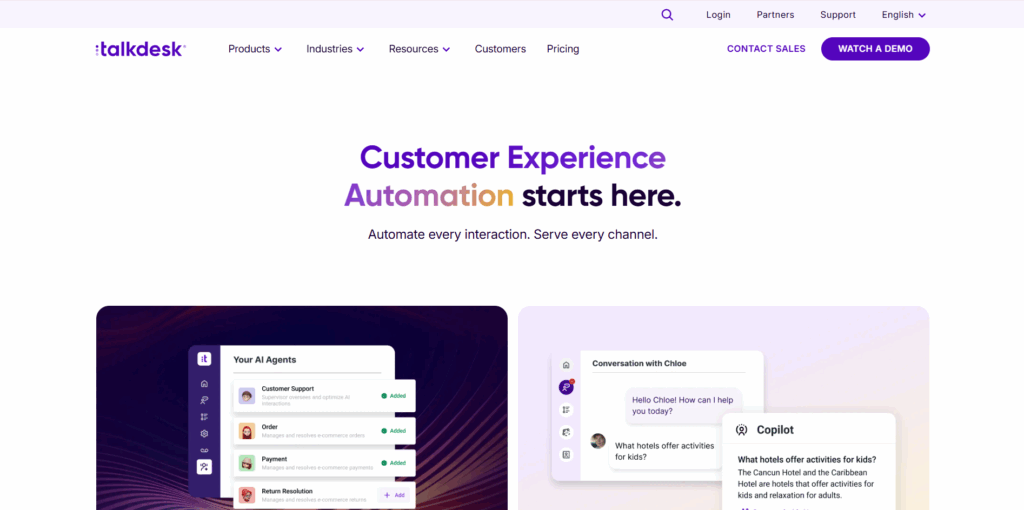
Talkdesk is a full cloud contact center platform that supports voice, digital channels, routing, analytics, and automation. It’s built to handle the full scope of contact center operations rather than just one piece. However, if responsive customer support and a true omnichannel experience are important for your business, then don’t skip Talkdesk alternatives.
Main features:
- Inbound and outbound capabilities, omnichannel support, and advanced routing allow you to cover and automate most customer interactions
- Dashboarding and analytics across channels provide insight into agent performance and customer interactions
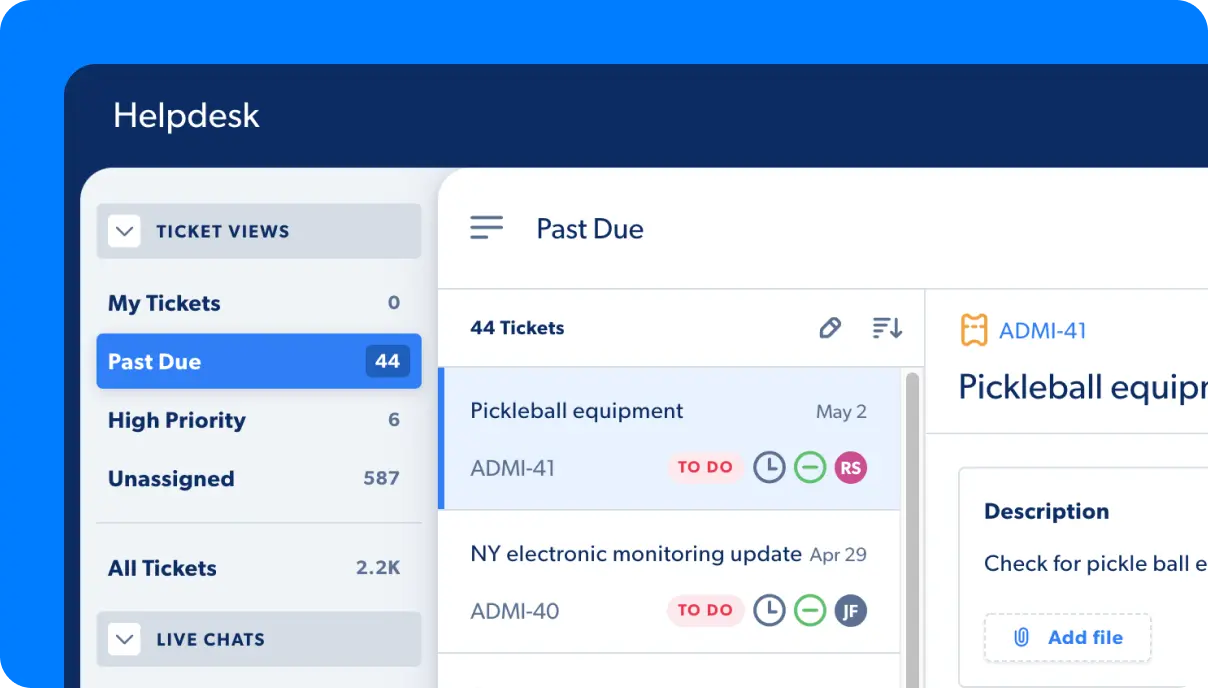
- Automation and workflow orchestration give teams no-code tools to build workflows, connect data sources, and automate routine tasks
- Integration ecosystem works with CRM, data cloud, and third-party systems, enabling unified data and experience
Pros:
- Comprehensive
- Good for organizations seeking to scale
- Strong support for both inbound and outbound workflows
Cons:
- Smaller operations may not need all of its features or bear the cost
- Implementation and integration work may be significant depending on your stack
G2 rating: 4.4/5
7. Voice.AI
Voice.AI offers AI-powered voice agents that can handle inbound and outbound calls, with multilingual support and enterprise-grade compliance. The focus is on automating the actual voice interaction via AI agents rather than only analytics or coaching.
Main features:
- AI voice agents for inbound and outbound calls can automate the majority of routine calls without human involvement
- Multilingual, 24/7 support enables global coverage
- Deployment flexibility allows you to choose between cloud and on-premise deployment
- Integration with CRMs and telephony systems lets AI agents plug into existing stacks
Pros:
- Highly valuable for automating large volumes of routine calls
- Good for organizations needing global reach or multilingual support with less human staffing
Cons:
- If your needs are more about full contact-center operations, you’ll still need complementary tools
- Complex interactions likely still require a human agent
G2 rating: N/A
8. Aloware
Aloware is an AI-driven contact center and call engagement platform that emphasizes outbound dialing, SMS and text, CRM integration, and automation, making it particularly suited for sales and outreach operations.
Main features:
- Power dialer and outbound calling allow you to reach customers faster
- Easy integration with popular CRM systems, so calls and texts are logged, and workflows are triggered from your CRM
- AI and voice analytics, call summaries, and routing help to optimize outreach
- Cloud contact-center capabilities
Pros:
- Excellent for outbound-heavy operations
- Good value for smaller and midsize operations
- CRM-centric
Cons:
- It may lack the full breadth of CCaaS features
- For very large enterprise-sized contact centers, it may reach limits
G2 rating: 4.1/5
9. Five9
Five9 is one of the heavyweight CCaaS platforms. It’s a full cloud contact-center solution with routing, dialers, AI, workforce tools, and automation. If Talkdesk is the sleek, modern option, Five9 is the deeply mature, highly configurable enterprise-grade classic.
Main features:
- Omnichannel routing across voice, SMS, chat, email, and social with intelligent IVR/ACD for a true omnichannel experience
- Predictive, progressive, and powerful outbound dialers for high-volume sellers or collectors
- Five9 “Genius” AI provides real-time agent assist, intent detection, and self-service
- Workflow and backend automation tools allow updating CRMs, triggering tasks, and orchestrating complex processes
Pros:
- Very robust for large or regulated contact centers
- Deep native dialer functionality for serious outbound teams
- Strong reliability and uptime track record
Cons:
- Can feel complex for smaller teams
- Implementation and customization take time and expertise
G2 rating: 4.1/5
10. NiCE CXone
NiCE CXone is a powerhouse for analytics, workforce optimization, routing, and automation. Where other tools help agents react better, NiCE tries to help organizations predict and architect the customer journey end-to-end.
Main features:
- Highly advanced analytics and speech intelligence across all customer interactions
- Workforce management, scheduling, forecasting, and QA are all native in the platform
- AI-driven self-service chatbots and voicebots come with strong orchestration tools
- Full inbound and outbound CCaaS with omnichannel routing and global scale
Pros:
- Among the most powerful analytics and WFM suites in the industry
- Can replace several separate tools with one unified platform
- Excellent for complex enterprise operations with multiple channels
Cons:
- Steeper learning curve
- May be overkill for small or medium centers
- Pricing sits at the premium end of the market
G2 rating: 4.3/5
All-in-one customer support automation
When you need your customer support to work, you can’t risk any surprises or limitations. That’s why many companies switch to Balto AI competitors to find the features they need the most for their businesses. While Balto AI is a great option for automated quality assurance, real-time support, and agent tools, it lacks some essentials. Hopefully, you’ll be covered after reading this article.
Let’s recap: the top 10 Balto AI alternatives are:
- Capacity
- Cresta
- Gong
- Observe.ai
- AmplifAI
- Talkdesk
- Voice.AI
- Aloware
- Five9
- NiCE CXone
If you want one platform that connects the most important contact center features into one functioning business infrastructure, you’re looking at Capacity.
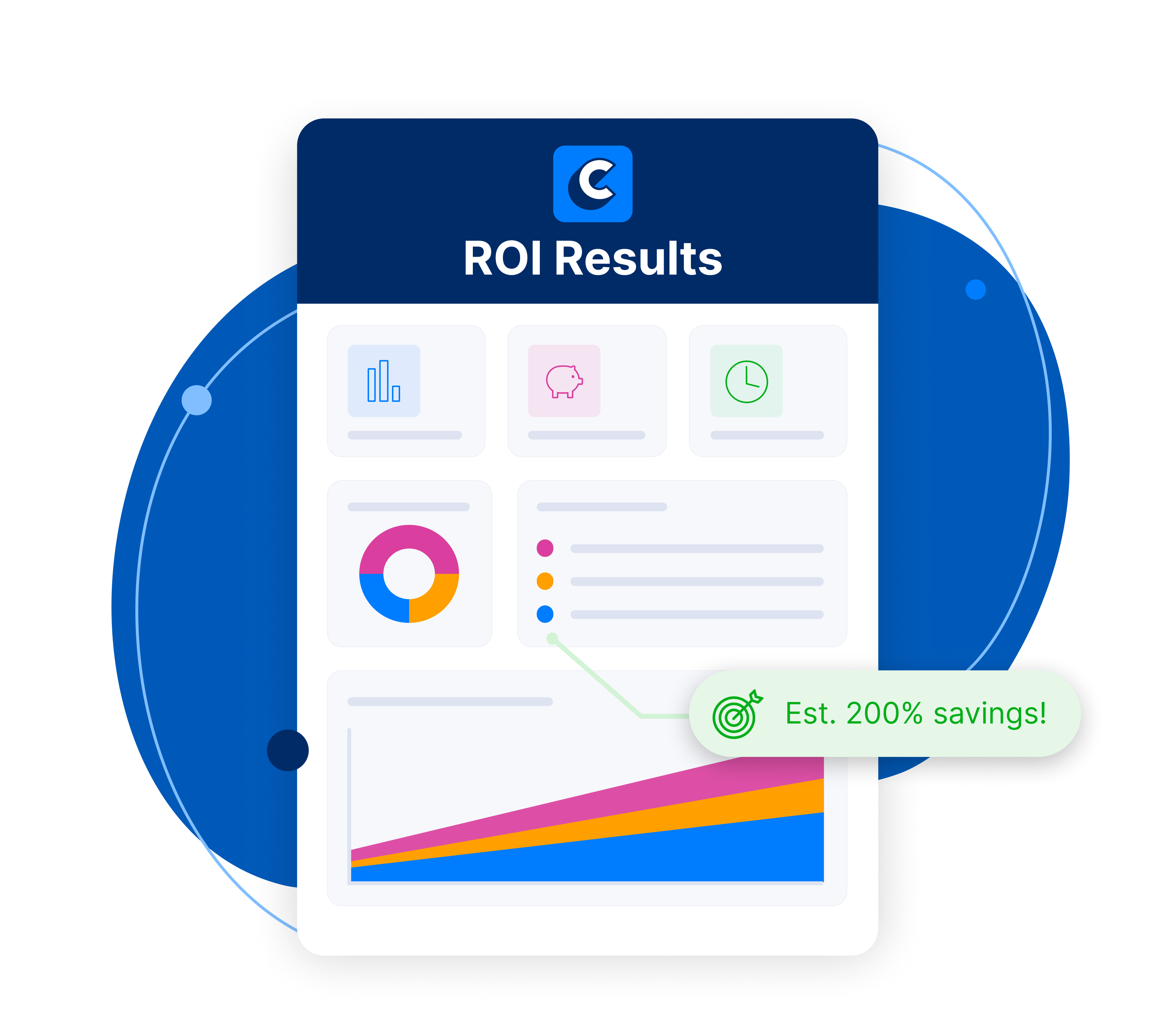
Inbound and outbound automation, agent-assist features modern support teams can’t live without, easy integrations, and conversational AIthat sounds just like a human are just the main features you can enjoy. And we’ll leave the best part for last: strong ROI and significant savings. See it for yourself by calculating the ROI you can achieve after integrating Capacity.
FAQs
There are many tools that aim to replace or supplement Balto AI in the contact center and agent assistance space. Some of the main competitors include:
– Capacity for unified internal and external support and knowledge management
– Observe.ai for strong real-time agent assist and conversation intelligence
– Talkdesk for a full CCaaS platform
– Cresta for enterprise-grade AI assistance
Balto is a real-time conversation-guidance tool for call centers, helping agents during live calls. Key capabilities include:
– Listening to live calls and providing on-screen prompts, checklists, and coaching alerts in real time
– Helping drive script adherence, handle objections, and support compliance during calls
– Summaries, QA scoring, and analytics to help improve performance
If your key requirement is the “real-time agent assist during calls” piece, then some of the alternatives to focus on are:
– Capacity
– Observe.ai
– Aloware
– Talkdesk
You can also check each vendor’s “live agent assist” or “in-call guidance” module specifically to make sure it meets your need for real-time prompts, not just post-call analytics.
For smaller contact centers, good alternatives would be those that offer lower costs, simpler setup, and less enterprise overhead.
Some good picks are:
– Capacity
– Aloware
– Voice.AI
To make sure a service provider is suitable for smaller businesses, check their feature page and case studies to see if businesses similar to yours use the tool.