


 Customer Support
 HR & Ops
 IT Support
 Sales & Marketing
- AI models are powerful, but without business context they often produce generic or inaccurate outputs.
- The real competitive advantage in enterprise AI is giving models access to your company’s proprietary knowledge and institutional expertise.
- Manual curation and disconnected tools don’t scale for enterprise AI workflows and agents.
- Capacity’s AI Knowledge Orchestration Layer connects and indexes organizational knowledge in real time to deliver more accurate, relevant AI experiences.
By Scott Litman, SVP at Capacity, and Steve Frederickson, Senior Director of Product at Capacity
Every business leader who has experimented with AI in the past two years has noticed something. The outputs can be impressive — thoughtful, persuasive, confidently delivered. And then you look a little closer, and something is off. The advice doesn’t reflect your market position. The analysis misses the competitive dynamics your team has been tracking for years. The recommendations sound like they came from a business school textbook rather than from someone who actually knows your company.
This is not a flaw in the foundational AI models themselves. It is by design.
The problem is context. And it’s the most important thing business and technology leaders need to understand about AI in 2026.
The Equation Every Business Leader Is Missing
Think of every AI interaction as an equation: inputs in, outputs out. The foundational models (GPT-x, Claude, Gemini, etc.) have made extraordinary strides on the output side of the equation. They write convincingly. They reason through complex problems. They produce formatted, structured, persuasive content at a speed no human team can match. The output capability is genuinely remarkable, and it continues to improve with each new release.
But every single model relies on the same input. The input side is where we will find the next era of value creation.
When you ask ChatGPT how to position your new product in the market, it doesn’t know your market. It doesn’t know your competitive strengths or weaknesses. It doesn’t know the analysis your research team spent three months compiling, the historical campaigns that underperformed, the supplier constraints shaping your pricing, or the customer listening data your team gathered last quarter. These models are built on everything that was public as of their training cutoff, and not the context that matters to your organization.
Foundational models are world-class at producing outputs. What they cannot provide is the input side of the equation — and that input is your company’s context.
Context, in this sense, is everything your company knows: your proprietary research, competitive intelligence, historical data, internal processes, product roadmaps, customer feedback, and institutional knowledge accumulated over years of operating in your specific market. It is scattered across systems and file stores, buried behind search tools of varying quality, and rarely optimized for AI agents to use.
Context is the difference between asking a highly trained consultant with no experience for advice and asking that same consultant after they’ve spent years embedded in your business.
As AI tools proliferate and foundational model capabilities continue to advance, here’s the hard truth: everyone has access to the same models. They are a commodity. You can buy tokens from any cloud provider. The raw intelligence is available to every company, including your competitors. What will differentiate your AI-powered workflows is not which foundational model you use. It’s how well you feed that model the context it needs to produce answers that are specific, accurate, and actually relevant to your business.
Context is the emerging battleground of enterprise AI, and the unlock for the next phase of usefulness.
A Story About a Product Launch — and a Very Expensive Mistake
Imagine your company is preparing to launch a new packaged goods product. You’ve sorted out the supply chain, defined the product, and aligned your sales channels. Now it’s time to determine how to position it in the market. You bring your marketers, product leads, and customer research team into the room.
Someone raises a reasonable question:
“Instead of spending the next two weeks workshopping this, why don’t we just ask an AI? It’s great at synthesizing inputs and reformatting what’s already been written.”
So you open ChatGPT and ask:
“How should we position our product in this market?”
The response comes back quickly. Five well-organized factors. Clear language. Confident framing. The team nods. This looks useful. You build your messaging strategy around these five pillars. You fund the campaign.
Then the results come in and they’re not what you expected.
What the AI didn’t know, and couldn’t know, is that your competitors have been dominating those first three factors for years. Your own research team had documented this. There was a competitive SWOT analysis sitting in a SharePoint folder laying it out clearly. There were historical ad spend comparisons showing exactly where competitors were investing and winning. There was customer listening data suggesting where your brand had differentiated advantages.
None of that made it into the prompt.
ChatGPT gave you a textbook answer to a textbook question. You gave it a generic input and got a generic output that happened to steer your messaging directly into your competitors’ greatest strengths and away from your own.
You didn’t get bad AI. You got good AI with no Context. And the result was a strategy that may have just handed your competitors a win.
This scenario plays out across industries every day. A support agent that doesn’t know your current product limitations. A sales tool that doesn’t know your pricing exceptions. An HR chatbot that doesn’t know how your company’s policies differ from industry defaults. Outputs that sound authoritative but are built on public information rather than proprietary knowledge.
The gap between what the AI says and what your business actually needs is the Context Gap. And closing it is the central challenge of deploying AI effectively at enterprise scale.
The Curation Trap: Why Most Approaches Fall Short
The intuitive response to this problem is manual curation: identify the documents most relevant to each use case, upload them to the AI tool, and tell it to focus there. Many tools offer this workflow.
The problem is that curation is a manual step. And manual steps don’t scale.
Further, this process includes only a minuscule fraction of the knowledge held inside a large enterprise and misses the institutional knowledge users may not even realize exists.
Some systems go one step further and let you reach into sources through tool calls. This is better, but still flawed. It asks users to opt in to context, depends on the quality of each tool, and requires the model to decide when to invoke them. Fundamentally, it is still a manual process.
The only robust way to solve for Context is to bring it in automatically and universally. A unified Context Layer ensures that all of your agents have the information they need and actually use it.
How Capacity Solves the Context Problem
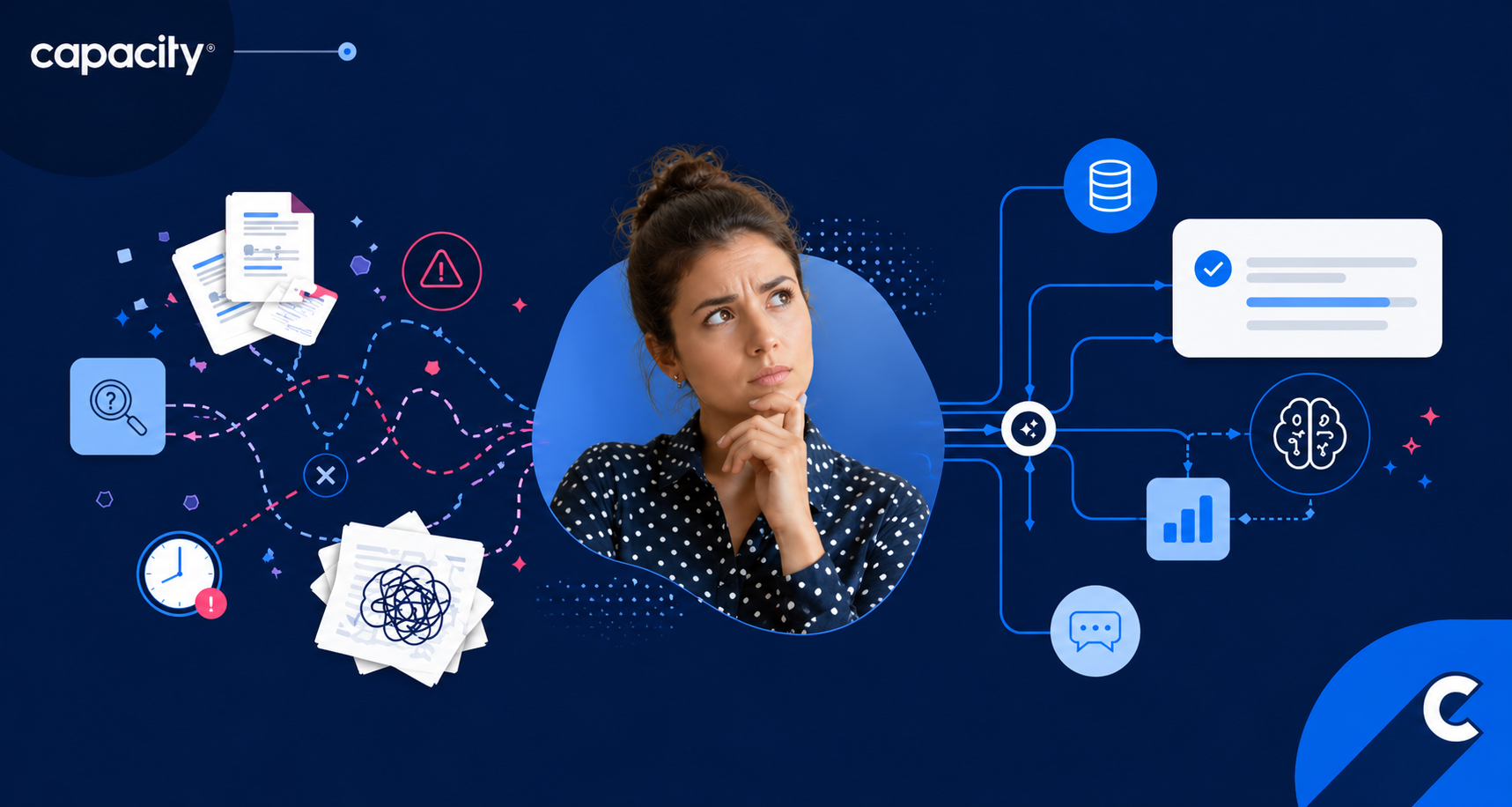
Capacity’s approach to Context is architecturally different in a way that matters: rather than asking you to curate what the AI should know, Capacity builds and maintains a unified, real-time index of everything your organization knows and makes it universally available to every user, workflow, and automation you build.
At the core of this is Capacity’s AI Knowledge Orchestration Layer: a system with real-time connectors to the sources where your knowledge actually lives. SharePoint, Salesforce, Confluence, ServiceNow, internal knowledge bases, documentation systems, CRMs, ticketing platforms — Capacity indexes all of it continuously as data changes.
When a policy is updated, the index reflects it. When a new competitive analysis is uploaded, Capacity knows about it. No manual curation. No tagging. No managing tool calls.
When you build a workflow or deploy an agent on Capacity, you’re not uploading a curated set of documents and hoping for the best. You’re drawing from one giant, live, enterprise-wide index of organizational knowledge with the flexibility to scope access as broadly or narrowly as the use case requires.
You can say:
“This agent should have access to everything.”
Or:
“This customer-facing bot should only draw from product documentation and current pricing.”
You make that selection once. The underlying index keeps itself current automatically.
The difference between a generic AI answer and a genuinely useful one isn’t the model itself. It’s whether the AI knows what your company knows.
Critically, Capacity’s indexing approach also respects your existing enterprise security model. Access rights and permissions are preserved. An employee asking about benefits receives answers scoped to what they’re authorized to see. A customer-facing agent gets public pricing sheets, not internal pricing strategy. The context is rich, but it’s governed.
The result is that every agent and automation built on Capacity starts with an inherent advantage: it actually knows your business. It knows your products, policies, history, and competitive position. It doesn’t need to be told. It doesn’t need to be curated. It just knows.
And as your business knowledge grows, your automations grow with it.
What This Means for Your AI Strategy
If you’re evaluating AI platforms or building out your automation strategy, Context should be near the top of your evaluation criteria.
Here’s why the stakes are high:
Companies that get context right will build AI agents and workflows that feel like knowledgeable insiders — specific, accurate, and relevant to the actual problems their businesses face.
Companies that don’t will continue producing outputs that look impressive on the surface and fail in practice.
The foundational models will continue improving. That improvement will be available to everyone.
The question is: how will you create competitive advantage when everyone has access to the same commodity intelligence?
The Bottom Line
Context is not a feature. It’s the foundation.
AI without context produces outputs that look good but miss the mark. AI agents with rich, accurate, real-time context produce outputs that are specific, trustworthy, and genuinely useful for decision-making at every level of the organization.
Every enterprise has years of accumulated knowledge locked inside documents, systems, CRMs, project histories, and research — knowledge that represents a significant competitive asset.
The question is whether your AI infrastructure is built to leverage that asset or leave it sitting on the table.
At Capacity, we believe context is where the next generation of enterprise AI will be won. We’ve architected our AI platform to help our customers win with it.
About the Authors
Scott Litman is SVP at Capacity, where he works with organizations to design and implement AI-powered support automation strategies. He is focused on helping business leaders navigate the rapidly evolving landscape of enterprise AI with clarity and confidence.
Steve Frederickson is Head of Product for Answer Engine at Capacity, where he leads the development of Capacity’s core AI and knowledge orchestration capabilities. He brings deep technical expertise in generative AI, enterprise search, and the architectural challenges of building AI systems that
