


 Customer Support
 HR & Ops
 IT Support
 Sales & Marketing

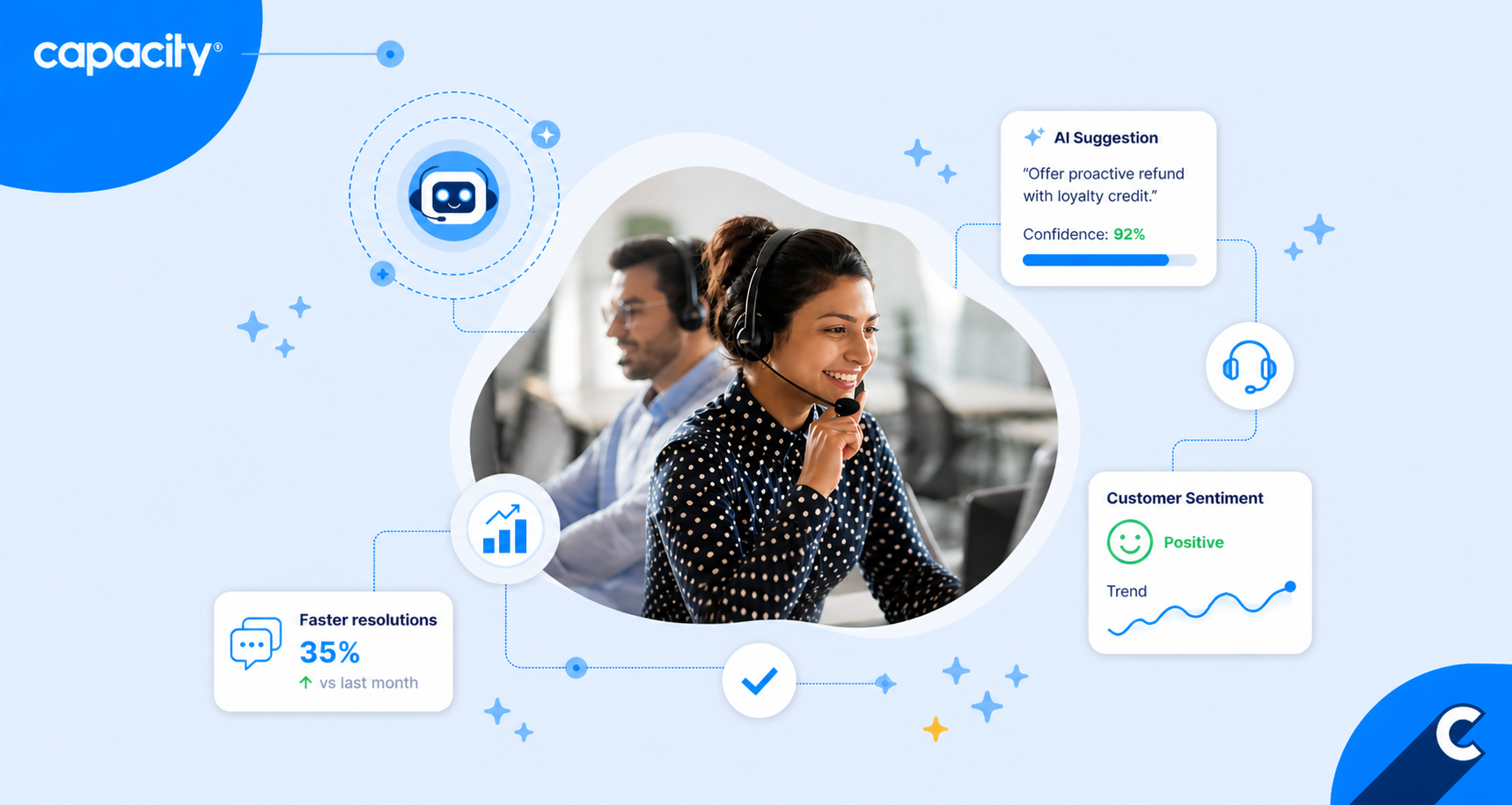
- The most effective approach to improve customer experience in a call center combines AI deflection for routine inquiries, real-time agent guidance during calls, unified knowledge management, and automated QA that reviews every interaction.
- When agents have the right context and tools, they resolve issues faster, make fewer mistakes, and deliver a more personal experience.
- Tracking the KPIs like first-call resolution, CSAT, service score, and sentiment trends ties it all together.
- Platforms like Capacity bring virtual agents, agent assist, QA, and conversational intelligence into one place, replacing the fragmented tool stacks that slow most contact centers down.
To improve customer experience in a call center, you need to focus on reducing wait times, improving first contact resolution, personalizing customer service, and offering relevant help. However, achieving this is pricey: the average cost per live conversation with a customer runs anywhere between $7 and $13.50, with most call center agents handling 30–50 calls daily.
When your agents have to answer so many calls daily (many of which repeat), they can’t provide an excellent customer experience because they rush through calls or make customers wait. As a result, you not only have a big bill on your hands, but also have to deal with frustrated customers.
In this article, you’ll find:
- How to improve customer experience in a call center
- Call center customer service tips that work
- What great call center CX looks like in practice
Why call centers are struggling with CX and support costs
Most call centers struggle with CX and support costs because they’re caught in a costly cycle: agents need to get relevant information from customers while helping them. But manual search is stressful and leads to escalations, with most agents spending a significant portion of every call switching between disconnected systems and knowledge bases just to find the right answer.
At the same time, only 2–5% of calls get reviewed through traditional QA, meaning compliance failures, systemic service gaps, and recurring customer pain points go undetected for weeks, by which point the damage to CSAT and retention is already done.
The underlying problem is fragmentation. Most contact centers run a patchwork of separate platforms for:
- CRM
- Agent assist
- Knowledge management
- QA
- Coaching
- Analytics
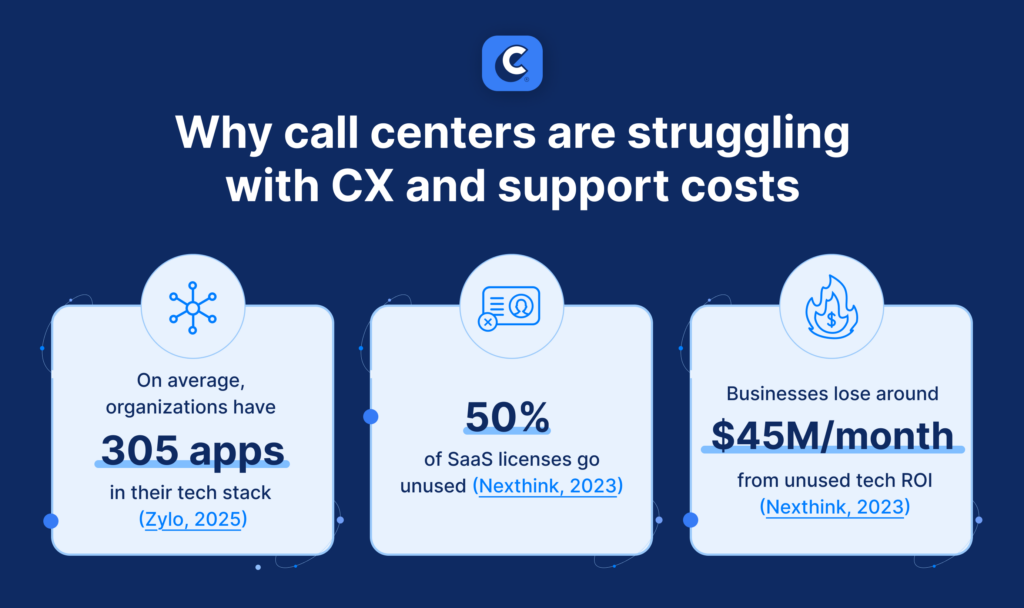
In its 2025 report, Zylo found that on average, organizations have 305 applications in their SaaS portfolio. A 2023 report by Nexthinkfound that almost 50% of SaaS licenses go unused. Based on the average license price, the company calculated that businesses lose around $45M per month.
But slapping automation on disconnected systems isn’t a magic bullet. When AI is layered on top of platforms that don’t share information, it just makes the problem worse: agents get inconsistent or incomplete answers, have to verify information across multiple apps, and still carry the burden of manual after-call work like logging notes and updating records. So, let’s find out how you can strategically use AI to improve your call center customer experience.
How to improve customer experience in a call center: 10 strategies
Some of the best ways to improve customer experience in your call center without wasting money are automation, strategic agent guidance, tracking the right metrics, and deflecting repetitive inquiries. Below, we explore the 10 best contact center customer experience strategies.
1. Reduce wait times with AI deflection
Every call that doesn’t need a human agent shouldn’t reach one. AI-powered AI agents and chatbots can handle routine inquiries with conversational AI, including:
- Account lookups
- FAQs
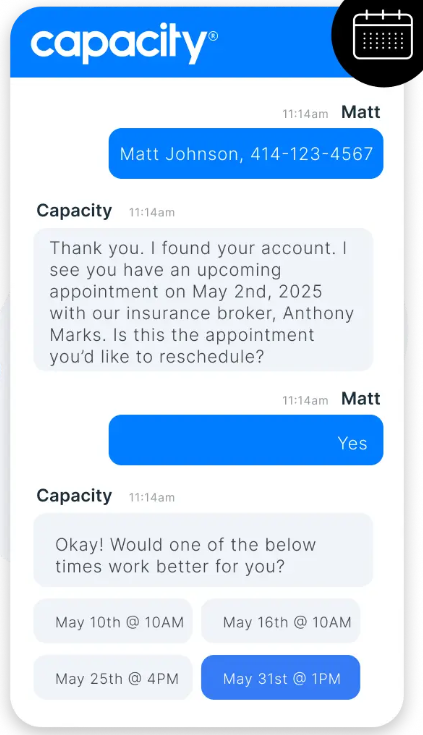
- Appointment scheduling
- Order status
For example, Capacity, a customer and employee support automation platform, found that most of its customers automate around 90% of inquiries with the right AI setup. Because let’s be frank, most customer questions can be solved with just a line of text, and AI is there to answer at any time without making anyone wait.
Strategic deflection frees agents for conversations that actually require human judgment and empathy. As a result, you get a team that has time and energy to focus on the critical cases, while customers can get simple questions answered using self-service (the option 61% of customers prefer for simple issues).
2. Give agents real-time guidance during calls
Agent assistance supports live agents during customer conversations by listening to and analyzing context to provide real-time guidance. It suggests responses or appropriate next steps without interrupting the call’s flow, so agents can stay focused and reduce manual lookups and after-call work.
A great example is when a customer calls about a return they never got refunded for. As the agent listens, the AI retail agent simultaneously pulls up the customer’s order history, flags that the return was received 12 days ago, and quietly surfaces the relevant refund policy on the screen, along with a suggested response: “I can see your return was processed on the 15th — the refund should hit your account within 3–5 business days. If it doesn’t, I can escalate it for you right now.” The agent delivers the line naturally, skips the manual order lookup, and wraps up the call faster.
3. Fix your knowledge management layer
Disconnected knowledge is one of the biggest sources of friction in a contact center. When agents have to search across multiple systems mid-call to find a policy, a procedure, or a product detail, customers wait, calls drag on, answers become inconsistent, and the call center customer experience takes a hit.
An AI-powered knowledge layer integrated directly into the agent’s workspace surfaces contextually based on what’s being discussed and eliminates the scramble. The right answer appears before the agent even has to ask for it.
Take V.I.P. Mortgage, a mortgage lender, as an example. The company used to struggle with many staff requests and training new hires on company policies. To support their team, V.I.P. Mortgage decided to go from a traditional multichannel to an omnichannel AI strategy. They worked with Capacity to build an internal digital assistant named “Ziggy.”
Ziggy answers over 90% of questions about company policies, product guidelines, and other information that helps 300 employees get quick, accurate support.

4. Automate QA instead of sampling it
With traditional QA, only 2–5% of calls get reviewed. This gap can cause compliance failures to go undetected, mean coaching is based on an unrepresentative sample, and let systemic issues take weeks to surface.
AI-powered quality management, on the other hand, covers 100% without extra work. Auto QA scores every interaction against consistent, configurable rubrics, flags problems immediately, and feeds findings directly into coaching workflows. The result is a QA function that’s faster, fairer, and genuinely scalable without growing headcount.
5. Personalize interactions with customer data
Customers expect agents to know who they are before the conversation starts, but agents aren’t mind readers and can’t pull the customer’s history, their previous issues, and their account status out of thin air.
Advanced AI tools connect to your CRM to surface contact information, deal stages, and custom fields to provide context-aware assistance, so agents begin every call with a full picture.
In 2021, McKinsey found that 78% of consumers would buy more if they received more personalization.
Personalization is also a driving force behind customer loyalty. It reduces the time spent on verification and re-explanation, makes customers feel valued rather than anonymous, and gives agents the context to resolve issues faster and more empathetically on the first contact.
6. Invest in agent coaching tied to real data
With AI-powered conversation intelligence, you get a holistic picture of an agent’s work over time. This lets you determine where to focus your coaching and gives agents a clear view of their own performance.
When coaching is grounded in evidence, such as specific moments, measurable patterns, and actual call outcomes, it lands differently. Agents understand exactly what to change and why, and progress can be tracked against the same data.
7. Measure the right KPIs
Tracking average handle time in isolation can push agents to rush calls at the expense of resolution quality. The metrics that actually reflect CX health are first-call resolution, average wait time, repeat contact rate, sentiment trends, and CSAT — and a unified AI system can make all of them measurable at scale.
Here are some of the most important call center productivity metrics and benchmarks to follow.
| Call center productivity metrics | Benchmark |
|---|---|
| AWT | 20–40 seconds |
| AHT | 5–8 minutes |
| FCR | 70–80% |
| CAR | 2–5% |
| SL | 80% of calls are answered within 20 seconds |
| CPC | $2.50–$5.00 for inbound, $6–$12 for outbound |
| CSAT | 80–90% is strong; above 90% is excellent |
| Agent utilization rate | 75–85%, with 90%+ being at risk of burnout |
| Agent turnover rate | <25% |
8. Reduce agent effort to reduce customer effort
Agents’ experiences shape customer experiences. When agents have the right information at their fingertips, they can work faster, solve issues more efficiently, and deliver a better call center customer experience. But the inverse is also true.
When agents have to switch between tools, hunt for answers, and manually log notes, they make more mistakes, take longer, and are more likely to escalate unnecessarily. Removing that friction through unified interfaces, automated after-call work, and real-time assistance shortens calls, reduces errors, and makes every customer interaction smoother.
9. Use post-interaction data to find patterns
Individual calls tell you what happened in one conversation. Aggregate post-call data tells you what’s happening across your entire customer base. With a unified system, you get insights into overall performance and areas ready for improvement, a clear view of KPIs, and data you can take back to your team for more effective coaching.
10. Deploy AI that empowers humans
The most effective AI for customer experience in a call center makes your agents measurably better. The “Agent as Coworker” model has human agents guiding AI, monitoring bot performance, stepping in during escalations, and using AI insights to tailor each interaction for a more personal and balanced service.
AI handles the repetitive, the routine, and the analytical, while humans handle the complex, the emotional, and the relational. When those roles are defined and integrated, the contact center becomes both more efficient and more human.
What great call center CX looks like in practice
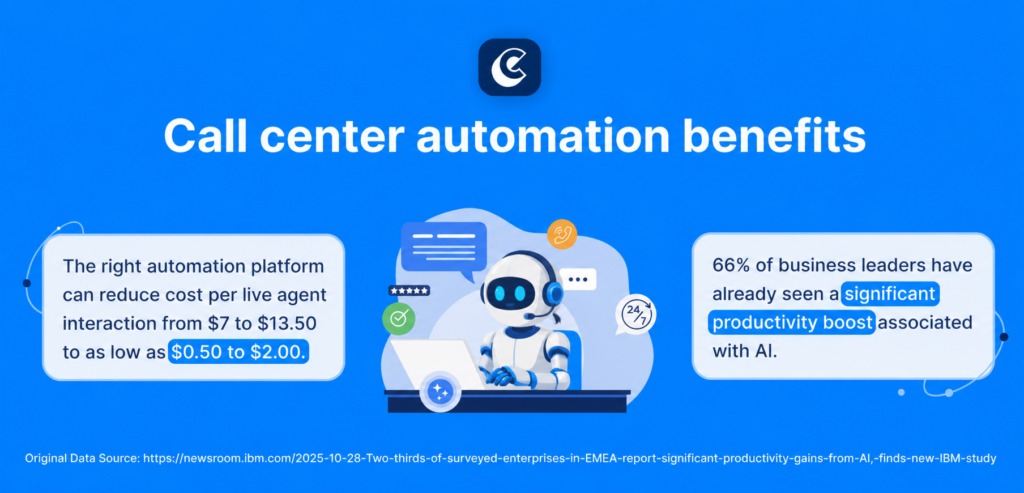
Great call center customer experience automation starts with a fine-tuned customer experience team structure where both human and AI agents work together. The agents are prepared to assist customers. The answer surfaces before the customer finishes explaining the problem. The issue is resolved the first time. And when the call ends, the system has already logged what happened, flagged anything worth reviewing, and identified whether this interaction is part of a broader pattern worth fixing.
The gap between a frustrating contact center experience and a good one often comes down to whether the right information reaches the right person at the right moment.
That shows up in your costs and team productivity. The right AI setup can bring the cost per live interaction down from $7–$13.50 to as low as $0.50–$2.00. According to a 2025 IBM report, 66% of business leaders have already seen a significant productivity boost associated with AI.
Culligan, a global utilities company, is a real-world example of AI-powered customer service. One big problem they were facing was turning website visitors into leads and simplifying appointment scheduling.
They came to Capacity, and together they launched AI-powered SMS automation to handle appointment booking, confirmations, and dealer communication. The decision proved right: after the launch of the new SMS Virtual Agent solution across all dealer networks, Culligan has scheduled thousands of appointments and generated $650,000 from those appointments alone. Due to great results, the company expanded its AI strategy to the website.
Its Contact Center with AI

Improve customer experience in your call center with an advanced automation strategy
Finding the right tools is the first step in improving customer experience in your call center.
Capacity is a system designed to help call centers improve customer experience, cut costs, drive more revenue, and empower their human agents. It doesn’t add more complexity. It centralizes information to power your virtual agents, human agents, QA, and conversational intelligence, replacing 4–5 disconnected AI vendors.
With agent assist tools, your team becomes more effective and resolves customer questions on the first contact. Intelligent virtual agents handle routine inquiries, giving customers a reliable self-service option. Together, they cut costs, reduce agent workload, and help you earn more. If that sounds good, see how automation can improve your call center customer experience.
Capacity Can Do?
FAQs
To improve customer experience in insurance, you need to focus on speed and clarity. Customers want fast claims processing, proactive communication, and agents who don’t make them repeat themselves. AI can automate routine inquiries like policy lookups and claim status updates, freeing agents for complex cases that need a human touch.
To improve customer experience in retail, focus on personalization and convenience. That means relevant product recommendations, frictionless returns, and consistent experience across in-store, online, and support channels. AI-powered chat and self-service tools help handle high inquiry volumes without sacrificing response quality.
AI improves CX by making every interaction faster and more relevant:
– Deflecting routine inquiries with virtual agents
– Surfacing the right information to human agents in real time
– Automating after-call work
– Flagging patterns across thousands of interactions that would take weeks to spot manually
Start with the data you already have: call recordings, CSAT scores, repeat contact rates, and resolution times. Aggregated, this tells you where customers are getting stuck, which issues keep coming back, and where your agents need support.
Sentiment analysis detects frustration, confusion, or satisfaction in real time, during a call or across thousands of them. That lets you flag at-risk interactions before they escalate, identify which topics consistently upset customers, and measure whether CX changes are actually landing the way you intended.
To improve customer experience in telecom, focus on reducing wait times, boosting first-call resolution on billing and technical issues, and giving agents full account context before the call even starts are the biggest levers. AI deflection also helps manage the high inquiry volumes typical in telecom.
To improve customer experience in e-commerce, focus on response speed and order visibility. Customers want instant answers about shipping, returns, and account issues — ideally without waiting for an agent. AI-powered self-service handles the bulk of these, while conversation data helps identify friction points in the post-purchase journey.