






Learn how to improve call center customer service with 15 proven strategies covering:
- Wait times
- Self-service
- Agent performance
- Quality assurance
- Customer feedback
- Scalable automation
Running a call center is a difficult task, especially when it has one of the highest employee turnover rates, reaching as high as 60% per year. Now add rising customer expectations—something 57% of customer care leaders anticipate—and the pressure on support teams becomes even greater.
If you’re thinking about how to improve call center customer service and prepare for growing demands, you’ve come to the right place! We’ve gathered and analyzed 15 call center tips for beginners and customer experience best practices to enhance your customer and employee experience.
In this guide on customer service best practices and tips for improving your call center operations, you’ll learn how to:
- Evaluate your current level of service
- Establish achievable and measurable KPIs
- Reduce the time customers spend waiting
- Analyze feedback to improve over time
- And many more helpful call center tips and tricks
Let’s dive right in!
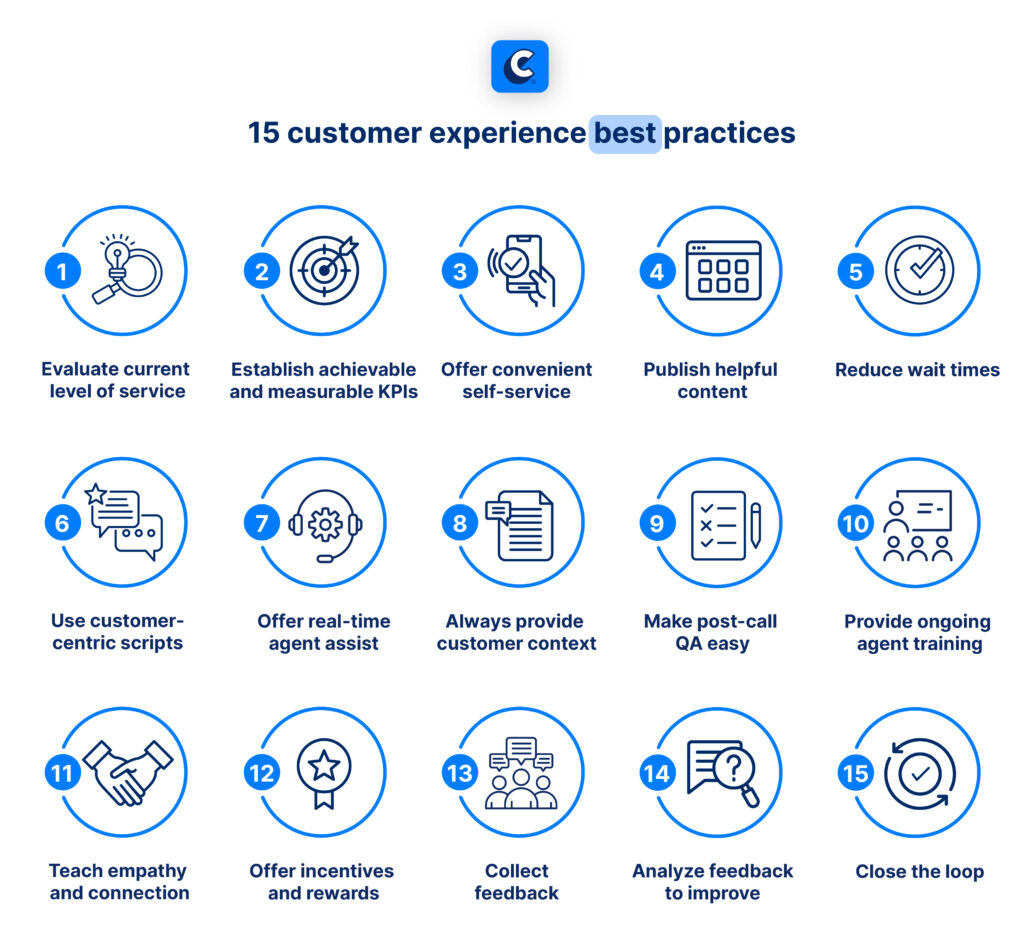
How to improve call center customer service: 15 customer experience best practices
Improved call center customer service not only reflects better customer experiences but also enhances employee productivity and motivation, as well as the overall perception of your business.
So let’s cut straight to the chase and go over the 15 best ways to improve call center customer service. At the end of each tip, you’ll find a quick checklist to help you evaluate your current service situation.
Best practice #1: Evaluate your current level of service
You can’t improve what you don’t clearly understand. Evaluating your current level of service establishes a factual baseline—how your call center actually performs today versus how you think or wish it performed.
This assessment should combine quantitative data, such as performance metrics, with qualitative insights, including customer and agent experiences.
The goal isn’t to assign blame, but to identify gaps, bottlenecks, and blind spots that directly affect customer satisfaction, efficiency, and agent morale. A solid evaluation provides clarity on what to fix first, what to preserve, and where investment will have the greatest impact.
Imagine a mid-sized support center reviewing its performance and concluding that calls are taking too long. On the surface, it looks like a speed problem because average call durations are higher than expected, and leadership assumes agents need to move faster.
But when the team digs into the data, they discover a different picture. Average handle time (AHT) is actually within industry norms. The real issue is a low first call resolution (FCR) rate, meaning customers are calling back multiple times to solve the same problem.
A closer look at call recordings reveals why. Agents often reach the right answer, but they lack clear authority or quick access to the right information to resolve common issues during the first interaction.
The problem isn’t speed. It’s an incomplete resolution. And the solution isn’t pressuring agents to hurry, but instead giving them the right tools, so they can confidently resolve issues the first time.
If this sounds familiar, we invite you to evaluate your current service baseline to see what might be missing.
✅ Quick checklist: Your current service baseline
Operational reality
☐ Peak hours and peak days are documented
☐ Seasonality patterns are identified
☐ Average handle time and hold time are known
Demand and volume
☐ Average daily inquiry volume is tracked
☐ Weekly volume trends are reviewed
☐ Top five call drivers are clearly defined
Customer experience
☐ Current CSAT score is documented
☐ Abandonment rate is monitored
☐ First-call resolution is measured
Infrastructure and constraints
☐ Core tech stack is documented
☐ Integration gaps are identified
☐ Staffing or scalability constraints are defined
💡 Pro tip: Benchmark internally before benchmarking externally.
Industry averages are useful, but your most powerful insights come from comparing your own teams. Find your internal top performers, study what they do differently, and scale those behaviors first.
Best practice #2: Establish achievable and measurable KPIs
Call center improvement ideas start with strategic key performance indicators (KPIs). KPIs translate your service goals into concrete, trackable outcomes. A common mistake many call centers make is choosing too many KPIs—or worse, unrealistic ones that pressure agents to game the system rather than help customers.
Effective KPIs are:
- Aligned with customer experience
- Within agent control
- Balanced between efficiency and quality
KPIs should clarify priorities, not confuse them. When done well, they create focus, accountability, and continuous improvement.
Consider another common scenario. A call center ties agent bonuses solely to average handle time, sending a clear message: finish calls as quickly as possible.
Agents respond exactly as you’d expect. They rush conversations, cut discovery short, and move customers off the line only to see CSAT drop and repeat contacts rise.
Once leadership reviews the KPIs, the problem becomes obvious. The incentive structure is optimizing for speed, not resolution. By rebalancing KPIs to emphasize quality and first-call resolution, the center sees better outcomes, even if individual calls run slightly longer. Customers get answers the first time, and satisfaction improves as a result.
✅ Quick checklist: Effective call center KPIs
Customer alignment
☐ KPIs directly reflect customer experience outcomes
☐ Metrics align with broader business goals
Agent control
☐ Agents can realistically influence each KPI
☐ Targets are based on historical performance
Clarity and focus
☐ KPIs are clearly defined and documented
☐ Agents are trained on how to improve them
Balance
☐ Quality and efficiency metrics are both included
☐ KPIs reinforce each other
💡 Pro tip: Limit frontline agents to 3–5 primary KPIs.
More than that dilutes focus. Leadership can track dozens of metrics, but agents should know exactly what “great performance” looks like on any given day.
Best practice #3: Offer convenient self-service options
61% of customers prefer to solve simple issues on their own through self-service instead of contacting an agent. Self-service options reduce call volume, lower costs, and allow agents to handle complex, high-value interactions.
The key is convenience, not just availability. Self-service must be easy to find, easy to use, and actually effective, or customers will abandon it and call anyway. That means you have to meet your customers where they are. Some convenient options include an automated chatbot on your website or an accessible knowledge base.
PacSun, an American retail clothing brand, did exactly that by providing more self-service options for its customers.
As the number of online shoppers increased, so did the complexity and workload on PacSun’s service support teams. To improve both customer and team experiences, they embraced automation.
PacSun used a combination of web chat and SMS Virtual Agents to introduce more convenient self-service options. The results exceeded their expectations.
Today, Virtual Agents resolve 85% of incoming inquiries, with one in three shoppers opting into SMS updates. These interactions don’t just deflect tickets, but also convert, generating a 19% conversion rate on personalized product recommendations.
Check if your business is ready for AI tools.
✅ Quick checklist: High-impact self-service
Accessibility
☐ Available across web, mobile, and IVR
☐ Easy to find without contacting support
☐ Uses clear, customer-friendly language
Coverage
☐ Solves the top customer contact drivers
☐ Includes clear next steps or escalation paths
☐ Works reliably without frequent errors
Continuity
☐ Self-service activity is visible to agents
☐ CRM data is connected
☐ Handoff to live support is seamless
💡 Pro tip: Design self-service around customer intent.
Customers don’t think in ticket categories or departments. Use call and chat data to identify what customers actually ask for, and build self-service around those needs.
Best practice #4: Publish helpful content
Helpful content is the foundation of both customer self-service and agent effectiveness, and it ties back to convenient self-service options. Clear, well-structured support content empowers customers to resolve issues independently and gives agents a reliable source of truth during live interactions.
Poor or outdated content has the opposite effect. It increases confusion, escalations, and handling time. Imagine running a SaaS company and not updating documentation on a new feature. Customers struggle to use it, reach out to support for help, and generate unnecessary ticket volume.
To keep content effective, high-performing call centers focus on a few practical habits:
- Review top call drivers monthly and update content accordingly
- Publish updates in parallel with product or policy changes
- Use real customer language from calls and chats, not internal terminology
- Design articles for fast scanning, not long reading
- Ensure agents and customers reference the same source of truth
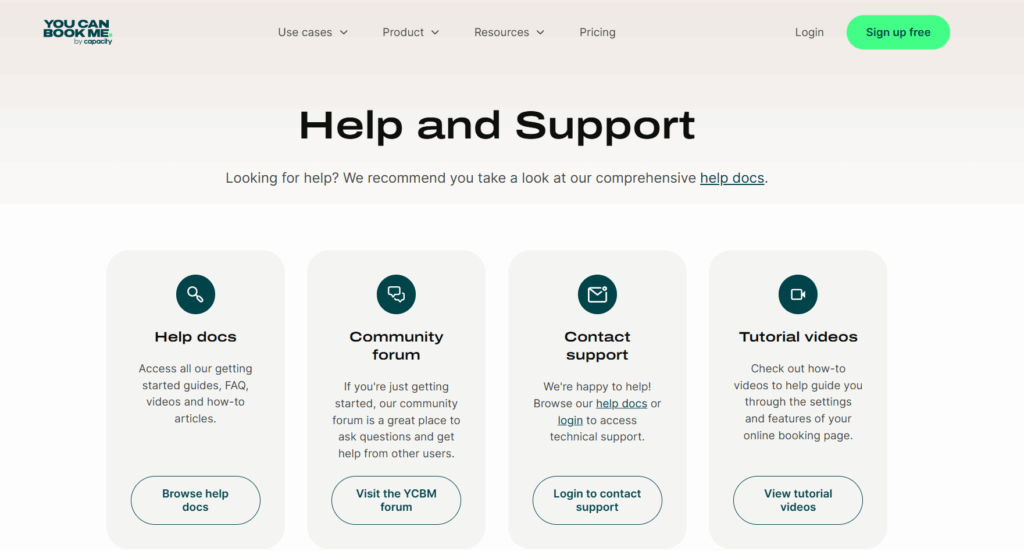
Another way to make your content more useful is to publish multiple formats, such as FAQs, virtual tours, and videos. YouCanBookMe, an online scheduling platform, offers a strong example of this approach. Customers can easily access written documentation, watch video tutorials, or connect with other users through the community forum, depending on how they prefer to learn.
✅ Quick checklist: Effective support content
Content quality
☐ Written in plain, customer-friendly language
☐ Step-by-step with clear outcomes
☐ Reviewed and updated regularly
Coverage
☐ Addresses frequent contact drivers
☐ Includes troubleshooting guidance
☐ Covers common mistakes and edge cases
Usability
☐ Searchable with relevant keywords
☐ Easy to scan with headings and bullets
☐ Optimized for mobile use
Alignment
☐ Matches agent training and scripts
☐ Consistent across channels
💡 Pro tip: Let your call recordings write your content.
The best FAQs come directly from customer questions—not assumptions. Review top call drivers monthly and turn the clearest agent explanations into published support articles.
Best practice #5: Reduce the time customers spend waiting
No one likes to be put on hold or wait to be assisted. For 75% of consumers, long wait times cause major frustration with the service. In fact, statistics on customer service best practices show that 75% of customers would rather have you call them back than stay on the line listening to hold music.
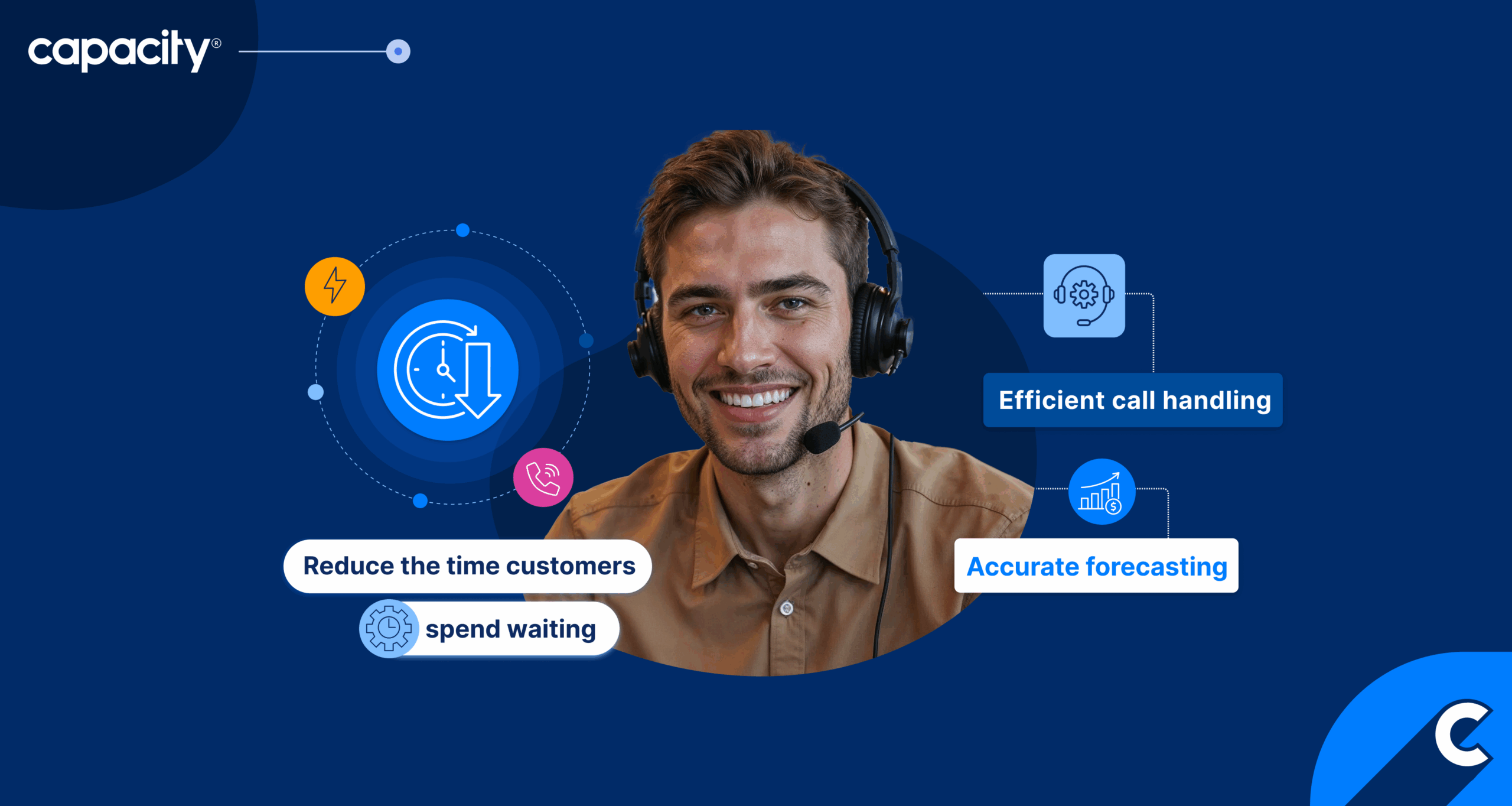
Reducing wait times isn’t just about staffing more agents. You can speed up your service with smart demand management, accurate forecasting, and efficient call handling.
For example, if your call abandonment rate is high, you might try to implement:
- Call-back options during peak hours
- Improved call routing based on issue type
- Better forecasting for seasonal demand
✅ Quick checklist: Lower wait times without sacrificing quality
Forecasting and staffing
☐ Call volume is forecasted by time and channel
☐ Schedules flex for peak demand
☐ Agents are cross-trained for overflow
Call flow
☐ IVR routing minimizes misdirected calls
☐ Transfers are limited and purposeful
☐ Escalation paths are clearly defined
Customer perception
☐ Callback options are available
☐ Estimated wait times are communicated
☐ Self-service is offered during peak volume
💡 Pro tip: Measure “time to resolution,” not just time to answer.
A fast answer that leads to multiple transfers or callbacks still feels slow to customers. Optimize the full journey, not just the first touchpoint.
Best practice #6: Use customer-centric scripts
Scripts should guide, not restrict, agents. Using customer-centric scripts that focus on empathy, clarity, and problem-solving is a great example of excellent customer service. When scripts are overly prescriptive, conversations feel robotic and disconnected, and your customers notice that right away.
The best scripts provide structure with flexibility, ensuring consistent quality while allowing agents to sound human and adapt to each customer’s situation.
A great way to make sure your scripts resonate with people is to write them based on real conversation scenarios. This way, not only will they sound more natural, but your team will also be more prepared to handle different real-life situations.
✅ Quick checklist: Human, flexible call scripts
Tone and language
☐ Conversational, natural wording
☐ Acknowledges customer emotions
☐ Avoids internal jargon
Structure
☐ Clear opening and expectation setting
☐ Guided discovery questions included
☐ Resolution summary and confirmation
Flexibility
☐ Agents can paraphrase naturally
☐ Supports multiple scenarios
☐ Encourages active listening
💡 Pro tip: Script the intent, not the sentence.
Train agents on what needs to be accomplished in each phase of the call. Then trust them to say it in their own words.
Best practice #7: Offer real-time agent assist
If you’re looking for how to improve call center customer service, you can’t ignore the power of real-time agent assist features for your team. Real-time agent assist tools provide agents with immediate, contextual guidance during live interactions:
- suggesting responses
- surfacing knowledge articles
- flagging compliance requirements
- automating post-call tasks
This reduces cognitive load, improves accuracy, and shortens ramp-up time for new agents while helping experienced agents remain consistent under pressure.
Even the largest companies invest in tools to help their teams succeed. A great example is PepsiCo, the name behind some of your favorite snacks and beverages. Like many companies with a large customer base, PepsiCo struggled to centralize its information and provide agents with an up-to-date, standardized knowledge base.
That was until they integrated Capacity’s Answer Engine®. This feature is essentially a private corporate search engine that can find information about your business, customers, products, and more in seconds.
Results? Now, PepsiCo leverages the millions of insights it generates, saves more than 438 hours each month, and has increased its monthly users by more than 2,500%.
✅ Quick checklist: Effective agent assist tools
Functionality
☐ Real-time guidance during live interactions
☐ Automatic surfacing of relevant knowledge
☐ Compliance and policy reminders
Integration
☐ Connected to CRM and ticketing systems
☐ Minimal screen switching required
☐ Fast, reliable performance
Adoption
☐ Easy to use with minimal training
☐ Trusted for accuracy and relevance
☐ Feedback loop for ongoing improvement
💡 Pro tip: Agent assist should support judgment—not replace it.
Use AI and automation to reduce friction, but empower agents to think critically and adapt to unique customer situations.
Best practice #8: Always provide customer context
Nothing frustrates customers more than repeating themselves. Think about the last time you had to get an issue resolved with a company, only to explain yourself to one agent through web chat, another through email, and then call to repeat everything all over again. It likely destroyed your motivation to buy from or use this company’s services ever again.
Providing full customer context—history, preferences, and previous issues—allows agents to deliver faster, more personalized customer experience.
To make customer context truly useful in practice, effective call centers focus on:
- Centralizing interaction history across all channels
- Making prior issues and resolutions easy to scan at a glance
- Carrying context across transfers and escalations
- Surfacing self-service activity to live agents
- Training agents to acknowledge context during the conversation
✅ Quick checklist: Full customer context for every interaction
Data availability
☐ Complete interaction history is visible
☐ Account details and preferences are accessible
☐ Prior resolutions and open issues are clear
Usability
☐ Context appears in a single dashboard
☐ Notes are concise and readable
☐ Key details are easy to find quickly
Continuity
☐ Context follows the customer across channels
☐ Self-service activity is visible to agents
☐ Transfers do not require repetition
💡 Pro tip: Teach agents to acknowledge context out loud.
Even small things like saying “I see you contacted us yesterday about this issue” build trust and reassure customers that their time and history matter.
Best practice #9: Make post-call QA easy
Quality assurance (QA) is only effective if it’s consistent, timely, and actionable. When QA processes are overly complex or time-consuming, reviews become sporadic, and feedback loses relevance.
The objective of call center QA should be coaching and improvement, not policing.
A great solution to make your QA process more seamless is integrating automated, real-time QA. This way, the software of your choice operates in the background during every customer interaction. It can spot inconsistencies or errors and help agents fix their mistakes. The real-time feature allows it to flag issues during conversations and prevent them from escalating.
✅ Quick checklist: Actionable quality assurance
Simplicity
☐ Focuses on critical behaviors and outcomes
☐ Short, clearly defined criteria
☐ Minimal subjective scoring
Consistency
☐ Standardized scoring across reviewers
☐ Regular calibration sessions
☐ Clear definitions for each score
Actionability
☐ Feedback delivered quickly
☐ Specific coaching points included
☐ Trends tracked over time
💡 Pro tip: If a QA form takes more than 10 minutes to complete, it’s too complex.
Shorter, focused QA drives higher participation and better coaching conversations.
Best practice #10: Provide ongoing agent training
Training should not end after onboarding. Customer expectations, products, and tools evolve—so must agent skills.
Research shows that 80% of employees would stay with a company long term if it provided sufficient training. This comes as no surprise, because ongoing training keeps agents confident, competent, and aligned with service standards. But ensuring regular training shouldn’t feel like a burden.
To make it more consistent, you can:
- Implement agent assist tools to help employees train on their own
- Encourage one-on-one meetings to clarify any doubts your team may have
- Organize team meetings to analyze common issues and ways to solve them (always focusing on the problem, not the person)
✅ Quick checklist: Continuous agent development
Relevance
☐ Training tied to real customer issues
☐ Based on QA and feedback data
☐ Updated as products and policies change
Format
☐ Short, focused sessions
☐ Mix of live, self-paced, and role-play
☐ Easily accessible on demand
Reinforcement
☐ Coaching follow-ups included
☐ Knowledge checks in place
☐ Skills applied in live calls
💡 Pro tip: Train little and often.
Frequent, bite-sized learning sticks far better than occasional, intensive sessions.
Best practice #11: Teach empathy and connection
Technical competence alone does not create great service—human connection does. However, customer service in the BPO industry usually focuses on speed and quality, pushing empathy to the side. But empathy helps agents understand customer emotions and respond in ways that defuse frustration and build trust.
It’s common to believe that empathy is something you either have or don’t have, but like any other skill, it can be taught, practiced, and measured.
For example, if you train your agents to acknowledge customer emotions before moving to problem-solving, it can make a significant difference. Most of the time, agents take the blame from customers when the problem isn’t their fault. Simple changes, such as validating frustration, can lead to higher CSAT scores even when issues cannot be resolved immediately.
✅ Quick checklist: Empathetic customer interactions
Start by evaluating a few specific situations using the checklist below.
Awareness
☐ Agents recognize emotional cues
☐ Customers are not interrupted or rushed
☐ Active listening is practiced
Language
☐ Uses validating statements
☐ Avoids defensive responses
☐ Maintains calm, supportive tone
Behavior
☐ Agents take ownership of issues
☐ Next steps are clearly explained
☐ Commitments are followed through
💡 Pro tip: Empathy prevents escalations.
A few seconds of emotional validation can save minutes of conflict.
Best practice #12: Offer incentives and rewards for performance
Recognition reinforces the behaviors you want to be repeated. When they’re fair, achievable, and aligned with service quality, incentives work wonderfully to motivate agents and boost their morale.
And the right rewards pay for themselves! Statistics show that in the U.S. alone, unhappy workers cost $1.9 billion per year due to a lack of incentives.
Great call center incentive ideas:
- Performance-based bonuses tied to CSAT, FCR, or quality scores
- Public recognition for top performers (team meetings, leaderboards, shout-outs)
- Gift cards or experience-based rewards
- Extra paid time off or flexible scheduling
- Skill-based incentives for certifications or training completion
- Team-based rewards to encourage collaboration
- Non-monetary perks, such as wellness benefits or learning stipends
✅ Quick checklist: Effective incentive programs
Alignment
☐ Rewards tied to customer experience metrics
☐ Quality and efficiency are balanced
☐ Performance criteria are clearly defined
Fairness
☐ Targets are achievable
☐ Scoring is transparent
☐ Equal opportunity across roles
Recognition
☐ Public acknowledgment is included
☐ Non-monetary rewards are offered
☐ Recognition is regular and timely
💡 Pro tip: Recognition doesn’t have to be expensive to be effective.
Consistent praise and visibility often matter more than monetary rewards.
Best practice #13: Collect feedback after every interaction
Customer feedback provides direct insight into how your service is perceived in real time. Collecting feedback after every interaction ensures you capture both successes and failures while they’re still relevant.
The key is to make feedback easy, fast, and meaningful for customers.
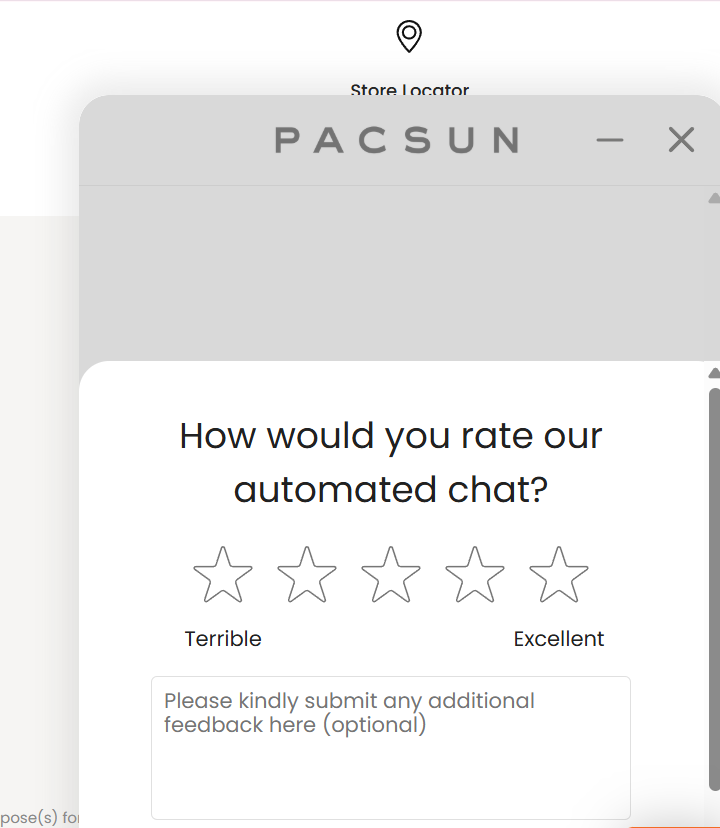
A great way to make a quick difference is to introduce short, one-question CSAT surveys immediately after customer interactions. They don’t need to contain pages of questions; a simple 1-to-5-star rating is enough to gain a better understanding of how your customers feel after every interaction.
PacSun offers another good example—this time of simple, fast evaluation of web chatbot interactions. Customers are given a quick 1–5 star rating option, with an optional field to share additional written feedback.
✅ Quick checklist: High-response customer feedback
Design
☐ Surveys are short and simple
☐ Questions are clear and relevant
☐ Minimal customer effort required
Timing
☐ Sent immediately after interaction
☐ Available across channels
☐ Delivered consistently
Coverage
☐ All interaction types included
☐ Anonymous option available
☐ Results tracked by agent and issue
💡 Pro tip: One good question beats five ignored ones.
Keep surveys short to maximize response rates and data quality. Use visual elements like star ratings or emojis to encourage customers to participate.
Best practice #14: Analyze feedback to improve over time
Collecting feedback without acting on it erodes trust. Clear analytics turns raw data into actionable insight, highlighting trends, root causes, and opportunities for improvement.
To make feedback analysis effective, start by grouping responses into clear categories such as wait time, agent behavior, resolution quality, and product or policy issues. Look for patterns over time rather than reacting to isolated complaints.
Pair quantitative data (CSAT scores, NPS, survey ratings) with qualitative feedback from open-text responses and call recordings. This helps you understand not just what customers are unhappy about, but why.
✅ Quick checklist: Feedback-driven improvement
Trend identification
☐ Feedback tracked over time
☐ Segmented by issue, channel, and agent
☐ Recurring pain points identified
Action
☐ Ownership assigned for improvements
☐ High-impact issues prioritized
☐ Changes implemented and measured
Communication
☐ Insights shared with agents
☐ Training and processes updated
☐ Customers informed when relevant
💡 Pro tip: Look for patterns, not outliers.
One angry comment is noise; repeated feedback is a signal. Focus improvement efforts where patterns emerge.
Best practice #15: Close the loop with customers and agents
Great service doesn’t end when the call does. Closing the loop means following up on unresolved issues, communicating outcomes, and showing both customers and agents that feedback and effort lead to real action.
When customers see that their input results in improvement, trust increases. When agents see that their insights are heard and acted upon, engagement and ownership rise.
Imagine a call center in a typical scenario: a contact center flagged low CSAT responses for follow-up within 48 hours. Customers received a brief apology, clarification, or resolution update. At the same time, trends from those follow-ups were shared with agents during team huddles, leading to process improvements and fewer repeat issues.
✅ Quick checklist: Closing the feedback loop
Customer follow-up
☐ Low CSAT or unresolved cases flagged automatically
☐ Timely callbacks or messages sent
☐ Resolution or next steps clearly communicated
Agent involvement
☐ Agents informed of follow-up outcomes
☐ Feedback reviewed during coaching
☐ Agent suggestions captured and reviewed
Operational improvement
☐ Patterns tracked and prioritized
☐ Process or policy changes documented
☐ Improvements communicated across teams
💡 Pro tip: Tell customers what changed because of them.
A simple message like “Based on customer feedback, we’ve improved this process” turns frustration into loyalty and proves that listening matters.
Improve your contact center customer experience with powerful automation
We hope this guide on the best ways to boost your call center service has given you ideas for your own business.
A quick recap of 15 steps on how to improve call center customer service:
- Evaluate your current level of service
- Establish achievable and measurable KPIs
- Offer convenient self-service options
- Publish helpful content
- Reduce the time customers spend waiting
- Use customer-centric scripts
- Offer real-time agent assist
- Always provide context
- Make post-call QA easy
- Provide ongoing agent training
- Teach empathy and connection
- Offer incentives and rewards for performance
- Collect feedback after every interaction
- Analyze feedback to improve over time
- Close the loop
If you want to maintain excellent customer experience and service scores as you scale, the right automation tools are the way to go.
Empower your team with smart agent assist features, provide customers with conversational and convenient self-service options, collect feedback, ensure the highest quality standards, and close the loop with Capacity. Designed for call centers that care about their customers and agents, Capacity’s white-label automation meets your business where you are.
But numbers speak louder than words—calculate your potential ROI using our ROI calculator. If you like what you see, book a demo, and let’s improve your call center customer service!
FAQs
Improving customer service in a call center starts with understanding the full customer journey and aligning people, processes, and technology around it.
Key steps include:
– Evaluating current performance
– Reducing wait times
– Empowering agents with the right tools and context
– Collecting customer feedback after every interaction
Customer service skills improve through ongoing training, coaching, and real-world practice. This includes teaching empathy, active listening, problem-solving, and clear communication—not just product knowledge.
Regular QA reviews, role-playing scenarios, and feedback-driven coaching help agents refine their skills over time. When agents are supported with clear scripts, real-time guidance, and recognition for strong performance, they become more confident, effective, and customer-focused.
The most important customer service metrics include:
– Customer Satisfaction (CSAT)
– First Call Resolution (FCR)
– Average Speed of Answer (ASA)
– Call Abandonment Rate
– Quality Assurance (QA) scores
Technology improves call center service by reducing friction for both customers and agents. Tools such as intelligent call routing, self-service portals, real-time agent assist, and integrated CRMs enable faster resolution, fewer transfers, and more personalized interactions.