





Do tickets keep piling up, customers becoming more frustrated, and your team on the verge of exhaustion? Then you should revisit your call center productivity metrics.
With as many as 97% of customers likely to tell their friends, family, or coworkers about a great customer experience, you can’t ignore the importance of providing excellent service.
However, not many call centers even measure their business productivity due to a lack of tools or benchmarks to know what to look for. Whether you want to improve your team’s performance or start tracking the productivity of your center, this guide is for you!
Keep reading to learn:
- What the average wait and handle times, first call resolution rate, service level, and other metrics should be
- How agent productivity impacts CX
- Why a lack of agent productivity might be costing your business
- The top six tools to improve call center productivity in 2025
What is call center productivity?
Call center productivity refers to how efficiently and effectively a call center and its agents use time, resources, and technology to achieve excellent customer service.
That usually means:
- Resolving customer issues efficiently
- Handling calls quickly
- Maintaining high customer satisfaction
- Keeping your team happy
In simple terms, it’s about getting more done with the same or fewer resources without sacrificing quality.
Your call center productivity reflects:
- How quickly and accurately agents handle customer inquiries
- How well the call center uses staff, technology, and systems
- How well the center balances speed with service quality
- How well processes and technologies support agents
The good thing about this is that there are clear metrics to measure your call center’s productivity and ensure your customers are happy and your team is thriving.
What are the key call center productivity metrics?
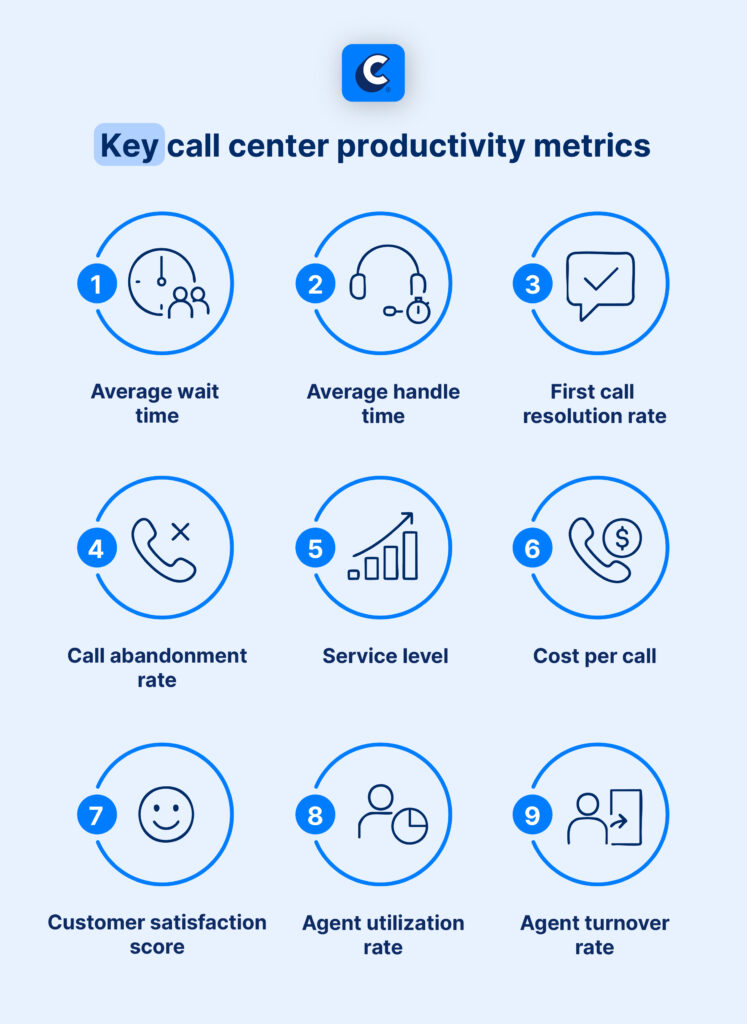
Every call center can and should set KPIs and call center productivity metrics to track and measure progress. You don’t need to follow them all, but we gathered 9 main call center metrics to make it easier to determine how well your business is functioning.
| Call center productivity metrics | Benchmark |
| AWT | 20–40 seconds |
| AHT | 5–8 minutes |
| FCR | 70–80% |
| CAR | 2–5% |
| SL | 80% of calls are answered within 20 seconds |
| CPC | $2.50–$5.00 for inbound, $6–$12 for outbound |
| CSAT | 80–90% is strong; above 90% is excellent |
| Agent utilization rate | 75–85%, with 90%+ being at risk of burnout |
| Agent turnover rate | <25% |
Average wait time
Average wait time (AWT) measures how long customers wait in the queue before their call is answered by an agent.
The formula: AWT=total number of calls answered/total wait time of all calls
So, say your team answers 450 calls, with the total wait time of all calls being 13,500 seconds, then your AWT score would be 30 seconds. That means, on average, each customer waited about 30 seconds before speaking with an agent.
A good benchmark for AWT is 20–40 seconds.
Average handle time
Average handle time (AHT) measures the total time spent per customer interaction, including talk time, hold time, and after-call work.
The formula: AHT = (total talk time + total hold time + total after-call work time) / total number of calls handled
For example, if your talk time is 2,000 minutes, hold time is 400 minutes, after-call work is 300 minutes, and calls handled in total is 400, then your AHT is:
(2000 + 400 + 300) / 400
2700 / 400
AHT = 6.75 minutes
A good benchmark for AHT is 5–8 minutes.
First call resolution rate
First call resolution (FCR) rate shows the percentage of customer issues resolved on the first contact, without follow-ups or escalations.
The formula: FCR = (number of issues resolved on first contact / total number of calls handled) × 100
If your team handles 1,000 calls in a given period with 780 of the issues resolved on the first contact, then your FCR rate is (780 / 1,000) × 100 = 78%.
A good benchmark for FCR is 70–80%, with 80%+ being excellent.
Call abandonment rate
Call abandonment rate (CAR) measures the percentage of callers who hang up before speaking to an agent.
The formula: Call Abandonment Rate = (Abandoned Calls / Total Incoming Calls) × 100
If during a given period, your call center received 1,200 incoming calls, but 60 of them were abandoned, then your call abandonment rate is (60 / 1,200) × 100 = 5%.
A good benchmark for CAR is 2–5%.
Service level
Service level (SL) measures the percentage of calls answered within a target time frame.
The formula: SL = (Calls Answered Within Target Time / Total Calls Received) × 100
So, say your target time to answer is 20 seconds. You receive 1,000 calls, and 850 of them get picked up within the target time; then your SL is (850 / 1,000) × 100 = 85%.
A good benchmark for SL follows an 80/20 rule, which means that 80% of calls are answered within 20 seconds.
Cost per call
Cost per call (CPC) shows the average cost incurred by the call center to handle one call.
The formula: CPC = Total Operating Costs / Total Number of Calls Handled
If your total operating costs are $25,000 with 5,000 calls handled, then your CPC is $25,000 / 5,000 = $5.00.
Average CPC is typically $2.50–$5.00 for inbound, $6–$12 for outbound.
Customer satisfaction score
Customer satisfaction score (CSAT) measures customer satisfaction after an interaction, usually through surveys.
The formula: CSAT = (Number of Satisfied Responses / Total Survey Responses) × 100
For example, after each interaction with your customer support, you invite customers to fill out a quick survey about their experience. If you get 400 responses, and 340 of them are rated as good or excellent, then your CSAT is (340 / 400) × 100 = 85%.
A good benchmark for CSAT is 80–90% is strong; above 90% is excellent.
Agent utilization rate
Agent utilization rate, or the number of agents per hour per call, measures how efficiently agents’ time is used by comparing total agent hours to handled calls.
The formula: Agent Utilization Rate = (Total Active Time / Total Logged-In Time) × 100
If a full-time customer support agent works 8 hours per day, and every day they spend 6.5 hours on calls with customers, then your agent utilization rate is (6.5 / 8) × 100 = 81.25%.
A good agent utilization rate benchmark is around 75–85%, with 90%+ being at risk of burnout.
Agent turnover rate
Agent turnover rate is the percentage of agents who leave the organization within a specific period.
The formula: Agent Turnover Rate = (Number of Agents Who Left / Average Number of Agents) × 100
For example, if in one year 15 agents left your company, and you normally have around 100 agents on your team, then your annual agent turnover rate is (15 / 100) × 100 = 15%.
Unfortunately, call centers have one of the highest turnover rates across industries, with an industry average being 30–45% annually, with some experiencing as much as 60%.
You should try to aim for <25%.
Why is call center productivity important?
Your call center productivity is important because every metric reflects how likely your customers are to buy from you or your clients again, or recommend you to other people. It doesn’t take much to ruin your reputation—as many as 32% of all customers stop doing business with a brand they loved after one bad experience. Winning that trust back? Almost impossible. So, let’s take a look at how your agent productivity affects customer experiences and the company’s operations.
Into a Performance Win
How does agent productivity impact CX?
If your agents are too overwhelmed to respond to your customers, don’t match their sentiment, or can’t solve customer issues promptly, the customer experience takes a hit.
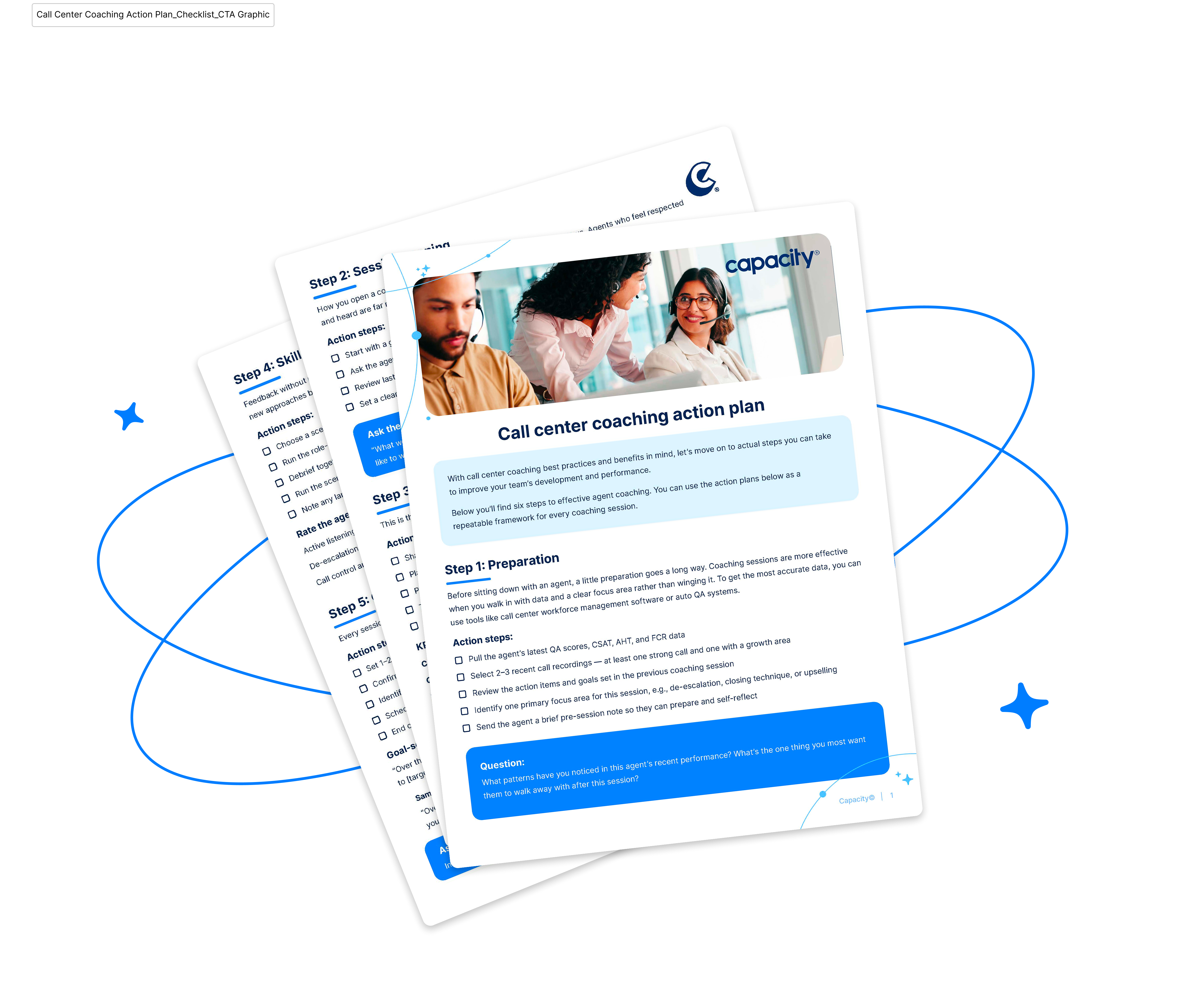
Keeping call center agent productivity metrics at the best benchmark is important for a better customer experience and growing customer loyalty. Let’s go over some of the main ways agent productivity affects how well your customers perceive your business.
- Faster, more helpful experiences: Speed, convenience, and accuracy are the main elements of a positive customer experience after having a problem, and 80% of customers agree. Productive agents handle calls efficiently because they know the systems, processes, and answers. This reduces average handle time and average wait time, so customers get solutions quickly.
- Higher brand satisfaction: When agents perform efficiently, errors decrease and responses become consistent. With smoother workflows, agents are less stressed, which leads to friendlier, more confident interactions.
- More loyal customers: 83% of customers agree that they feel more loyal to brands that respond to and resolve their complaints. Productive agents can handle more calls without sacrificing quality, giving each customer enough attention. When customers consistently have problems solved, they’re less likely to switch to competitors.
- Better brand reputation: High agent productivity supports strong service-level consistency, even during high call volumes or peak seasons. Efficient, helpful service generates positive word-of-mouth and online reviews.
How does agent productivity impact operations?
Not only are your customers affected, but the entire company is impacted by your support team’s productivity and attitude toward their work. Better productivity translates to lower support expenses, less turnover, and ultimately, growing call center revenue.
- Lower support expenses: Productive agents handle more calls in less time, reducing the total CPC. And technology is helping service teams achieve this faster. Nearly every organization using AI in their customer service is seeing the payoff, with 95% saving time and cutting costs.
- More engaged agents: Productive agents experience less frustration because systems work smoothly, calls are resolved effectively, and goals feel achievable. Add a balanced workload to the mix, and you have a happier, more engaged team ready to help.
- Less turnover: When you give your team the right tools to do their jobs, satisfaction increases and stress decreases. Engaged, productive teams develop a sense of pride and ownership, reducing the need for constant rehiring.
More revenue: Productive agents can handle more calls, solve issues faster, and upsell or cross-sell more effectively. On top of that, improved customer satisfaction and loyalty lead to repeat purchases and referrals.
Again, achieving this would be difficult without the right tools. AI-powered platforms help businesses save millions, and Choice Hotels provides a great example. By integrating Capacity’s AI-powered Virtual Agents, the company managed to save nearly $2M in support costs, and now they automatically route 97.4% of calls.
How do you improve call center productivity?
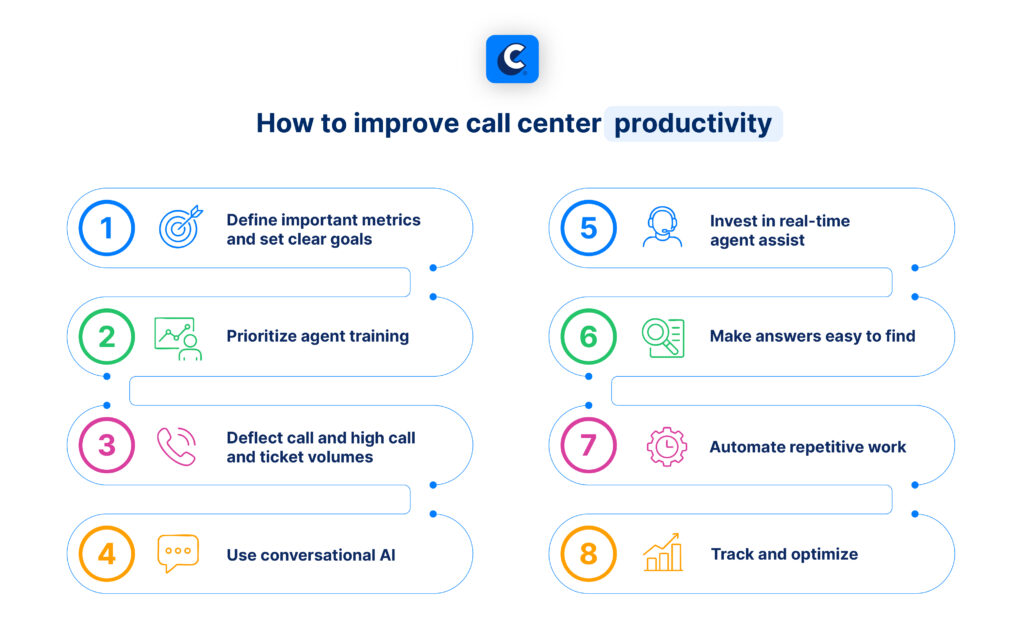
To improve call center productivity, you need to set clear goals and define how you want to measure your team’s success and productivity. But the true secret to call center success lies in the tools they use to help them achieve efficiency and productivity without exhausting their teams or sacrificing service quality. Let’s go over the main steps you need to take to transform your call center.
Define important metrics and set clear goals
You can’t improve what you don’t measure. Clearly defined metrics give visibility into performance, reveal bottlenecks, and motivate agents with specific targets. As you read earlier, you don’t have to track every little metric. Some of them might not even apply to your business! But to know the key areas to track, you need to set goals.
For example, if you notice that wait times are long and customers are growing frustrated, then you need to revisit your AWT, AHT, and agent utilization.
Make sure you set realistic and measurable goals. For example, if your average wait time is close to 1 minute, then your goal could be to lower it to 40 seconds by the end of the next quarter.
This way, you avoid wasted effort by focusing on what actually drives CX and efficiency.
Prioritize agent training
Well-trained agents handle calls faster, resolve issues correctly the first time, and maintain a consistent and personalized customer experience. If we circle back to the goal of reducing AWT to 40 seconds, you should know how to achieve that without breaking your budget.
A great place to start is by equipping your team with the right systems to accelerate call center training and boost new-hire confidence. For example, AI-powered features like auto quality assurance help ensure every customer interaction, whether by call or chat, meets your highest standards.
Meanwhile, real-time agent coaching software can deliver instant, on-the-job support for the new hires or when you introduce new features or processes. If an agent gets stuck mid-conversation, their AI coach can offer a quick tip or response suggestion, helping them recover seamlessly and keep the customer experience on track.
Deflect high call and ticket volumes
When call volume spikes, agents can’t maintain service quality or speed. Even if you don’t always have call spikes, things like:
- Outages
- Sales
- Seasonal patterns
- Service issues
happen and can cause an influx of customer inquiries, so you need to be prepared.
One way to tackle never-ending tickets is to integrate intelligent self-service options to handle simple inquiries, freeing agents up for more complex cases.
A great option is intelligent virtual agents (IVAs) that can be deployed across different channels to assist your customers. For example, you can use IVAs on your website to help customers find the best products, make bookings, handle cancellations, and so on. Voice IVAs also do an excellent job of responding on-brand to your customers and assisting them without sounding robotic or getting confused.
Use conversational AI
There’s a huge difference between scripted voice bots and conversational AI agents. Conversational AI makes interactions smoother, faster, and more secure without sounding like a robot from an early-2000s movie.
Times have changed, and conversational AI platforms that integrate voice biometrics can authenticate callers faster and identify their sentiment, adjusting their tone and approach accordingly. This helps avoid repetitive interactions and misunderstandings.
You also have features like speech recognition that automate call note-taking and intent detection. Whether the system works on its own or helps your agents on the side, it can detect small details your team would otherwise miss and help them provide excellent service.
Invest in real-time agent assist
Even skilled agents need real-time support to maintain consistency under pressure. Think of situations when you have a surge of calls and your agents need to respond in the moment. What if they don’t know the answer or need to look for specific information across different systems or past conversations?
The good news is that you don’t need to hire extra staff or personal assistants for every support agent. It takes only one system to assist your entire team simultaneously.
Real-time agent assist tools listen to live conversations and provide instant prompts such as policy reminders or next-step suggestions. Think of a utility business during an outage. If it just happened somewhere across the country or abroad, your support team might not know about it, but real-time agent assist unifies that information and helps agents access the latest updates.
SECO Energy, a Central Florida electric cooperative, gives a perfect example. They serve over 200,000 households in the U.S. but had been struggling to ensure seamless 24/7 assistance for their customers—until they integrated Capacity’s AI-powered virtual agents. With that, they managed to reduce CPC by 66% while assisting customers with:
- Outage reporting
- Authentication
- Account management
Make answers easy to find
Most businesses have a knowledge base and a helpdesk portal. But if your customers struggle to find answers on their own and your agents take ages to go through lengthy documentation, you have a problem.
A centralized, well-structured knowledge base can completely change how you search for and access information, reducing AHT by giving agents quick access to the right answers.
To level it up a notch, solutions like Capacity’s Answer Engine® deliver answers straight to the point. The Answer Engine® integrates with your helpdesk to help agents find information using prompts and receive only relevant results. The best part is that they can use it for both internal and external queries.
Automate repetitive work
A common pattern in most call centers is that, the majority of the time, agents are busy with repetitive queries that could have been automated.
Think:
- Simple FAQs: Do you ship to X country? Can I bring my cat to the hotel? How long will the outage last?
- Routine tasks: Password resets, account management, bookings, and cancellations
- Even more complex inquiries: Upselling, finding alternative products or services, helping to process a return, or receiving a refund
These can and should be automated.
Not only does automation give agents more time to focus on what matters, but it also reduces manual errors and speeds up after-call work.
Track and optimize
When you have clear goals and metrics you want to focus on, as well as the right tools to help you, the final checkbox is tracking and optimizing everything. Continuous monitoring and optimization are the foundation of sustainable productivity gains.
By keeping track of KPIs, you can spot trends and areas for improvement. You know exactly what you need to keep doing and what to remove to achieve your goals. Most importantly, it builds a culture of accountability and improvement across teams.
What are the best tools to improve call center productivity in 2025?
The best tool to improve agent productivity in 2025 and the years to come will have:
- Advanced AI-powered features to automate your agents’ work and offer self-service to your customers
- Specific metrics tracking so you can customize it to your business
- Additional features like knowledge management and quality assurance to boost your operations
But enough with theory, and let’s move on to practical tools. After analyzing SaaS solutions across various features, we selected the 6 best platforms to improve your call center agent productivity in 2025.
| Feature | Capacity | Zendesk | Freshdesk | Intercom | PolyAI | Sierra AI |
| AI Chatbot / IVA | ✓ | ✓ | ✓ | ✓ | ✓ | ✓ |
| Knowledge Base | ✓ | ✓ | ✓ | ✓ | ✗ | ✗ |
| Real-time Agent Assist | ✓ | ✓ | ✓ | ✓ | ✗ | ✓ |
| Cost Tracking / Reporting | ✓ | ✓ | ✓ | ✓ | ✗ | ✗ |
| Auto QA | ✓ | ✓ | ✗ | ✓ | ✓ | ✓ |
| Corporate Search Engine | ✓ | ✓ | ✓ | ✓ | ✗ | ✗ |
1. Capacity

If you want to level up your call center agent productivity and boost customer experience, then look no further. Capacity is an AI-powered support automation platform that connects your tech stack, automates repetitive tasks, and provides live agent assist. It focuses on reducing support costs and deflecting volume while helping your agents work faster and more efficiently.
Main features for call centers:
- IVAs that you can deploy across voice, chat, email, and SMS deflect over 90% of incoming interactions
- A unified knowledge base centralizes information so agents don’t waste time hunting for answers
- Real-time agent assist offers assistance during a live call, AI suggestions, and quicker access to information
- QA automation offers real-time call center quality assurance for every interaction
2. Sierra AI

Sierra AI builds autonomous AI agents that can operate across channels like voice and chat and integrate with existing call center infrastructure to deliver on-brand, human-like support.
It works best to deflect high call and ticket volumes while using conversational AI. However, if you want something more user-friendly and cost-efficient, don’t miss Sierra AI competitors and alternatives.
Main features for call centers:
- A no-code and programmatic platform lets your less tech-savvy employees build AI agents
- Integration with voice and phone systems and existing call center tech allows AI agents to handle or escalate interactions with customers seamlessly
- Omnichannel support is available across chat, voice, etc., so the AI agent is everywhere your customer is
3. PolyAI

PolyAI specializes in advanced voice assistants for enterprise contact centers. Their AI supports complex conversations in many languages, integrates with telephony and different CRMs, and is built for scale. However, if you operate in an industry with strict compliance requirements or need more from voice analytics, you shouldn’t miss apps like PolyAI.
Main features for call centers:
- A voice assistant that handles incoming calls, understands interruptions, context shifts, and multiple languages
- Real-time dashboards and analytics on conversation data enable monitoring of trends, issues, and agent hand-offs
- Seamless escalation and handoff to human agents with full context
4. Intercom

Intercom is a modern customer service and messaging platform combining chat, automation, ticketing, and real-time support across channels. It helps agents work faster and smarter while also supporting self-service. However, if you need a solution for a small call center, then you can check out Intercom alternatives for different business needs.
Main features for call centers:
- Omnichannel messaging across chat, in-app, and email, and the ability to escalate to voice or video
- Workflow automation, macros, and no-code tools for routing and triggers
- Analytics for queries, performance, and channel trends
- Knowledge base and self-service features, so customers or agents can find answers quickly
5. Freshdesk

Freshdesk is a customer-support and contact-center-oriented platform offering omnichannel support with IVR, automatic call distribution, real-time dashboards, and cloud deployment. Its main goal is to make operations simpler and scalable. For full automation, you might want to look for Freshdesk alternatives.
Main features for call centers:
- Cloud contact center with voice channel, chat, social, and unified inbox for a centralized experience
- IVR, call recording, nested call queues, and real-time dashboards for performance
- Workforce management features, like shift scheduling, forecasting, and real-time monitoring
- Knowledge base, automation, and multi-channel ticketing for agents
6. Zendesk

Zendesk is a well-known cloud-based customer service platform that has expanded into full contact-center capabilities, offering voice, IVR, AI-powered guidance, analytics, and omnichannel support. While Zendesk is a strong option, it’s not the cheapest, so if you need something more affordable and user-friendly, you might want to look at Zendesk alternatives.
Main features for call centers:
- Smart IVR and self-service options integrated with the voice channel
- An agent workspace that unifies voice and digital channels. Plus, it offers real-time sentiment and performance analytics
- Ticketing, routing, and macros automations with multi-channel support, knowledge base
Boost your call center productivity without overwhelming your team
You don’t need to run your team to exhaustion to ensure your customers are happy and loyal to your brand. Choosing the right tools can boost your call center productivity, improve customer experiences, and provide your team with the right resources to succeed.
It’s not a nice-to-have—it’s a must for winning call centers.
If you’re looking to eliminate customer frustration, lower your agent turnover rates, and achieve perfect benchmarks for different call center metrics, then AI-powered internal and external customer support by Capacity is the way to go. We’re not going to overpromise—calculate how much you’ll save with Capacity.
Capacity Can Do?
FAQs
You can improve agent productivity by:
– Defining clear KPIs
– Investing in training to keep skills sharp and consistent
– Using AI and automation to offload repetitive tasks
– Providing real-time agent assist
– Empowering agents with knowledge
– Maintaining balanced workloads
Increasing overall call center productivity is about maximizing output while maintaining service quality.
Tactics that work:
– Use IVAs and chatbots to handle simple inquiries
– Implement self-service tools and knowledge bases to reduce inbound load
– Use dashboards to monitor KPIs in real time
– Unified platforms like Capacity, Intercom, or Zendesk streamline communication and context sharing
– Set achievable goals, provide feedback loops, and recognize high performance
Call center productivity is measured by how efficiently agents and systems deliver customer service outcomes.
The most common metrics include:
– Average Handle Time (AHT)
– First Call Resolution (FCR)
– Agent Utilization Rate
– Service Level
– Cost per Call (CPC)
Agent productivity can be expressed as a ratio of productive time to total time, or through output-based metrics, depending on your call center’s goals.
For example:
– To calculate Average Handle Time, you need to: (Talk Time + Hold Time + After-Call Work) ÷ Calls Handled
– To calculate First Call Resolution (FCR), you need to: (Calls Resolved on First Contact ÷ Total Calls) × 100
– To calculate Agent Utilization Rate, you need to: (Total Active Time ÷ Logged-in Time) × 100