


 Customer Support
 HR & Ops
 IT Support
 Sales & Marketing
Does this sound familiar? You try yet another knowledge management and customer support automation tool, but many features are still missing, leaving your team stressed and your customers frustrated.
That’s the reality for many businesses nowadays: they need a solution that solves all their customer support issues, but very few can offer complete automation with features that improve support efficiency and make teams more productive.
One tool that tries to achieve all that is Talkdesk, a customer experience (CX) automation platform with inbound and outbound virtual agents, QA, and analytics. However, its overreliance on voice support, lack of comprehensive knowledge management features, and customer service that isn’t always available when you need it most cause many users to look for Talkdesk alternatives. If you’re in the same boat, you’ve come to the right place!
In this guide on Talkdesk and its alternatives, you’ll learn:
- The three main reasons why people switch to Talkdesk competitors
- What to look for in a CX automation platform
- 13 platforms you can try instead to boost your customer experience in 2026
Sounds good? Let’s dive right in!
What is Talkdesk? Features and pricing explained
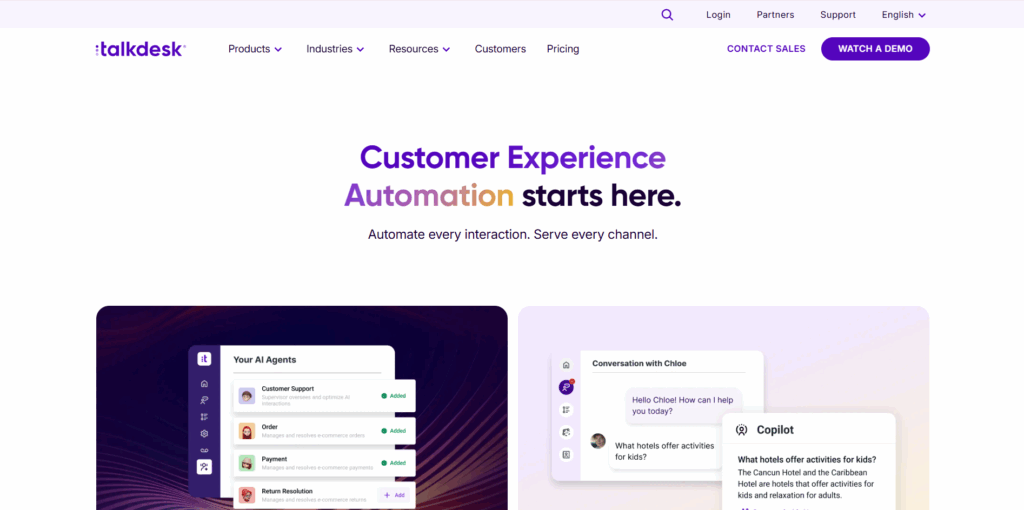
Talkdesk is a cloud-based contact center platform that helps businesses manage customer interactions across multiple channels, including:
- Phone calls
- Chat
- SMS
- Social media
…all in one place.
It provides tools for customer service and sales teams to handle inbound and outbound communications efficiently. Agents can make and receive calls directly from a browser, view customer details, and log interactions automatically. In other words, it promises to connect and centralize your company’s customer service for better CX.
Key features
- Automatic call distribution (ACD) routes incoming calls to the right agent or department, reducing wait times
- Interactive voice response (IVR) lets customers self-serve or choose options before speaking to an agent
- AI automation offers tools like speech analytics, chatbots, and real-time agent assistance
- Integrations with major CRMs and business tools like Salesforce, Zendesk, HubSpot, Microsoft Teams, and more
Talkdesk pricing

Talkdesk pricing is divided into three main plans:
- CX Cloud Digital Essentials – USD 85 per user/month
- CX Cloud Voice Essentials – USD 105 per user/month
- CX Cloud Elite – USD 165 per user/month
You can also add extras and add-ons for an additional fee.
Why look for Talkdesk alternatives?
Most businesses look for Talkdesk alternatives because it doesn’t deliver all the features they need to manage their customer support teams efficiently. If 360-degree corporate knowledge management, internal agent assistance, and responsive customer support are important to you, then let’s go over some key things to keep in mind if you’re considering the platform—and why you might want to check out Talkdesk competitors.
Why you should trust us
Before we get into Talkdesk alternatives and limitations, let’s get clear on why you should even trust us—after all, we are competitors. We firmly believe that you shouldn’t jump at the first business tool you find because it might:
- Not meet your specific goals
- Lack necessary features
- Make your team’s work even harder
- Damage your customer experience (and it takes only two bad experiences for 46% of consumers to never look at a business again. Yikes!)
That’s why we encourage you to take your time and explore your options. We gathered Talkdesk customer reviews across G2, Capterra, and other SaaS product pages to provide an unbiased view of why people most often look for Talkdesk alternatives. We’re leaving the links to these pages so you can investigate further.
With that being said, let’s take a look at those reviews and what people are saying about Talkdesk.
1. Limited integrations
The key to true automation lies in data synergy between different systems in your business. Modern customer service operations usually rely on a web of systems like CRMs, ticketing tools, analytics, chatbots, and back-office databases. If the contact center platform doesn’t integrate smoothly, you end up with:
- Silos
- Manual workarounds
- Lost efficiency
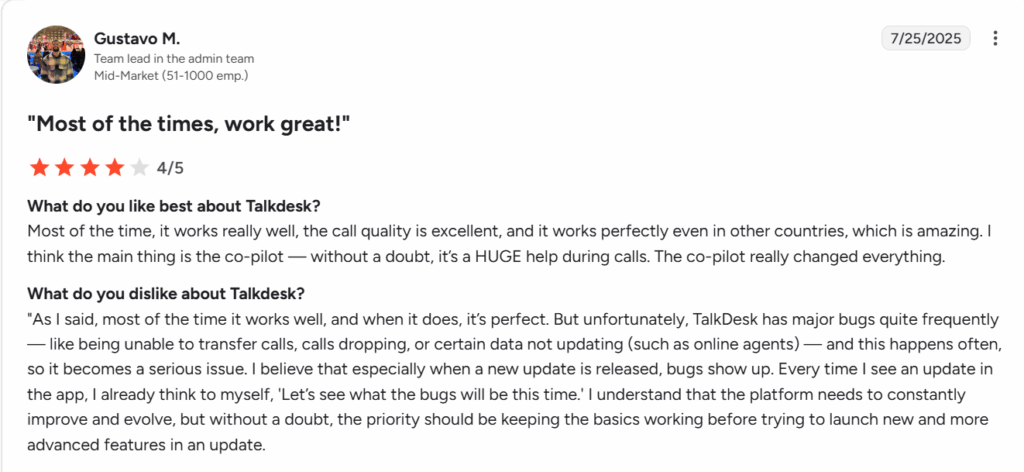
Talkdesk says it supports “60+ business tool integrations,” but customer reviews suggest that deeper or custom integration work may be required.
2. Over-reliance on voice

Many customers today expect omnichannel experiences across:
- Chat
- Social media
- SMS
- Self-service
…not just voice calls.
Statistics show that 41% of customers prefer to communicate with a business through live chat, while only 32% opt for call assistance.
Talkdesk does advertise voice plus other digital channels like chat, email, SMS, and social in its plans. However, some users report that while the voice side is solid, the non-voice channels or full omnichannel workflows feel less mature.
3. Poor customer support

When you’re looking for tools to improve customer support, you also deserve timely and personalized assistance. Poor support from the vendor’s side can lead to downtime, frustrated agents, lost revenue, and high switching costs.
If you’re in a high-stakes environment where you have to be available 24/7, employ global agents, or adhere to regulatory compliance, you need premium-level support guarantees. But when it comes to Talkdesk, many clients mention that support isn’t as responsive or helpful as they expected when they first became customers.
Vendor Really Stack Up?
What to look for in Talkdesk alternatives: 4 main features
Talkdesk positions itself as an AI customer experience platform. If you’re looking for similar tools, don’t overlook features like omnichannel support, backend automation capabilities, full corporate knowledge management, and a support team that helps you whenever you need it. Let’s go over four main features and benefits a genuinely helpful customer experience platform should provide.
Dedicated support teams
When things go wrong:
- Integrations fail
- Agents can’t access history
- Workflows hang up
- Bugs happen
you want more than “submit a ticket and wait 24 hours.” You can’t wait 24 hours because your customers sure won’t. You need a partner.
When choosing a Talkdesk competitor, make sure:
- The vendor guarantees a dedicated account manager or team instead of a generic customer support desk
- Support hours align with your business, especially if you operate 24/7 or across multiple countries
- They don’t just help with “product issues,” but also with integrations, custom work, training, and onboarding
True omnichannel
A true omnichannel experience means customers can use multiple channels, like voice, chat, email, SMS, social, and messaging apps, seamlessly. Data carries across channels, so customers don’t have to repeat themselves, and agents can access unified information.
If your customer support operates across channels, make sure:
- The platform offers all the channels you need
- It provides a unified interface for agents so they can see all interactions in one view, regardless of channel
- Transitions between channels are smooth. For example, a customer starts in chat, moves to voice, or follows up by email, and the agent still has full context
- The vendor supports a single queue across channels and cross-channel routing
Backend automation capabilities
As your volume grows and interactions become more complex, manual routing, data entry, and agent task-switching become bottlenecks. Automation helps boost efficiency, reduce errors, and provide better CX, but only if done right.
Make sure:
- The platform provides workflow engines or automation tools where events or conditions trigger actions
- It integrates with your backend systems, so automation can span across platforms, not just within the contact center tool
- It supports AI or decision logic for things like intent detection, routing, agent assist, and cross-channel behavior
- It offers a smooth configuration
Full CX platform
Many businesses today recognize that customer experience goes far beyond inbound calls.
It covers:
- Digital touchpoints
- Proactive engagement
- Analytics
- Customer journey management
- And more
A “contact center” tool that only manages incoming interactions might fall short when you want to engage with your customers or offer proactive communication.
Instead, look for:
- A vendor that positions itself as a CX platform covering support, sales, marketing, proactive outreach, and data
- One that provides or integrates with features like journey analytics, real-time dashboards, customer data platform capabilities, proactive engagement, and personalization
- A platform that connects “front-office” interactions with “back-office” systems like CRM, ERP, and data warehouses to give you a holistic view of customers and operations
- AI features, like an AI chatbot or voicebot that offer self-service and help agents work more efficiently.
The 13 best Talkdesk alternatives in 2026
Finally, we’ve come to the best Talkdesk alternatives to try in 2026. We compared 13 tools based on their main features, pros, cons, and customer reviews. Take a look to compare which ones meet your customer needs and business goals best.
1. Capacity

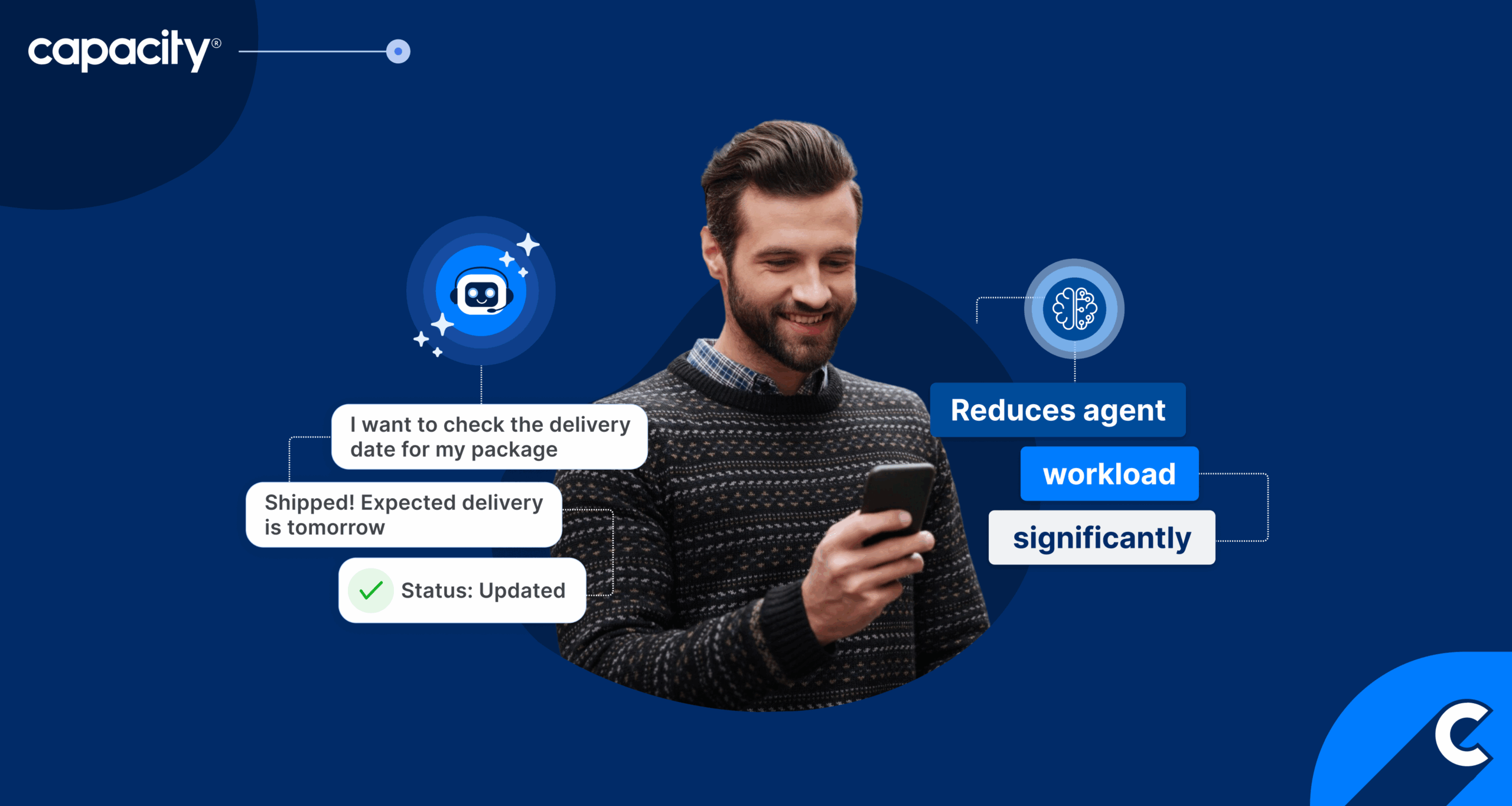
Capacity is a strong Talkdesk alternative if you’re looking for a unified customer experience, internal support automation platform, and helpdesk software in one. It emphasizes using AI and automation to reduce human agent load by deflecting over 90% of queries, automating workflows, and offering agent assist features.
It’s especially suited to businesses wanting to automate high-volume, repetitive support tasks and equip their teams with the tools to succeed at their job.
Main features:
- AI-powered intelligent virtual agents and conversational AI allow you to automate all your communication channels, wherever your customers are. IVAs not only respond to customer queries but also proactively engage and help them with more complex issues such as bookings, cancellations, technical support, and more.
- Omnichannel helpdesk with an integrated knowledge base and Answer Engine® makes your helpdesk the main source for self-service. This means customers can find answers to most of their questions using your self-service options. Meanwhile, Answer Engine® helps your team find relevant information in seconds, whether they need to request PTO or find details about the latest product update.
- Corporate knowledge management connects your business data across internal chats, emails, third-party integrations, documentation, and more to give you a centralized knowledge hub whenever your team needs to pull historical customer data, find files, or clarify a doubt.
- Low- to no-code tools help less tech-savvy employees adjust automation workflows without needing tech support.
- Analytics and insights into automation performance across text and voice support give you a complete view of how your customers and service agents are doing.
Pros:
- Reduces agent workload significantly by automating many routine interactions
- Improves the speed of resolution and reduces costs
- Offers many useful agent assist features like real-time coaching, post-call summaries, and auto quality assurance
Cons:
- It might be overkill for small businesses
2. Five9
Five9 is a cloud-based contact center platform aimed at organizations that want a broad set of features for agents, routing, multichannel interactions, and analytics. It positions itself as “Intelligent Cloud Contact Center.”
Main features:
- Multichannel engagement enables customers to connect seamlessly across voice, chat, email, SMS, and social channels within a unified platform
- AI and automation streamline interactions, reduce handle times, and enhance customer experiences
- Analytics and workforce optimization provide real-time insights, performance analytics, and tools to optimize staffing while giving agents the context and guidance they need to perform at their best
- Cloud-native scalability and flexibility deliver a secure, reliable, and easily scalable solution that adapts to changing business needs without the limits of on-premises infrastructure
Pros:
- Good choice if you need a full suite for large agent teams
- Advanced AI features
Cons:
- It might be more complex to implement
- Some users report that while it supports “digital channels,” it may still be somewhat too voice-centered
3. Avaya
Avaya is a long-standing player in the communication and contact center world. Their services promise to improve customer experience, increase employee engagement, and drive business growth, perfect for enterprises with complex operations, high call volumes, routing, advanced metrics, and those wanting deep telecom or CTI integration.
Main features:
- Omnichannel customer journeys connect every customer touchpoint—voice, chat, messaging, and social—into a consistent, personalized experience across all channels
- AI-driven self-service lets customers resolve issues quickly through intelligent virtual assistants and natural language understanding
- Their Avaya Infinity Platform supports large, complex organizations with secure, high-performance infrastructure designed for global operations and heavy interaction volumes
- Agent performance management features equip supervisors with real-time insights, coaching tools, and analytics to boost agent effectiveness and customer satisfaction
Pros:
- Excellent fit for large organizations with complex contact-center workflows and heavy call traffic
- Depth in telephony
Cons:
- Some users note that cloud features and agility may lag behind
- Implementation time and cost may be higher
4. NiCE CXone
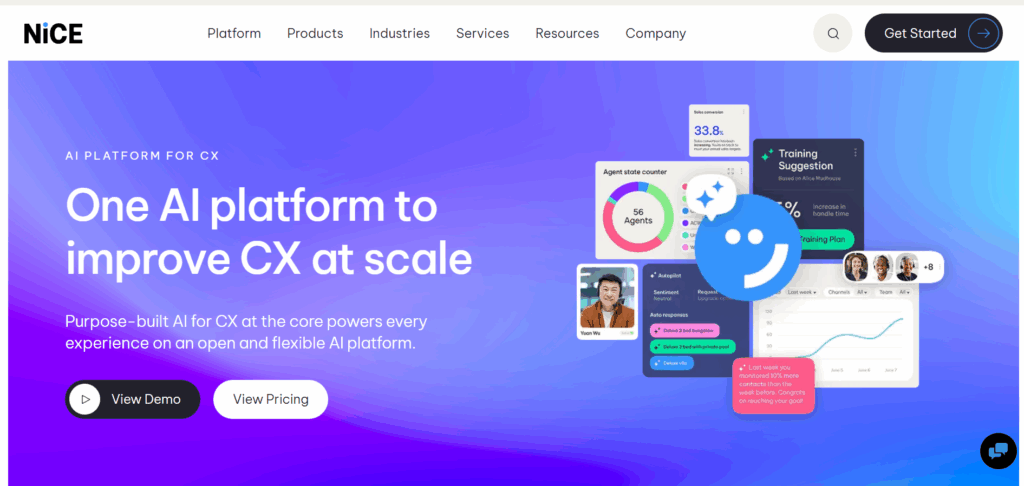
NiCE CXone is a modern, cloud-native CX platform that aims to unify the customer journey across channels, integrate automation, and provide a full experience, not just voice routing. Their CXone platform promises to deliver a “Purpose-built AI for CX.”
Main features:
- Unified agent workspace brings all customer interactions, tools, and data into a single intuitive interface to simplify the agent experience and boost productivity
- Linked front-office and back-office connect customer-facing and back-office operations to ensure seamless issue resolution and end-to-end service visibility
- AI-powered agent assist uses real-time AI insights and recommendations to guide agents during interactions, improving accuracy and efficiency
- Cloud-native architecture delivers a secure, scalable, and flexible platform to support rapid innovation and reliable global performance
Pros:
- Supports the whole customer journey
- Cloud-native means potentially faster updates
Cons:
- Has a steep learning curve and might need a skilled admin
- Some users may find the UI or tooling less intuitive
5. Genesys
If you’re looking for a long-standing alternative to Talkdesk, then Genesys shouldn’t slip your radar. Genesys offers a broad and mature contact center and CX platform that enables a unified agent experience across voice, digital, self-service, and analytics.
Main features:
- Support for voice provides high-quality, reliable voice interactions integrated with digital channels for a consistent, personalized customer experience
- AI and automation power predictive routing, virtual agents, and workflow automation that enhance efficiency and engagement
- Cloud-native architecture offers a flexible, scalable, and secure cloud platform that enables rapid deployment and continuous innovation
- Real-time analytics delivers actionable insights and performance metrics instantly to optimize customer journeys and agent effectiveness
Pros:
- Mature ecosystem, many integrations, broad feature set
- Proven in large enterprises and global deployments
Cons:
- Potentially higher complexity and cost
- If your company is small or simple, you may pay for more than you need
6. Trellus
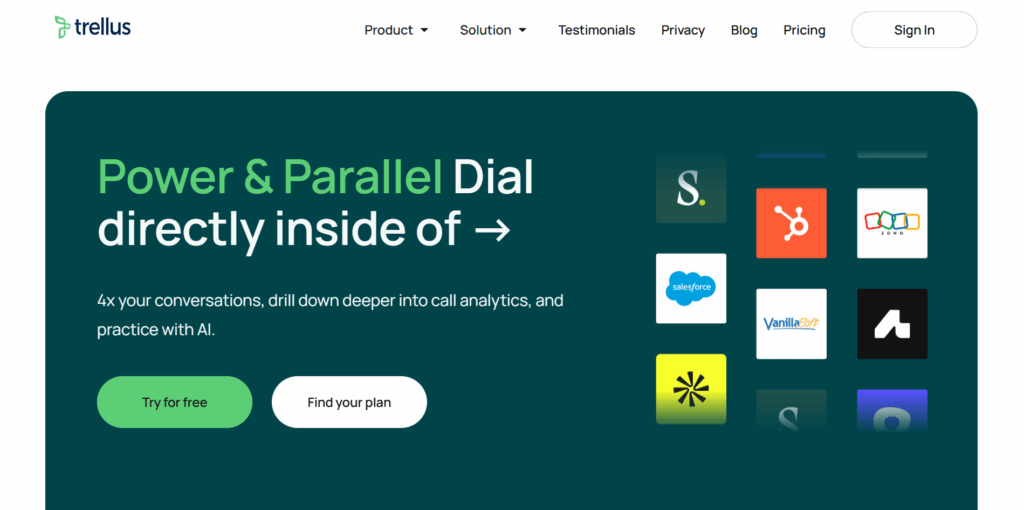
Trellus is more narrowly focused: it leans into sales, call analytics, and conversation intelligence rather than being a full contact center platform. It offers real-time AI coaching, call transcription, and analytics, especially useful for revenue teams.
Main features:
- Real-time call transcription, summary, and conversational intelligence allow you to analyze conversations instantly to provide searchable transcripts, key insights, and actionable summaries
- AI coaching delivers real-time feedback and personalized guidance to help sales and service teams improve communication and performance
- Automated follow-up actions streamline post-call workflows by automatically generating tasks, messages, and next steps based on conversation outcomes
- Analytics for sales and conversation quality provides detailed metrics and trend analysis to measure sales effectiveness and enhance overall conversation quality
Pros:
- Excellent if your key need is improving sales or agent effectiveness
- Strong value in conversation intelligence and rep coaching
Cons:
- Not a full CCaaS platform
- May require integrations to tie into your broader contact-center stack
7. 8×8
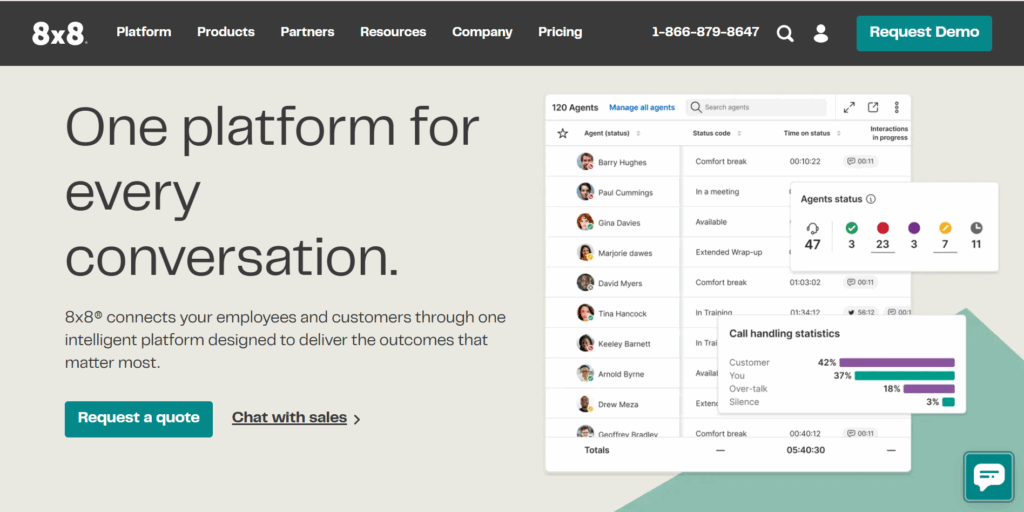
8×8 offers a cloud contact center solution bundled with unified communications across voice, video, and chat. It emphasizes omnichannel support and cost‐effective deployment for various business sizes. It’s a great alternative if you’re looking to unify your customer support.
Main features:
- Omnichannel routing directs customer interactions across voice, chat, email, and social channels to the best available agent for faster, more personalized service
- Analytics and dashboards for agent and journey insights offer real-time and historical analytics with intuitive dashboards to track performance, customer journeys, and service quality
- Secure, scalable cloud platform ensures reliability, flexibility, and continuous innovation
- Global deployment supports multinational operations with a unified platform designed for consistent performance and compliance across regions
Pros:
- Good all-rounder, especially if you want unified communications
- Suited for SMB and medium-sized organizations
Cons:
- The admin side may be less intuitive or require more training
- Smaller partner ecosystem or fewer advanced features compared to top-tier enterprise vendors
8. RingCentral

RingCentral is well known for unified communications. It offers powerful features for healthcare, education, government, retail, and many other industries, which include omnichannel support, AI insights, and deep integrations within its communications ecosystem.
Main features:
- Skills-based omnichannel routing across voice and digital channels automatically connects customers to the most qualified agents across voice, chat, messaging, and social channels
- 99.99% uptime SLA ensures exceptional reliability and business continuity with enterprise-grade availability and performance guarantees
- Deep integration with phone, messaging, and video analytics unifies communication data across modalities to deliver comprehensive insights into customer and team interactions
- Workforce management features optimize staffing, forecasting, and scheduling
Pros:
- Great choice if you already use RingCentral for other communications and want a seamless extension into customer support
- Strong reliability and modern cloud architecture
Cons:
- Because it’s part of a broader UC platform, the contact center component may not be as deep or specialized as pure CCaaS vendors
- Pricing and modules may get complex when layering advanced features
9. Dialpad

Dialpad is a communications platform with a strong emphasis on AI, especially for contact center use cases. It offers voice, video, messaging, and a cloud contact center built from the ground up with AI capabilities baked in.
Main features:
- Real-time transcription and sentiment analysis capture and analyze conversations to provide live transcriptions and detect customer sentiment during calls
- Omnichannel support unifies voice, video, messaging, and digital channels so customers can connect seamlessly through their preferred method
- Live coaching and an AI assistant for agents deliver in-the-moment guidance, suggested responses, and call insights that help your team perform more effectively
- Features for remote teams enable secure access from any device or location, making it ideal for flexible and distributed teams
Pros:
- Great if you want to boost agent performance and use insights from interactions
- A strong option for remote and distributed teams
Cons:
- May lack some of the deep enterprise contact center features
- If you need very custom heavy workflows, you might need additional integrations or customization
10. Zendesk

Zendesk is one of the most well-known customer support automation platforms out there. It’s a strong competitor to Talkdesk, especially if you’re looking for a solution for a large company. It’s mainly known for its helpdesk and support ticketing, but it also offers contact center capabilities with omnichannel, calling, AI, and analytics. It’s a good choice if your support operation is part of a broader CX ecosystem.
Main features:
- Omnichannel communication brings together customer interactions across email, chat, voice, social media, and messaging apps into a unified workspace for seamless support
- AI-powered assistance, after-call work automation, and quality assurance tools help agents respond faster, automate post-interaction tasks, and maintain consistent service quality
- Strong automation and ticketing workflows streamline customer service operations with intelligent routing, triggers, and macros that accelerate issue resolution
- Extensive integrations connect easily with hundreds of third-party apps and business systems to create a connected, customizable support ecosystem
Pros:
- Excellent fit if you want tight integration between helpdesk and contact center
- Strong ecosystem of apps and integrations
Cons:
- It can be too much for smaller or mid-sized businesses
- Costs can escalate when adding advanced features, AI, or workforce management modules
11. Sierra AI

Sierra AI is a relatively new platform that focuses on building generative AI agents for customer support. These agents are designed to act on behalf of a brand—handling interactions across channels, performing tasks, and integrating into existing contact center and telephony ecosystems. However, its steep learning curve and missing features might make you want to check out Sierra AI competitors.
Main features:
- AI agents across voice and chat can take phone calls with a lifelike voice and chat-based conversations
- Integration into existing call center infrastructure allows agents to plug into major telephony and routing systems and hand off to humans with context
- Branding and channel consistency allow building once and deploying across multiple channels, retaining brand tone, style, and customer context
- Constant learning and task automation enable Sierra’s agents to perform tasks autonomously, e.g., look up orders, reschedule, etc.
Pros:
- Strong option for embedded AI agents
- Good for organizations wanting to shift from human-only to AI-augmented support
Cons:
- As a newer vendor, it may have fewer features for full customer experience workflows
- If your need is a broad omnichannel experience, not just advanced AI agents, you might find gaps
12. PolyAI

PolyAI specializes in voice-first conversational AI assistants for contact centers. Their focus is on automating inbound calls using voice assistants that sound human, understand intent, and integrate with existing systems. Although PolyAI focuses a lot on voice, it might not have the strongest voice analytics in the market. If that’s something you’re looking for, then don’t skip apps like PolyAI.
Main features:
- Natural language voice assistants handle spoken conversations, including alphanumeric capture without keypad input
- A multilingual and global approach supports many languages, accents, and dialects
- Integration with existing contact center stacks works with tools like Twilio, integrates with voice routing, and can hand off to human agents with context
- Real-time analytics captures structured data from spoken interactions, provides insight about intent, automation opportunities, and helps reduce agent load
Pros:
- Strong in voice automation
- Global reach and language support
Cons:
- It may not cover the full breadth of contact center needs
- Implementation may still require significant integration work
13. Medallia

Medallia is one of the main alternatives to Talkdesk due to its mature enterprise-grade experience management offering. It helps organizations gather signals across voice, chat, surveys, and digital behavior, analyze them, and drive action to improve CX and EX. Being a mature platform with advanced features, it can also be more difficult to set up and master. If you’re in for a simpler customer experience automation solution, then check out Medallia alternatives.
Main features:
- Signal capture and unified experience data collect data from voice, chat, web behavior, and surveys to build a seamless user experience
- Real-time analytics uses AI to identify trends, root causes, and highlight where action is needed
- Action orchestration enables workflows for frontline teams, linking insights to operations, helping teams prioritize, act, and measure
- Scalability and enterprise readiness are great for large organizations, global deployments, secure data governance, and scale
Pros:
- Strong insight capabilities
- Mature vendor, good track record with large enterprises
Cons:
- Cost and complexity might be high
- For smaller or simpler contact center operations, the breadth may be more than needed
Automate your customer support from A to Z
Having top tools to automate your customer support has never been more important. And you have a lot of options to choose from, including top alternatives to Talkdesk, like:
- Capacity
- Five9
- Avaya
- NiCE CXone
- Genesys
- Trellus
- 8×8
- RingCentral
- Dialpad
- Zendesk
- Sierra AI
- PolyAI
- Medallia
But here’s the thing: it’s not enough to just automate some repetitive tasks—true automation should help at every step of the way to make your agents’ jobs easier and boost customer experience. That’s what Capacity helps you achieve. Don’t take only our word for it—check out our ROI calculator to see how much money you’ll be saving with true white-label automation.
FAQs
There are quite a few Talkdesk competitors that promise stronger automation, knowledge management, and agent assist tools for your staff, including:
– Capacity
– Five9
– Genesys Cloud CX
– Medallia
If you’re picking “top” by feature-richness and market recognition, don’t skip:
– Capacity
– Zendesk
– Medallia
– PolyAI
If automation and AI are your priority, we recommend considering:
– Capacity
– Five9
– Dialpad
– PolyAI
All of these tools promise to automate your support operations and boost customer support.
For SMBs with lighter budgets or simpler needs, you should check out 8×8 Contact Center or Trellus.