


 Customer Support
 HR & Ops
 IT Support
 Sales & Marketing


- To improve agent coaching with auto QA, use it to score 100% of customer interactions and coach on specific moments instead of overall averages.
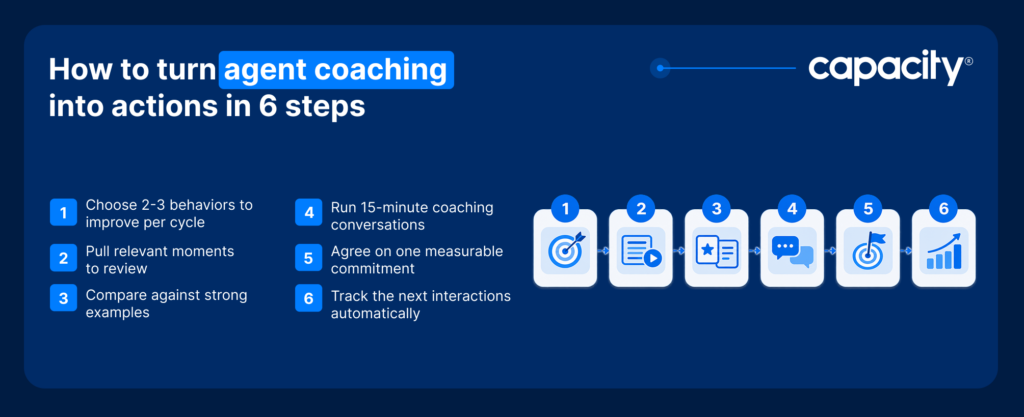
- Follow 6 steps: Pick 2–3 behaviors per agent per cycle, pull the relevant moments, compare them with top performers’ examples, run 15-minute sessions where the agent reflects first, agree on one measurable commitment, and automatically track the next 10 interactions.
- Prioritize in 3 layers: Coach by risk first (compliance misses and critical failures), then by impact (CSAT, FCR, and AHT), then by trend (slipping scores, improving agents, and new hires).
- Keep it fair with 5 practices: Show the evidence behind every score, let agents dispute scores, calibrate scorecards regularly, keep people in charge of employment decisions, and recognize what agents do well.
- Results: Peak Credit Union raised acknowledgment language by 31% and cut rep confusion by 50% in the first month of using Capacity’s Auto QA coaching.
Automated quality assurance (auto QA) is a powerful coaching tool for contact centers that uses timely and evidence-based feedback to improve agent productivity. Most coaching fails because feedback is late and general. Auto QA makes call center training ongoing and happen in real time, based on your own predefined criteria and “what good looks like” standards.
In this guide on how to improve agent coaching with auto QA, we explain the difference between traditional and automated coaching and why the former doesn’t work well when you have a growing business and team.
Keep reading to learn:
- What auto QA contact center coaching software changes about team progress
- How to turn auto QA results into actionable feedback
- What to prioritize when coaching
- How to make sure auto QA is compliant with the latest regulations and is fair to everyone on your team
Why does traditional agent coaching fall short?
Most coaching programs still rely on manual quality assurance, where a supervisor reviews a small sample of each agent’s calls every month and builds feedback around what they find. That approach made sense when listening to calls by hand was the only option, but it turns coaching into a matter of luck because you just can’t evaluate and gather evidence from every interaction. If you analyze just 1–3% of customer interactions, you can’t accurately spot the patterns that need your attention or turn them into call center agent coaching.
As a result, by the time feedback reaches an agent, the moment has passed, the advice is too broad to act on, and the conversations that most needed attention may never have been reviewed at all.
With so little coverage, most issues go unnoticed, and agents miss chances to improve where it matters most. And most companies still have a huge gap between testing automation and using it at scale. Capgemini’s World Quality Report 2025–26 found that 43% of organizations are experimenting with Gen AI in QA, but only 15% have scaled it enterprise-wide.
What does auto QA change about coaching?
Auto QA driven coaching changes the whole process of agent training from reactive to ongoing and proactive. It’s continuous and happens in real time, which allows you to spot training opportunities right away so agents improve before they can form bad habits. It’s also more specific because auto QA provides evidence of why feedback is necessary.
Because of how auto QA improves agent coaching, the auto QA software market is growing. According to Econ Market Research findings from 2025, the global coaching software market is expected to grow from its current valuation of US$0.68 billion to US$3.31 billion by 2035.
So, let’s go over the key differences and benefits for your business and team.
- Specific moments over averages: Instead of coaching from an overall score, supervisors can point to the exact moment in a conversation where something went right or wrong. Coaching with quality assurance data makes feedback concrete and much easier for agents to act on.
- Prioritization by impact: With full coverage, supervisors can focus on the issues that affect customers and outcomes the most. Coaching time goes where it will make the biggest difference.
- Consistency across supervisors: Every interaction is scored against the same criteria, so agents aren’t evaluated differently depending on who reviews them. That builds trust in the feedback and makes performance easier to compare across teams.
- Speed of feedback: Interactions are evaluated shortly after they happen, so issues can be addressed while they’re still fresh. Agents can correct course before a habit takes hold.
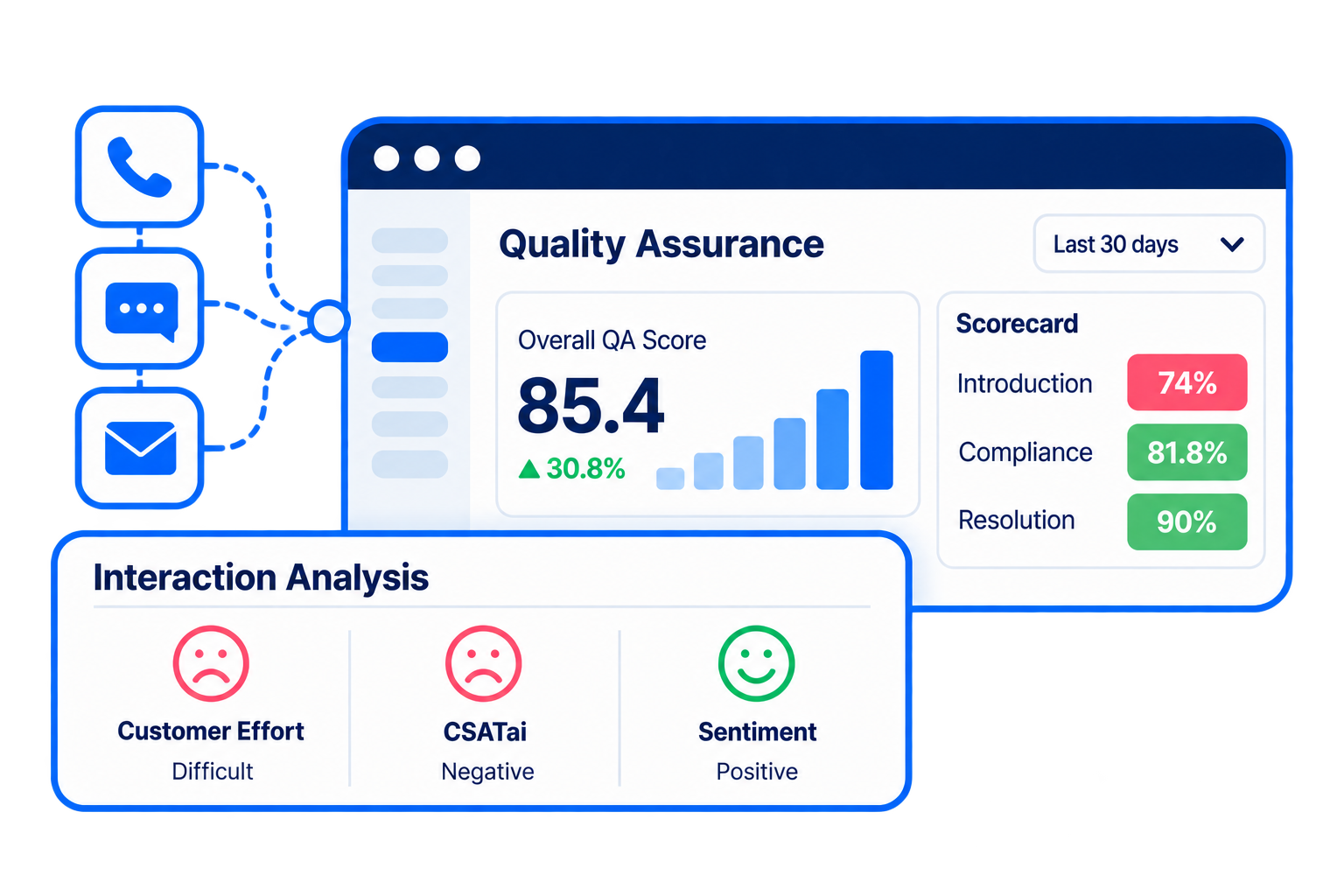
If you keep missing critical coaching moments and notice that customer satisfaction is dropping, but you aren’t sure why, auto QA can help you uncover insights from 100% of interactions.
automatically
How do you turn auto QA scores into coaching actions?
To turn auto QA scores into call center agent coaching, you need to look at them through the lens of feedback for a specific person instead of treating them as just another CSAT score. This step is one of the hardest for most companies. According to Capgemini’s findings, 94% of organizations review production data, but almost half of them struggle to turn it into action. To make this step concrete, let’s take a contact center scenario where Maya, a supervisor, is coaching Jordan, an agent on a billing support team.
1. Choose two or three behaviors to improve per agent per cycle
Auto QA will surface plenty of opportunities, but trying to fix everything at once dilutes the effort. Pick the two or three behaviors that matter most for each agent this cycle and set the rest aside for later.
Looking at Jordan’s scores, Maya sees that he resolves issues accurately but often skips confirming that the customer’s problem is solved and rarely sets clear expectations about refund timelines. Those become his two focus areas for the next two weeks.
2. Pull relevant moments to review
Instead of reviewing whole calls, pull the specific moments where each focus behavior showed up, or should have. This keeps the session focused and shows the agent exactly what you mean.
Maya filters Jordan’s recent interactions for refund requests and pulls three clips where he ended the call without explaining when the customer would see their money back.
3. Compare against strong examples from top performers
Showing what good looks like is often more effective than describing it. Find a few moments where top performers handled the same situation well and use them as a reference.
Maya pulls two clips from a colleague who consistently scores high on expectation-setting. In both, the colleague clearly explains the refund timeline and what the customer will see on their statement. She works with Jordan to understand why the top performer’s calls work well.
4. Run 15-minute coaching conversations, with agent reflection first
Keep sessions short and focused. Start by playing the moments back and asking the agent what they notice before offering your own view. Agents are more likely to own a change when they identify the gap themselves.
Maya plays Jordan’s clips and asks what he’d do differently. Jordan points out on his own that customers kept calling back to ask about their refunds. Only then does Maya share the top performer’s examples.
5. Agree on one measurable commitment
End the session with one clear, specific commitment the agent can act on right away, framed so it can be measured.
In our scenario, Jordan commits to stating the refund timeline and confirming the customer understands it on every refund call.
6. Track the next ten interactions automatically
Because auto QA scores every interaction, there’s no need to wait for the next manual review to see if the coaching worked. Track the next ten relevant interactions to confirm the change is sticking, and follow up quickly if it isn’t.
Maya sets up Jordan’s next ten refund calls to be flagged automatically. Within a few days, she can see whether Jordan is consistently setting expectations and either recognize the improvement or step in early if the old habit returns. Although optional, recognizing positive changes is important. Pointing out only mistakes discourages your team, while acknowledging their effort boosts their motivation.
When agent coaching is done right, the results show up fast. For example, Peak Credit Union used Capacity’s Auto QA solution for contact centers to score every member call and coach agents on problem behaviors like “powerless-to-help” language. In the first month, acknowledgment language rose 31%, and rep confusion dropped 50%.
How do you prioritize what (and who) to coach first?
To decide whom to coach first, you should start with the areas and teams that face the most risk. In banking, that could be teams handling loan applications. In retail, it could be the people responsible for refunds. And in healthcare, teams that handle private health information should go first, since there’s no room for error. Let’s take a look at call center coaching best practices.
Coach by risk
Start with anything that could cause real harm to customers or the business, such as critical failures and compliance misses. A skipped identity verification or a missing required disclosure can carry legal, financial, or reputational consequences, so these should be addressed right away, often outside the regular coaching cycle.
Let’s go back to the example of Maya’s team. Contact center auto QA features can flag a call where Sam, another agent on Maya’s team, updated a customer’s billing address without completing identity verification. Maya doesn’t wait for Sam’s next scheduled session. She reviews the call with him that same day, walks through the verification steps, and sets his upcoming account-change calls to be flagged so she can confirm the step isn’t skipped again.
Coach by impact
Once risk is covered, focus on the behaviors that most influence key outcomes like CSAT, first contact resolution (FCR), and average handle time (AHT). Agent performance coaching data can show which behaviors correlate with those metrics on your team, so coaching time goes toward the changes most likely to move results.
In our earlier example, Jordan’s habit of not explaining refund timelines was driving repeat calls, which made it a clear impact priority. Auto QA showed that customers who didn’t hear a timeline were far more likely to call back within a week, so fixing this one behavior had a direct effect on FCR.
Coach by trend
Finally, look at how performance is changing over time. An agent whose scores are slipping may need support before a small issue becomes a pattern, while an agent who is improving deserves recognition to reinforce the progress. New hires also benefit from closer attention early on, when habits are still forming and coaching tends to stick fastest.
For example, Maya notices that Lena’s empathy scores have dropped steadily over the past three weeks, even though nothing in her calls has been flagged as a critical failure. Maya checks in with her before it turns into a pattern. At the same time, she sees that Chris, a new hire, has improved his call-closing scores every week since joining, so she makes a point of recognizing that progress in their next one-on-one.
How do you keep auto QA coaching fair?
To keep auto QA coaching fair, focus on evidence and real results. Auto QA only improves coaching if agents trust it. Also, don’t forget to notice when agents improve. This shows you actually care about their experience with the company, which means a lot considering that the contact center turnover reaches 42% (2022 NiCE WEM Global Survey).
It’s also important to factor in local and global regulations. For example, under the EU AI Act, high-risk systems include those intended to be used to make decisions affecting employment terms, promotion, termination, task allocation, and monitoring or evaluating workers’ performance. Using voice recognition in a call center to track employees’ emotions, such as anger, has been prohibited.
The call center coaching best practices below help keep coaching fair for agents and on the right side of regulation.
- Show the reasoning and evidence behind every score: Every score should link back to the exact moment in the conversation that triggered it, along with an explanation of why. Agents can see what happened instead of being handed a number, and supervisors can check that the evaluation holds up.
- Give agents a way to dispute scores: No automated system gets everything right. A simple process for agents to flag a score they disagree with, reviewed by a person, catches errors, improves the model over time, and shows agents their perspective counts.
- Calibrate scorecards regularly: Have supervisors and QA leads periodically review a sample of scores based on your auto QA scorecards. This keeps scoring aligned with what good service actually looks like as products, policies, and customer needs change.
- Separate coaching from performance management: Auto QA scores should inform development conversations, not trigger automated decisions about pay, promotion, or termination. Keeping people in the loop for any employment decision supports fairness and helps you stay clear of the stricter requirements for high-risk AI. It’s also worth confirming that your agent coaching software evaluates what agents say and do, not their emotional state.
- Recognize what agents do well: Full coverage surfaces strengths just as readily as gaps. Calling out great moments balances the feedback and reinforces the behaviors you want to see more of.
Action-focused coaching for your team
Automating your quality assurance processes can lower operational costs, help you catch mistakes as they happen, and improve the customer experience before customers churn. But this speed also brings challenges in how you give feedback to your teams. Luckily, auto QA can also become your number-one coaching tool, delivering evidence-based feedback at the right time.
Capacity, a CX automation solution for contact centers, helps companies across finance, healthcare, retail, and other industries uncover insights from 100% of customer interactions. Our Auto QA scores customer interactions using your scorecards and criteria, so you can evaluate what matters most to you. Then, conversation intelligence analyzes those interactions and gives you real findings you can use to coach your agents. And with real-time agent assist, you can support your team in the moment so they succeed at their work and create positive customer experiences.
automatically
FAQs
To coach agents more effectively, focus on two or three specific behaviors at a time, use real moments from the agent’s own conversations, and let the agent reflect before you share your view. Keep sessions short, end with one clear commitment, and follow up to confirm the change sticks.
QA scores show where each agent is strong and where they need support, which helps supervisors decide what to coach and who to prioritize. The most useful scores link back to specific moments in a conversation, so coaching can focus on concrete examples rather than averages.
Short, regular sessions work better than infrequent long ones. Many teams coach weekly or every two weeks, with extra attention for new hires and quick, timely feedback whenever a critical issue comes up.
To measure agent coaching effectiveness, compare an agent’s performance on the targeted behavior before and after coaching, ideally across their next set of relevant interactions. If the behavior improves and related outcomes like CSAT or repeat contacts move in the right direction, the coaching is working.
Track improvement on coached behaviors, QA score trends, and customer outcomes such as CSAT, FCR, and AHT. It also helps to monitor coaching activity itself, like how often sessions happen and whether agents follow through on their commitments.