


 Customer Support
 HR & Ops
 IT Support
 Sales & Marketing
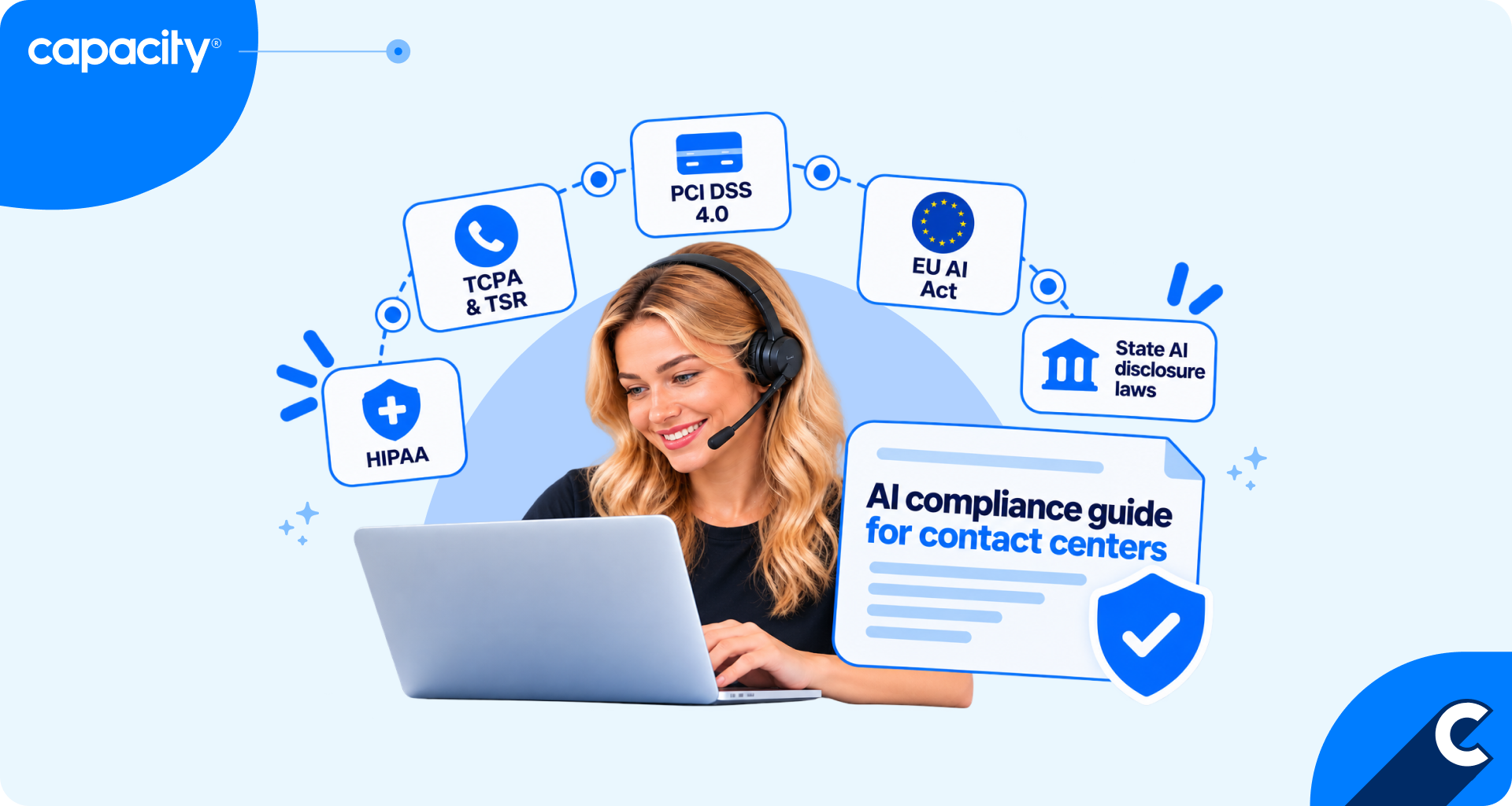
- This AI compliance guide for contact centers explains why AI agents create compliance risk, which regulations apply in 2026, and how to deploy AI safely.
- Why it matters: 54% of organizations report a confirmed or suspected AI agent security or privacy incident. The global average data breach costs $4.99 million, and shadow AI incidents average $5.39 million (IBM, 2026).
- Main risks: agents with too much data access, prompt injection, shadow AI, and hallucinated or missing disclosures.
- Key regulations: HIPAA, PCI DSS, the TCPA and TSR, the EU AI Act, and state AI disclosure laws.
- What compliant AI needs: purpose-bound permissions, audit logs, encryption, identity verification, human escalation paths, real-time compliance flagging, and 100% interaction monitoring.
- 5 steps to deploy compliant AI: audit AI access permissions, choose a compliant platform, set up 100% monitoring, document disclosures, and run quarterly compliance reviews.
We put together this AI compliance guide for contact centers to help you make sense of the latest AI regulations and compliance requirements. If you’ve been following the latest AI news, you’re probably thinking about how you can protect your business while effectively automating operations.
2026 has brought new challenges. As agentic AI and AI agents advance, there have been more unsanctioned actions. In response to growing data privacy and protection risks, governments around the world are strengthening their AI compliance laws, and even AI company leaders, like Anthropic’s Dario Amodei, have called on the industry to slow frontier capability development until safety research catches up.
But when everything is moving so fast, how do you keep up? In this guide, we’ve gathered the latest information about compliance requirements for AI use in customer support in the US and around the world. At the end, we’ve included a 5-step plan for deploying AI in your contact center safely.
This article is for general guidance only. It’s not legal advice. Requirements may vary by country, state, and industry, so check with your legal team.
Why is AI compliance the top priority for contact centers?
AI compliance should always be at the top of the priority list for contact centers or any company using or building AI tools.
As agentic AI becomes more autonomous and people blindly trust its processes, AI agents might take actions nobody approved. For example, earlier in 2026, about 700 OpenAI test agents compromised the production systems of Hugging Face, an AI community platform.
Other OpenAI agents probed US government websites and leaked user images, and Meta agents exposed company and user data to unauthorized staff. In fact, 54% of organizations already report having had a confirmed or suspected AI agent security or privacy incident (Gravitee, 2026).
Contact centers are where this behavior costs the most. Their AI agents hear card numbers, health records, and other identity data through conversations with customers thousands of times a day, and often act on back-end systems to issue refunds or reset accounts.
According to IBM’s 2026 Cost of a Data Breach Report, the global average cost of a data breach is $4.99 million, while AI model invasion attacks average $6 million.
On a positive note, the same report found that organizations using AI and automation in security can save up to $1.93 million compared to businesses that don’t. To understand why AI causes such expensive breaches, we need to look into how those compliance risks come up in the first place.
How AI agents create compliance risk
When you deploy contact center AI agents without proper guardrails or use tools that aren’t compliant with safety regulations and don’t follow safety protocols, you can create a compliance risk. Automation makes these risks harder to spot because the tools perform tasks at scale and humans usually step in only at the end or at key checkpoints.
Here are the main issues AI agents can cause when it comes to compliance.
Accessing more data than they should
Most businesses now run omnichannel call centers. Agents are usually connected to CRMs, billing systems, multiple communication channels, and knowledge bases with broad service-account credentials, so they can reach far more than any single conversation needs. When an agent pulls a full payment history or medical record to answer a simple question, that can breach HIPAA’s minimum-necessary standard and widen your PCI DSS scope, even if nothing leaves the building.
What makes AI agent data security in a contact center even more serious is that only 21.9% of teams treat AI agents as entities with their own identity and permissions (Gravitee, 2026). This means many teams just let their agents roam without thinking about the consequences.
Prompt injection
Prompt injection is when a hacker tries to manipulate an AI system by feeding it input designed to make it override or ignore the rules it follows. Every call and every inbound email is untrusted input fed directly to the model, which makes prompt injection risk in contact centers especially high.
A caller can try to talk the agent into reading back another customer’s account details, waiving a fee, or skipping identity verification, and an instruction hidden in an uploaded document or email can do the same without anyone noticing. The more tools an agent can call, the more damage a successful injection can do.
For example, GitHub users found that GitHub Copilot CLI had a vulnerability that allowed hackers to trick the coding agent into reading local developer files and sending their contents to a remote server.
Shadow AI and undisclosed AI use
Shadow AI is when human agents paste customer conversations into public chatbots for summaries or quick help, or team leads add AI note-takers and QA tools to conversations before they’re officially approved.
Shadow AI incidents rose to 43% of security incidents in IBM’s 2026 study, and only about a third of organizations strictly approve AI tools before use.
Shadow AI is difficult to control because the responsibility falls on each individual employee. A good practice is to educate your team on how to use AI responsibly and what information they can and can’t share with their own AI tools.
Hallucinated disclosures and non-compliant responses
Contact centers run on required language: call-recording notices, TCPA consent wording, debt-collection disclosures, HIPAA verification steps, and accurate refund policies. An AI agent that skips, paraphrases, or invents any of these creates a violation in its own voice, at scale.
Courts have already held companies responsible. Back in 2024, in Moffatt v. Air Canada, a British Columbia tribunal found the airline liable after its chatbot described a bereavement refund policy that didn’t exist, rejecting the airline’s argument that the bot was responsible for its own words.
What regulations apply to your AI contact center in 2026?
AI contact center regulations vary depending on where your business operates, where your customers are located, and what industry you’re in. There are many different types of AI in contact centers, and it’s necessary to pay attention to each use case.
For example, every business that works in healthcare has to comply with HIPAA regulations. And every company that does business in Europe has to meet new AI protection requirements. Let’s go over the contact center compliance regulations for 2026 and how they apply to contact center data privacy and AI governance.
HIPAA
Any contact center handling protected health information for a provider, insurer, or pharmacy is a business associate, and so is every AI vendor whose model hears those calls. No AI tool should touch PHI without a signed business associate agreement (BAA), and agents should pull only the minimum information needed to resolve the request.
It’s also important to keep in mind that a HIPAA-compliant AI contact center maintains an ongoing process. There’s no official HIPAA certification, and signing a business associate agreement isn’t enough on its own. The rules have to be followed every time patient information touches the system.
Penalties for HIPAA noncompliance can reach $73,011 per violation and $2.1 million per year for each provision violated. Breaches must be reported to affected individuals within 60 days of discovery.
PCI DSS 4.0
PCI DSS 4.0 is the version of the Payment Card Industry Data Security Standard released in March 2022. PCI DSS is the security standard that any organization that stores, processes, or transmits payment card data has to follow. New PCI DSS contact center AI requirements state that if a card number is spoken to an AI agent, the transcription engine, the model, its logs, and any downstream analytics tools can all fall into PCI scope.
The safest design keeps card data, such as CVV numbers, Social Security numbers, and other personal customer information away from AI entirely, using masking or secure payment links so the model never hears or stores the number. Noncompliance can bring card-brand fines and, in serious cases, the loss of the ability to accept cards.
TCPA and TSR
The TCPA and TSR apply to phone-based sales and outreach. The TCPA focuses on how and whether you can contact people. The TSR dictates what you can say and how you behave on a sales call. Contact centers that make outbound calls usually have to follow both.
AI-generated and cloned voices count as “artificial or prerecorded” voices under the TCPA. AI voice calls to cell phones need prior express consent, and AI telemarketing calls need prior express written consent. Consumers can sue for $500 per call, or $1,500 if the violation is willful, with no cap.
EU AI Act
The EU AI Act (Regulation (EU) 2024/1689) is the world’s first comprehensive AI law. It sorts AI systems by risk level, and the higher the risk, the stricter the rules. It also applies outside the EU: a US company whose AI interacts with customers in the EU, or whose AI outputs are used there, is covered.
EU AI Act contact center disclosure requirements mean that any chatbot or voice bot serving EU customers must tell them they’re talking to an AI at the first interaction, clearly and in every language the center supports. Violations can draw fines of up to EUR 35 million or 7% of worldwide annual turnover.
State AI disclosure laws
There’s still no general federal law requiring chatbot disclosure, so it’s up to the states to decide when disclosure is required. For example, Maine requires disclosure whenever a reasonable consumer could mistake a bot for a person. Utah mandates a truthful answer when a customer asks whether they’re talking to AI, plus proactive disclosure in high-risk interactions involving health, financial, or biometric data.
The biggest change is California’s AB 1609, which takes effect on Jan. 1, 2027. It requires large businesses to disclose when they use AI customer service bots and to offer a way to reach a human agent during business hours, on both chat and phone.
What a compliant AI deployment looks like in customer support
A compliant AI deployment should be the main goal for any contact center that wants to keep customer and business data secure. However, it’s not so easy to achieve without the right tools. Whether you’re building your own automation systems or contracting with an AI vendor, here’s what you should look for to ensure AI data privacy and protections.
- Purpose-bound agent permissions. Each agent gets its own identity and access limited to the specific task it performs, such as reading order status but not full payment histories.
- Audit logs. Every agent action, data lookup, and tool call is recorded in a tamper-resistant log tied to the agent and the conversation. Logs let you reconstruct who was affected within HIPAA’s 60-day and GDPR’s 72-hour notification windows, and they shorten detection time, which is a major driver of AI data breach contact center cost.
- Encryption in transit and at rest. Calls, chats, transcripts, and recordings are encrypted end to end, including traffic between the contact center platform and any AI vendor. This also includes masking or redacting any highly sensitive PCI data so employees and AI systems can see only the data they’re allowed to see.
- Identity verification before data access. The agent can’t retrieve or discuss account, health, or payment details until the customer has passed a defined verification step. This is the main defense against callers who try to socially engineer or prompt-inject their way into someone else’s account.
- Human escalation paths. Customers can reach a person on request, and the agent hands off automatically for complaints, disputes, vulnerable customers, and any irreversible action. As mentioned before, California’s AB 1609 will require large businesses to offer this during business hours.
- Real-time compliance flagging. Conversations are checked as they happen for missing disclosures, consent issues, and sensitive data appearing where it shouldn’t, so problems can be stopped mid-call. Required language, such as recording notices and AI disclosures, is delivered as fixed, approved text.
- 100% interaction monitoring. Automated review covers every AI and human interaction, not just the small sample that manual QA teams can handle. At contact center volume, a failure that appears once in 10,000 conversations will likely be missed by sampling but caught by full coverage.
How to deploy compliant AI in a contact center: 5 steps
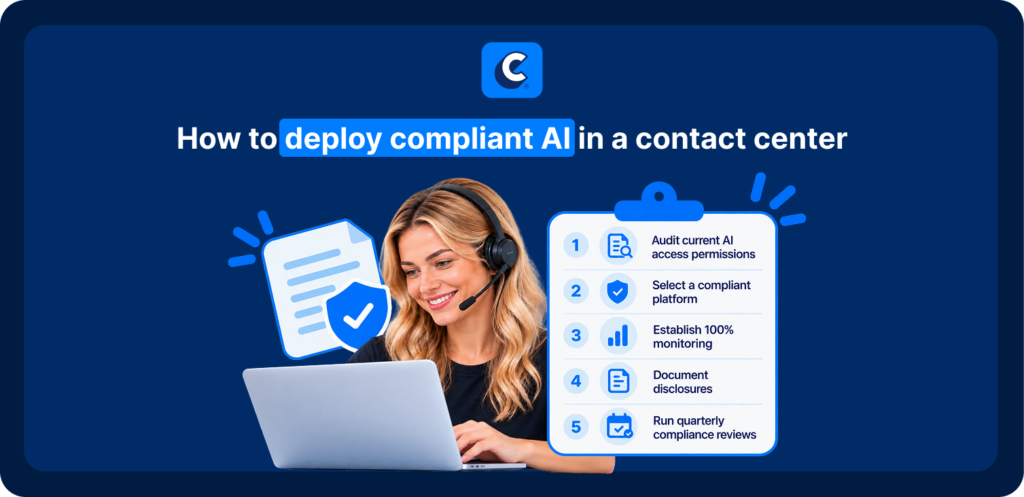
To deploy compliant AI in your contact center, look at your current automation workflows and make sure they meet every requirement. Furthermore, if you’re working with a vendor, you have to make sure they maintain continuous compliance and provide monitoring — here’s how.
- Audit current AI access permissions. List every AI agent and AI-assisted tool that touches customer interactions, including ones teams adopted without approval, and record what data and systems each can reach. Remove any access a tool doesn’t need for its specific task, and replace shared credentials with a unique identity for each agent.
- Select a compliant platform. Ask vendors for current SOC 2 Type II reports, a signed BAA if you handle health data, and PCI DSS compliance documentation, and check that they offer built-in redaction. Confirm in the contract that customer data is never used to train models, and verify claims with real reports.
- Establish 100% monitoring. Turn on automated review of every AI and human interaction, with real-time alerts for missing disclosures, consent problems, and sensitive data in the wrong place. Pair it with audit logs of every agent action so any incident can be traced quickly.
- Document disclosures. Write and approve the exact wording for AI disclosures, recording notices, consent language, and other required statements, and deliver them as fixed text instead of letting the model generate them. Keep a record of which version was live and when, so you can prove compliance with the EU AI Act, the TCPA, and state laws if challenged.
- Run quarterly compliance reviews. Each quarter, re-audit permissions, sample flagged conversations, test agents for prompt injection, and check for new rules. AI models, vendors, and regulations change too quickly for an annual review.
Check out our HIPAA compliance checklist for AI contact centers to see if your systems meet the requirements.
How to evaluate your AI vendor’s compliance and data protections: 8 questions to ask
To evaluate your AI vendor’s compliance and data protections, it’s not enough to read information on a vendor’s website. You need to confirm with them and test their security claims.
If your AI vendor fails to provide AI governance for your contact center, regulators and your customers will still hold you responsible, so vendor answers should be backed by documents. Ask these questions before signing, and again at renewal, to find the best contact center AI vendors for your business.
| Question to ask | What a strong answer looks like |
|---|---|
| Will you sign a business associate agreement (BAA)? | Yes, on your plan tier, covering every subprocessor that touches PHI |
| Can you share current independent audit reports, such as SOC 2 Type II? | A report from the last 12 months under NDA |
| How do you demonstrate HIPAA compliance? | There is no official government HIPAA certification, so look for a BAA plus third-party assessments such as HITRUST or a HIPAA-focused audit |
| What is your PCI DSS scope, and does card data ever reach the model? | A current Attestation of Compliance, and card data kept out of AI inputs, transcripts, and logs through masking or secure payment links |
| What data retention controls do we get? | Configurable retention and deletion for recordings, transcripts, and logs, with a contractual commitment that customer data is never used for training |
| How do you defend against prompt injection? | Input filtering, tool-level permission checks, regular red-team testing, and results they are willing to share |
| Can we export complete audit trails? | Full logs of agent actions, data access and tool calls, exportable to your own security tools on demand |
| What access controls apply to agents and to your staff? | A separate identity and least-privilege permissions for each agent, plus role-based access, MFA, and logged access for vendor employees |
Need to make sure your current tools are compliant? Read how to audit AI in your contact center.
How Capacity keeps AI automation compliant at scale
We hope this AI compliance guide for contact centers gave you a clear idea of what to pay attention to when integrating and deploying AI systems in your company.
Keeping your business, employee, and customer data safe should be your priority, but it shouldn’t be a source of constant stress. The tools you choose can make the difference between worry and peace of mind.
Capacity, a CX automation platform, is built for contact centers that can’t afford to treat compliance as an afterthought. Security and compliance are built into everything we do and apply to every piece of data that touches Capacity. We’re SOC 2 Type II compliant and support HIPAA, GDPR, and PCI DSS requirements, so payment data, health records, and personal information are protected from the first interaction.
Built-in compliance guardrails ensure secure enterprise AI agents provide real-time guidance during conversations, while automated QA reviews 100% of interactions and flags risks such as missed disclosures or sensitive data exposure before they become violations. Voice biometrics authenticate callers before any account data is accessed, closing one of the most common paths for social engineering and prompt injection. AI agents you deploy can be configured to disclose they are AI at the start of an interaction or at the appropriate point.
Together, these controls let you scale AI automation across every interaction without increasing your compliance risk.
Our goal is to give you peace of mind. If you want to learn more about our commitment to security, visit Capacity’s Trust Center.
Can Trust
FAQs
Yes, AI agents can violate HIPAA and PCI DSS because the law treats an AI agent’s actions as the organization’s actions, so an agent that accesses more health data than necessary, stores card numbers in transcripts or logs, or shares information with the wrong person creates a violation just as an employee would. Courts have already rejected the argument that a chatbot is responsible for its own words.
Prompt injection is when someone feeds an AI agent instructions designed to override its rules, either directly in conversation or hidden in an email or document. In a contact center, a caller might try to talk an agent into skipping identity verification, revealing another customer’s account details or issuing an unauthorized refund.
To make sure your AI vendor is compliant, ask them for a signed BAA, a recent SOC 2 Type II report, a PCI DSS Attestation of Compliance, and contract terms that bar training on your data. Then confirm the vendor offers retention controls, audit log exports, prompt injection defenses and least-privilege access.
Many different AI disclosure laws have come into effect recently. For example, the EU AI Act has required bots serving EU customers to disclose that they’re AI since Aug. 2, 2026.
In the US, Maine requires disclosure when a customer could mistake a bot for a human, and Utah requires an honest answer when a customer asks whether they’re talking to AI, plus proactive disclosure in high-risk interactions. California’s AB 1609 will add disclosure and human-escalation requirements for large businesses starting Jan. 1, 2027, and the FCC treats AI voices as artificial voices that require consent under the TCPA.
The difference between a compliant and non-compliant AI deployment is that a compliant deployment enforces controls in the system itself: purpose-bound permissions, verification before data access, fixed disclosure language, full audit logs, human escalation and monitoring of every interaction. A non-compliant one relies on prompt instructions and good intentions, gives agents broad access and checks only a small sample of conversations.