


 Customer Support
 HR & Ops
 IT Support
 Sales & Marketing
- A 6-step framework for evaluating contact center AI vendors includes AI capability depth, knowledge integrations, channel coverage, and more.
- Shortlisting providers involves mapping interactions, auditing your stack, setting scoring criteria, checking references, and running a time-boxed pilot before committing.
- Top contact center AI companies:
- Unified AI-native platforms: Capacity, Cresta
- CCaaS platforms with AI layered on: NICE CXone, Genesys Cloud CX, Five9
- Specialist point solutions: Balto, Observe.AI, PolyAI
| Category | Vendor | Key Features |
|---|---|---|
| Unified AI-native platforms | ||
| Capacity | AI Knowledge Orchestration Layer, AI virtual agents, real-time agent assist, auto-QA, outbound automation | |
| Cresta | Real-time agent coaching, generative AI agents, conversation intelligence, behavioral insights dashboards | |
| CCaaS vendors with AI | ||
| NICE CXone | AI-powered WFM, omnichannel routing, compliance-aware automation, outbound campaign automation | |
| Genesys Cloud CX | Agentic Copilot and Virtual Agents, journey management, empathy detection, native MCP/A2A interoperability | |
| Five9 | Real-time transcription and summarization, in-call guidance, intelligent virtual agents, proprietary AI model tuning | |
| Specialist / point solutions | ||
| Balto | Live call guidance, automated compliance monitoring, 100%-of-calls AI scoring, CRM-synced call notes | |
| Observe.AI | Auto QA on 100% of interactions, real-time agent assist, VoiceAI agents, sentiment and coaching analytics | |
| PolyAI | Natural multi-turn voice conversations, support across many languages, end-to-end call resolution, live-agent handoff | |
The right contact center AI vendors can help you scale your business without going over your operational budget, improve customer experience, assist your team, and gain better insights into how your business is doing.
It’s a smart investment in your contact center: with every dollar invested in AI, companies see an average of $3.5 in return, and the top 5% of organizations average as much as $8. (Microsoft, 2023).
However, different types of contact center AI serve different purposes. That’s what this contact center AI buyer’s guide will help you figure out and answer the question: which contact center AI software is best for your unique business needs?
Keep reading to learn:
- Why most contact centers end up with too many vendors
- 6 steps to evaluate contact center AI sellers to find the one that fits
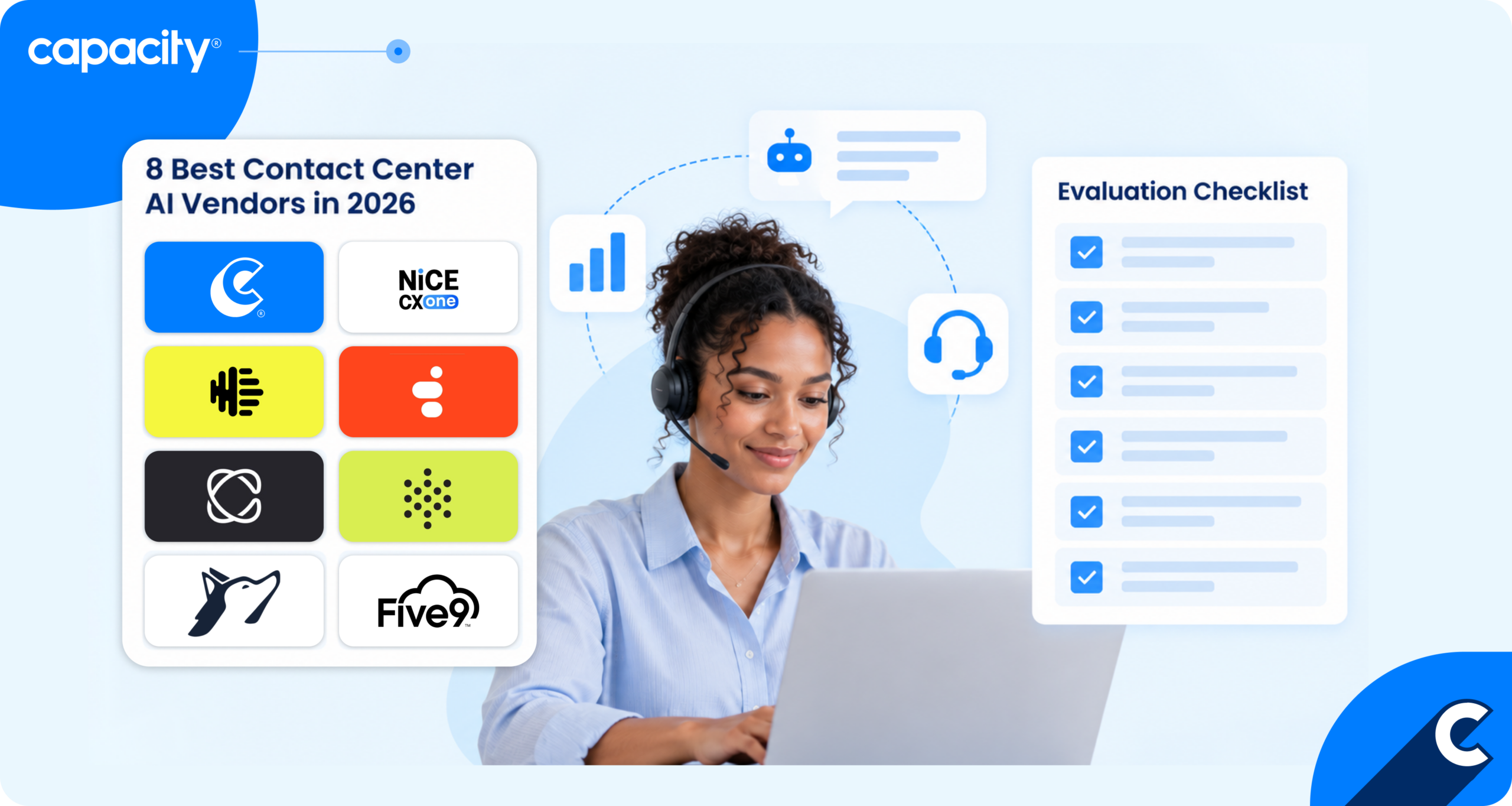
- 8 Best contact center AI vendors in 2026 for each category
- How to build your contact center AI vendor shortlist
What counts as a contact center AI vendor?
A contact center AI vendor is any company selling software that applies AI contact center technology to the core work of a customer contact center: routing, answering, coaching, or summarizing customer interactions. This can include features like speech/text analytics, generative or conversational AI, automation, or real-time guidance.
However, there are many different types of contact center AI, and the categories matter when you’re evaluating business tools.
Here are the most common types of AI-focused contact center platforms:
- Full-stack CCaaS (Contact Center as a Service) platforms with AI layered on top, like Genesys and NICE. These companies built their business on the underlying infrastructure and have since bolted on AI copilots, summarization, and bots as feature add-ons to an existing suite.
- AI-native contact center platforms, like Capacity or Cresta, are architected around AI from the start. AI is the core product, not an add-on.
- The third type is point solution vendors that solve one problem within the contact center stack. For example, many contact centers choose Balto AI for real-time agent guidance during calls, or PolyAI for voice AI/IVR automation.
Why most contact centers end up with too many vendors
Most contact centers, perhaps even yours, eventually accumulate too many vendors and tools. When you see a new shiny demo or someone bragging on LinkedIn about how a platform helped them slash costs, you might want to also try it.
Each decision is individually rational, but the cumulative effect is a patchwork where every tool has to be trained, integrated, and monitored separately. You end up with countless contracts, separate support relationships, and different roadmaps that may or may not align.
On a deeper level, you’re losing data. When every point solution owns its own slice of customer interactions, that data stays siloed. That’s how you get a real-time guidance tool that doesn’t learn from what the voice bot is seeing, and the QA tool can’t feed insights back into automation.
So how do you connect your contact center operations without losing useful features? Unified automation platforms that offer a single AI layer are the way to go. They embed AI systems and integrate with your tools to connect scattered data and use it to power your communication channels, agent support, quality monitoring, analytics, and more.
This way you get one source of truth and easy control over everything in your organization. For example, Capacity offers an AI Knowledge Orchestration Layer, which learns from interaction data across channels and use cases. That’s the difference between “we have a lot of AI tools” and “our AI actually gets better every quarter.”
How do you evaluate contact center AI vendors? 6 steps to follow
Knowing a platform’s AI capability, channel coverage, security level, and other features helps you evaluate a vendor and pick one you can trust long-term. Below, we gathered 6 steps to find the right fit and questions to ask so you know what you’re getting.
1. AI capability depth
AI capability depth means that the vendor you pick offers features that can autonomously resolve interactions end-to-end, assist human agents, and cover post-interaction work.
According to a Forrester study, 59% of managers notice an increase in customer retention and lifetime value when their human agents have the right AI tools.
Vendors often lead with impressive demos, so push past the pitch to real numbers on what the AI closes out on its own.
Questions to ask: What percentage of interactions does contact center AI software resolve end-to-end without human involvement? What’s the escalation rate, and what triggers a handoff to a live agent? Can you see resolution rates broken out by channel or use case, not just a blended average?
2. Knowledge integrations
An AI tool is only as good as the knowledge it can draw on, so the ability to connect to and stay synced with existing knowledge bases, help centers, and internal docs is critical. Stale or fragmented knowledge is one of the most common reasons deployed AI underperforms.
Questions to ask: Which knowledge sources and systems do you integrate with out of the box? How does the AI handle conflicting or outdated information across sources, and how often does it resync?
3. Channel coverage
Customers reach out across voice, chat, email, and SMS, so it matters whether a vendor’s AI performs consistently across all of them or is strong in only one. Some vendors are voice-first and treat digital channels as an afterthought, or vice versa.
Questions to ask: Which channels is your AI natively built for versus bolted on later? Does the resolution rate hold steady across channels, or does it drop outside your strongest one?
4. Auto QA and conversation intelligence
Beyond handling interactions, a strong platform should automatically review 100% of conversations for quality, compliance, and coaching insights. This is also where a unified platform has an edge, because conversation intelligence analyzes and understands conversations with customers to come up with the right tone and answer, as well as “feeds” this information into the learning loop to improve the overall performance and results of the system.
Questions to ask: Do you score 100% of interactions or a sample? Can QA findings automatically inform agent coaching or update the AI’s own behavior over time?
5. Security and compliance
Contact centers handle sensitive customer data, so certifications, data handling practices, and industry-specific compliance (HIPAA, PCI, SOC 2) need to be verified. This is especially important for any vendor with access to full conversation transcripts.
Questions to ask: What compliance certifications do you hold, and can you share recent audit results? Where is customer data stored and processed, and who has access to it?
6. Time-to-value
Sophisticated AI is only useful if it can get implemented and start delivering results in a reasonable timeframe. Some platforms require months of custom integration work before showing any impact.
Questions to ask: What’s the typical timeline from contract signature to live deployment? What does the implementation process require from our team, and can you share a reference customer’s actual timeline?
What are the best contact center AI vendors in 2026? 3 categories compared
The best contact center AI platforms are the ones that can help you target as many different issues with one tool, saving costs and driving revenue. In this list, we gathered the top 8 contact center AI companies in 2026 based on the AI services they offer: unified AI-native platforms, CCaaS vendors with AI features and point solution vendors.
Take a look at the AI contact center comparison to evaluate their features, functionality, and other details to help you find the right ones for your business.
Unified AI-native platforms
1. Capacity
Capacity is a contact center AI platform that unifies IVAs, enterprise search, voice AI, real-time agent assist, auto QA, and workflow automation on a single shared knowledge layer. Its agentic AI for contact centers is built to solve the fragmentation problem we described earlier. The platform’s design means contact centers don’t need four or five disconnected contact center software vendors to fully automate their operations. With just one tool, you can cut average handle time while lifting deflection rates.
Its AI agents handle FAQs and routine inquiries across voice, email, chat, and messaging, while real-time agent assist surfaces suggestions and knowledge to agents mid-conversation. Every detail that passes through them then goes back to the AI Knowledge Orchestration Layer, where auto QA and conversation intelligence assess 100% of interactions and use their insights to optimize the learning loop.
Key features: unified knowledge layer across channels, AI virtual agents, real-time agent assist, auto-QA, outbound automation
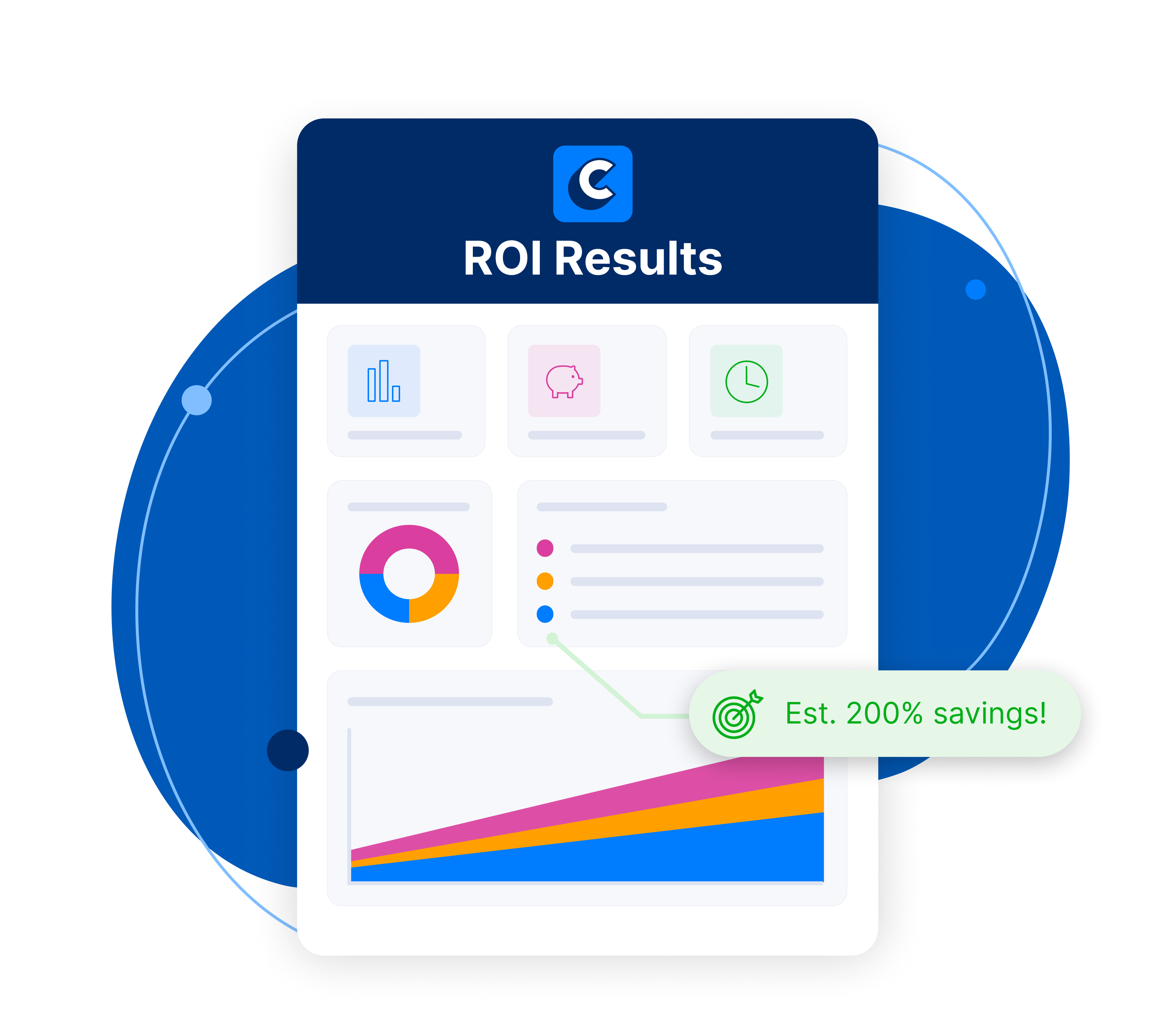
Most contact centers can reach $2M–$5M+ in annual savings. Check our ROI calculator to see how much you can save with unified automation.
2. Cresta
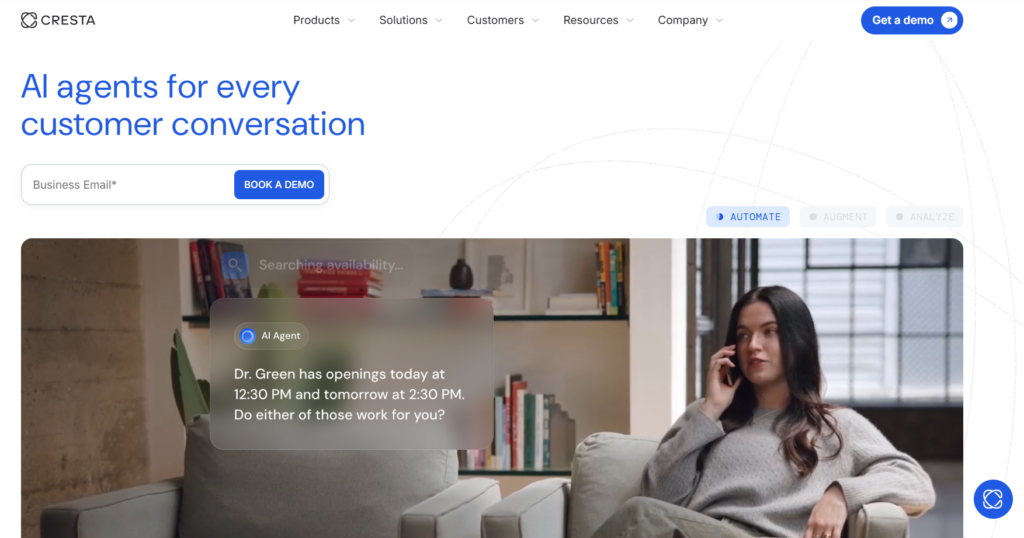
Cresta was founded by AI researchers with deep roots in Stanford’s AI lab and Google’s Contact Center AI team, and it’s built its reputation on generative AI that pairs human and AI agents. The platform combines AI and human intelligence to help contact centers surface customer insights and behavioral best practices, automate conversations and inefficient processes, and help every team member work smarter and faster.
It can analyze all telephone calls and surface insights easily to help contact centers make strategic decisions.
Key features: real-time agent coaching, generative AI agents, conversation intelligence, behavioral insights dashboards, task-optimized models trained on customer-specific data
CCaaS vendors with AI
3. NICE CXone
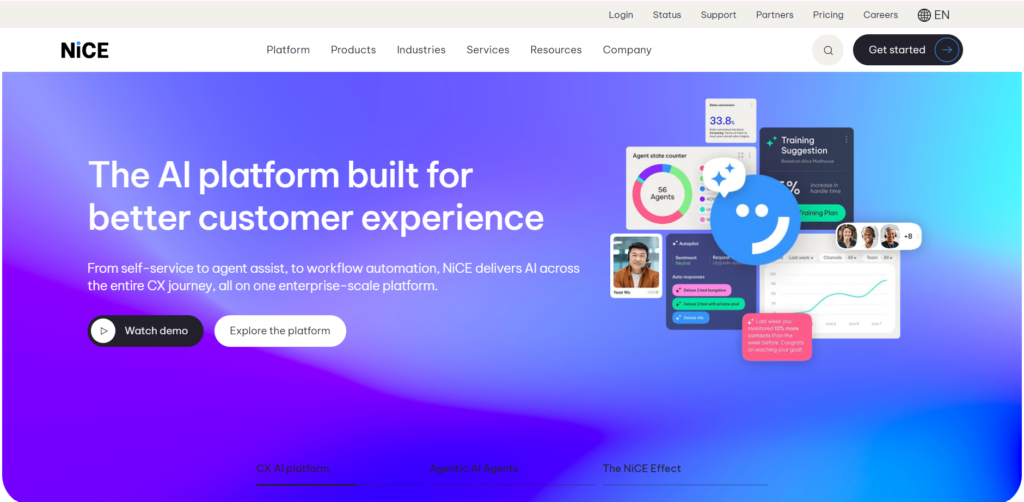
NICE CXone takes the opposite architectural approach from Capacity and Cresta. It starts from a mature, full-scale CCaaS foundation and layers AI on top. Its scope spans omnichannel engagement, routing, workforce management, quality management, analytics, automation, and AI-assisted service operations, with AI-powered forecasting, scheduling, adherence, and intraday workforce management built in.
Key features: AI-powered WFM, omnichannel routing, compliance-aware automation, outbound campaign automation
4. Genesys Cloud CX
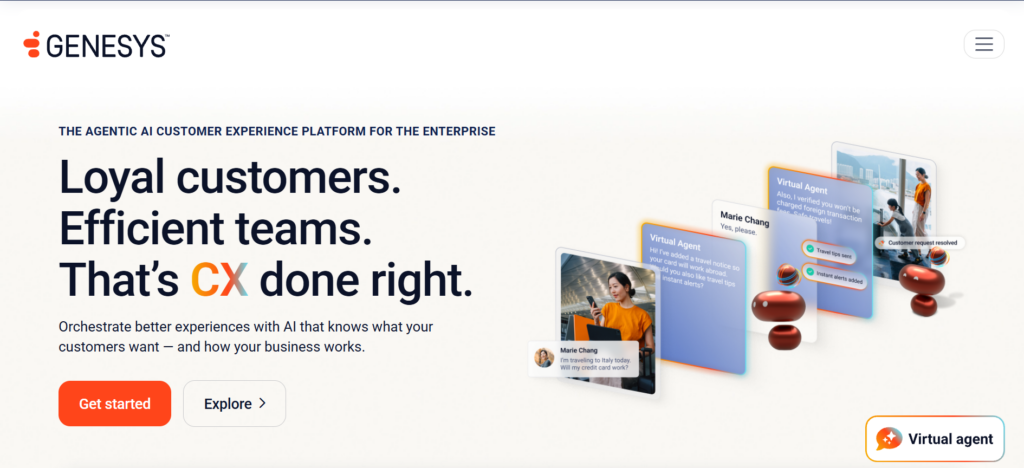
Genesys Cloud CX is the other major full-stack platform, and it’s been pushing hard into “agentic” AI over the past year. New agentic Genesys Cloud Copilot and Virtual Agent capabilities provide greater autonomy and native agent-to-agent and MCP interoperability to accelerate AI orchestration, alongside enhanced Work Automation and new Associate capabilities for agentic CX workflows.
Key features: agentic Copilot and Virtual Agents, journey management, empathy detection, native MCP/A2A interoperability, workforce engagement management
5. Five9
Five9 rounds out this category with a cloud contact center platform built around Agent Assist and virtual agent capabilities layered on core telephony and routing infrastructure. Five9 Agent Assist provides contact center agents with real-time transcripts, call summaries, guidance, and reminders, using real-time speech recognition and natural language processing to analyze calls as they happen. It’s a solid fit for mid-sized to large operations that want AI-assisted agent workflows without a heavy CCaaS migration.
Key features: real-time transcription and summarization, in-call guidance, intelligent virtual agents, proprietary AI model tuning
Specialist and point solution vendors
6. Balto AI
Balto AI focuses on real-time guidance and coaching for agents, live and mid-call. It gives agents real-time prompts with the answers and resources they need live in conversations, automatically summarizes calls into notes, and scores calls so QA teams can focus on exceptions and disputes.
It’s used across insurance, financial services, healthcare, home improvement, collections, retail, and BPO, where compliance and sales conversion are top priorities. If you’re looking for more features in one tool, check these Balto AI competitors.
Key features: live call guidance, automated compliance monitoring, 100%-of-calls AI scoring, CRM-synced call notes, coaching workflows
7. Observe.AI
Observe.AI specializes in conversation intelligence and automated quality assurance, aiming to replace the old model of sampling a handful of calls for QA. Its suite of AI Copilots guides agents in real time with prompts and next-best actions, automatically generates post-call summaries to cut after-call work, and its Auto QA evaluates interactions for accuracy and compliance, while a Coaching Copilot turns those insights into personalized coaching. It’s a great tool for conversational intelligence, but if you’re in for more features, take a look at Observe.AI alternatives.
Key features: Auto QA on 100% of interactions, real-time agent assist, VoiceAI agents, sentiment and coaching analytics, contact center-tuned LLM
8. PolyAI

PolyAI is the voice AI specialist on this list, focused on natural-sounding, customer-led phone conversations. Its voice AI holds sophisticated multi-turn conversations optimized for understanding callers regardless of accent, slang, or off-topic digressions, and supports many languages with rapid multi-language deployment.
While PolyAI focuses on voice automation, don’t miss other apps like PolyAI with features for voice and text interactions.
Key features: natural multi-turn voice conversations, 45+ language support, end-to-end call resolution, seamless live-agent handoff with context, deep telephony/CCaaS integrations
How to build your contact center AI vendor shortlist
To build your contact center AI vendor shortlist, you should get clear on what you need in the first place. Seeing your competitors integrate new contact center AI solutions or watching new promising demos can make you buy tools you don’t actually need. So we recommend starting by mapping your customer interactions, auditing your current stack, and only then contacting potential contact center software vendors and evaluating them — here’s how.
- Map interaction types by volume and complexity. Break down your inbound and outbound volume by category, then sort each one into what’s AI-ready. The first tasks to hand off to automation are usually repetitive, closed-loop tasks such as password resets or appointment scheduling. This mapping becomes your requirements doc. It tells you which vendors’ actual strengths match your needs.
- Inventory your current stack and use it as your integration checklist. List every system a new AI tool would need to integrate with: your CCaaS platform, CRM, knowledge base, WFM tool, and any other solutions. If a vendor can’t confirm a native integration with your CRM or telephony provider, that’s a real cost (custom development, delays, or a permanent workaround) you need priced in before you shortlist them.
- Set scoring criteria upfront, before you see a single demo. Decide which dimensions matter most to your organization, whether that’s a resolution rate, security certifications, time-to-value, channel coverage, or cost. Assign priority to each before any vendor pitches you. A pre-built scorecard keeps every vendor being judged against the same bar.
- Request a reference customer call or watch a live webinar. Case studies are marketing documents, curated to show the vendor’s best outcome. A reference call lets you ask questions a case study will never answer. A live webinar or product walkthrough also shows you real usage patterns.
- Run a time-boxed pilot before committing to full deployment. Pick a narrow, well-defined slice of interactions and test the vendor’s actual performance against your own data for a set period, typically 30 to 60 days. This is the only way to validate resolution rates, escalation behavior, and integration stability outside of a sales environment, and it gives you leverage to negotiate contract terms based on real results.
Why Capacity contact center AI is built differently
Capacity is built differently because it treats knowledge as infrastructure and as the key for every other connected tool and channel. Most contact center AI vendors ask you to solve the same problem over and over: train the voice bot on your policies, then train the chat bot, then the agent-assist tool, and repeat every time something changes.
At the center of Capacity’s CX Automation platform is an AI Knowledge Orchestration Layer that integrates knowledge with CCaaS, specialist tools, and other systems you use to get and process information. It integrates once and makes it available across the entire customer journey, from the first self-service chat on your website to agent assist during a live call, 100% auto QA coverage after the fact, and outbound campaigns reaching back out.
That architecture is also what makes the system self-sustaining. The AI Knowledge Orchestration Layer optimizes itself and gets smarter with every new document and customer interaction, so accuracy compounds over time.
Find the right contact center AI vendor for your operation
A 2021 report by SnapLogic revealed that 81% of employees believe AI improves their overall performance at work.
Finding the right contact center AI vendor takes time, but it’s worth it for your team and your business. Otherwise, the scenario repeats: you get one-off tools and end up with even more scattered information and an invoice at the end of the month you didn’t foresee. The best contact center AI vendor is the one that reduces fragmentation, integrates cleanly, and shows real ROI.
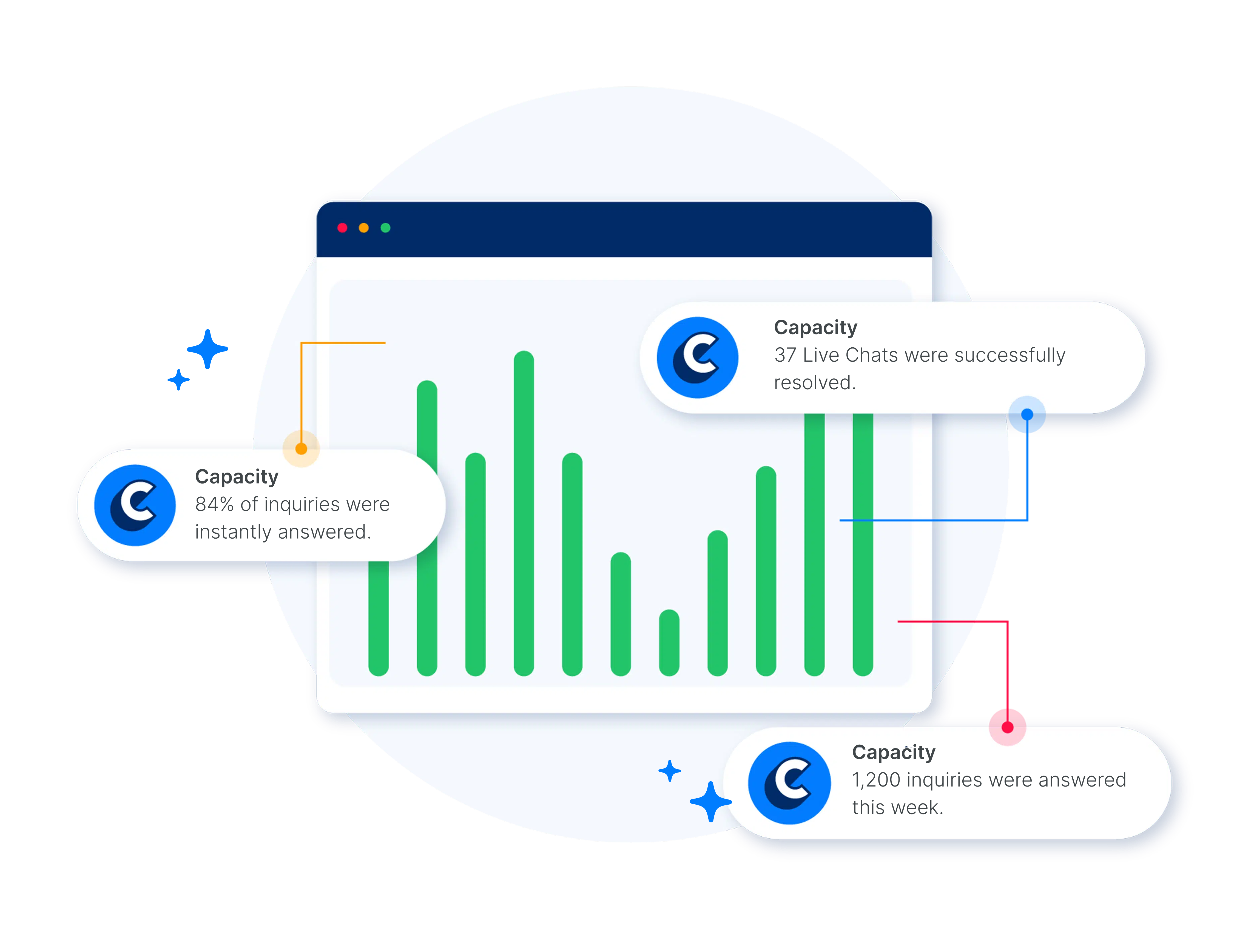
Capacity is built for this exact thing: to focus on results across as many touchpoints as possible. Its agentic nature lets Capacity resolve interactions end-to-end. That’s why our customers see around 90% deflection across chat and over 50% across voice and SMS.
It’s one platform designed to replace the scattered stack of point tools most contact centers end up with, unifying everything under one roof. If you’re ready to say goodbye to confusion and data that leads to dead ends, try automation that solves problems.
center into a
true revenue driver
FAQs
When you’re choosing a contact center AI vendor, look at their AI capability depth, how well it integrates with your existing knowledge sources, coverage across your real channel mix, whether QA runs on 100% of interactions or just a sample, security certifications, and how fast you can realistically get to value.
The difference between CCaaS vendors and contact center AI vendors is that CCaaS vendors provide the underlying infrastructure, with AI often added on as a feature layer. Contact center AI vendors are narrower or more AI-native: some are unified platforms built around AI from the ground up, others are point solutions solving one specific problem.
How contact center AI vendors handle data security and compliance varies significantly by vendor, so it shouldn’t be assumed. Ask directly about certifications (SOC 2, HIPAA, PCI, etc.), where data is stored and processed, who has access to conversation transcripts, and how recent their audit results are.
The strongest vendors tend to have high autonomous resolution rates, knowledge that stays synced and consistent across every channel rather than siloed per tool, QA that covers 100% of interactions instead of a sample, and a fast path from contract to live deployment.