


 Customer Support
 HR & Ops
 IT Support
 Sales & Marketing

- Healthcare call center software helps clinics, hospitals, insurers, and medical billing teams automate patient support, cut costs, improve the patient experience, and stay HIPAA compliant.
- We compared 11 tools, including Capacity, Talkdesk, and Genesys, on features, pros and cons, and ratings.
- Must-have features include a signed BAA, deep EHR/EMR integration, AI-powered patient self-service, omnichannel support, built-in identity verification, 100% auto QA, healthcare KPI dashboards, and flexible scaling.
- To choose the right fit, define your top call drivers, confirm BAA coverage, check EHR integration depth, pilot one high-volume workflow, then optimize and scale.
Healthcare call center software is a tool your contact center needs if you want to grow revenue, cut costs, help your team work more efficiently, and improve the patient experience. Platforms like Capacity, Talkdesk, Genesys, and others help healthcare call centers, clinics, hospitals, insurance providers, medical billing companies, and other healthcare organizations automate support at scale while keeping call center patient experience and security as top priorities.
With advancements in AI healthcare automation and compliance, the healthcare contact center solutions market is estimated to reach USD 65.0 billion by 2035 (Future Market Insights, 2025).
If you’ve noticed your team is struggling to handle a growing number of patient inquiries, scheduling is becoming inefficient, or you want to avoid coding errors, the right healthcare call center software can help. And in this guide, we’ll help you learn everything you need to know about healthcare support automation.
Keep reading to explore:
- Key features to prioritize when looking for medical call center software
- Top 11 platforms not to miss in 2026 and 2027
- A checklist to help you find the right call center software for hospitals
What to look for when evaluating healthcare call center software: 8 features not to miss
Every healthcare call center is different, but the best healthcare call center software should offer features like HIPAA compliance and security certifications, EHR/EMR integrations, efficient patient self-service, omnichannel support, and more. Let’s go over 8 features to help you get a better idea of what to look for.
- HIPAA compliance and BAA availability: The vendor you choose to work with should sign a Business Associate Agreement (BAA) and show safeguards like encryption in transit and at rest, access controls, and audit logs. Without a BAA, any platform that handles protected health information puts your organization at legal and financial risk. Failing to comply with HIPAA can result in fines of $50,000 or more per violation.
- EHR/EMR integration depth: Look for real bidirectional integration with systems like Epic, Cerner, or athenahealth. Agents should be able to view schedules, update records, and book appointments without switching between applications.
- AI-powered patient self-service: Voice and chat assistants should handle routine tasks such as appointment scheduling, prescription refill requests, billing and collections around the clock. This cuts hold times and frees agents to focus on complex or sensitive calls. The 2026 Philips Future Health Index global report found that 50% of healthcare professionals can see more patients by using AI in their work. Patient access call center software gives people a convenient and fast way to book and manage appointments, make payments, check their prescription information, and more.
- Omnichannel call center support: Patients expect to reach you by phone, SMS, email, web chat, and patient portal, with context carried across every channel. Unified AI tools for patient support keep patients from repeating themselves when they switch from one channel to another.
- Authentication and identity verification: Built-in verification, such as knowledge-based questions, one-time passcodes, or voice biometrics, confirms a caller’s identity before PHI is discussed. Automating this step protects privacy and cuts time off every call.
- Post-call auto QA for compliance monitoring: AI-driven quality assurance should review 100% of interactions for required disclosures, HIPAA adherence, and script compliance. This surfaces risks and coaching opportunities much faster.
- Reporting dashboards with healthcare KPIs: Dashboards should track key healthcare metrics, like appointment conversion, no-show rate, first-call resolution, abandonment rate, and average speed to answer. Real-time and historical views help leaders staff appropriately and prove ROI. Because AI-powered automation cuts down on admin work, 47% of healthcare workers work less overtime with the right tools (Philips, 2026).
- Scalability to match rising or falling demand: Cloud-based platforms should let you add or remove agent seats quickly during flu season, open enrollment, or public health events. Flexible licensing ensures you only pay for the capacity you actually use.
The 11 best healthcare call center software tools in 2027
The best healthcare call center software is the one that can help you automate as many patient support tasks as possible while cutting costs and driving additional revenue. We’ve gathered 11 HIPAA-compliant contact center software tools and compared their features, pros and cons, and ratings. Each one offers unique features, so make sure the one you choose checks all your boxes.
1. Capacity
Best for omnichannel AI-powered patient self-service and HIPAA-compliant live agent guidance
Capacity takes a unified approach to contact center automation. It connects knowledge, data, and systems into a single AI Knowledge Orchestration Layer that drives AI agents, real-time agent assist, auto QA, and conversation intelligence.
For healthcare teams, that means AI agents handle scheduling, patient authentication, billing, collections, claim verification, and FAQs to reduce inbound calls and free up staff for critical cases, while live agents get guidance pulled from the same source of truth. Capacity prioritizes data safety and offers SOC 2 Type II and HIPAA compliance, covering authentication, data handling, and payment processing. For organizations that store, process, or transmit credit card data, Capacity redacts and masks highly sensitive data such as card numbers, CVV, Social Security numbers, and dates of birth in recordings, transcripts, and logs.
Useful features for healthcare call centers:
- AI agents across healthcare chatbots, voice, SMS, and email, all trained once on a shared knowledge layer. Patients get consistent answers whether they call, text, or chat, and your team only has to update information in one place.
- Voice authentication and secure identity verification before PHI is discussed. Automating identity checks protects patient privacy and removes a repetitive step from every agent-handled call.
- Automation for prescription refills, equipment requests, and payments. AI agents complete high-volume transactions end to end, shortening call queues and giving patients a fast way to get routine tasks done at any hour.
- Intent detection routes urgent cases to live agents while handling routine requests autonomously. Patients with time-sensitive needs reach a human quickly, while simple inquiries are resolved without ever entering the agent queue. All of this is achieved with conversational healthcare AI that can carry a natural conversation across 30 languages.
- Real-time agent assist with knowledge lookup, plus 100% auto QA and auto-generated call summaries. Agent assist works by providing agents with accurate answers mid-call and enabling supervisors to review every interaction for compliance.
- Proactive outbound campaigns over WhatsApp, SMS, and voice. Automated outreach for appointment reminders, follow-ups, billing and collections, and care gap notifications helps reduce no-shows and keeps patients engaged between visits.
- Integrations with EHR, practice management, and contact center platforms. Connecting to the systems your team already uses gives AI agents and staff real-time access to patient data and lets Capacity layer onto your existing infrastructure without a full replacement.
Pros:
- One platform covers self-service, agent assist, and post-call QA, so insights flow between them
- Voice agents can run alongside existing contact center infrastructure without a full rebuild
- Full conversation context transfers to a human when the AI can’t resolve an issue
Cons:
- It’s not a full healthcare CCaaS platform, so some teams will still need a separate telephony vendor
User rating: 4.7/5 (G2), 4.5 (Capterra)
Can Verify
2. Talkdesk
Best for EHR-integrated workflows and clinical routing
Talkdesk was early to build a contact center specifically for healthcare, and its Epic ties run deep. Talkdesk Healthcare Experience Cloud for Providers connects directly to Epic through public and private APIs, embedding AI, persistent call controls, and agent tools inside Epic Cheers. It uses the HL7 FHIR standard and private APIs for a pre-built, Epic-validated integration that doesn’t require middleware.
On the automation side, Talkdesk Customer Experience Automation orchestrates multiple AI agents that work together to automate entire patient journeys.
Useful features for healthcare call centers:
- Autopilot for Healthcare voice bots that handle scheduling, services, and payments through Epic workflows
- Talkdesk Copilot embedded directly in Epic Cheers for real-time AI assistance
- Advanced Dialer integration that connects Epic work queues and Cheers outreach campaigns for automated patient outreach
- Automatic handoff of conversation context from AI agents to staff during escalations
- Click-to-call from within Epic and synchronized patient identification
- Agent Workspace that unifies EHR and CRM data in one view
Pros:
- Out-of-the-box workflows help providers reach value without building from scratch
- Supports patient access, revenue cycle, and patient services use cases in one platform
Cons:
- Healthcare pricing can be steep
- Its deepest integration work centers on Epic, so other EHR environments may get less functionality
User rating: 4.4/5 (G2), 4.5 (Capterra)
3. NiCE CXone
Best for large enterprise health systems already in the NiCE ecosystem
NiCE CXone is an enterprise-scale CCaaS platform that recently made a significant push into healthcare. NiCE offers integration between CXone and Epic EHR that brings patient records and communications into a single AI-powered interface. For automation, the company calls the NiCE-Cognigy integration central to its strategy and expects it to expand capabilities over time.
Useful features for healthcare call centers:
- Omnichannel patient interactions across voice, chat, SMS, WhatsApp, and social
- CXone Copilot and AutoSummary for contextual agent guidance and automated summaries
- Secure call recording and transcription in workflows built to support compliance requirements
- AI-powered routing, summarization, and quality management tools
- Listing in Epic Showroom under Toolbox integrations
Pros:
- Broad workforce engagement and analytics suite for organizations already standardized on NiCE
- Native Epic integration replaces the third-party connectors many customers previously relied on
Cons:
- Its healthcare-specific depth is still maturing
- Deployment can take weeks to months
User rating: 4.3/5 (G2), 4.2 (Capterra)
4. Genesys Cloud CX
Best for complex, multi-site health systems
Genesys Cloud CX is built for scale and orchestration across many departments and locations. Its call center software for hospitals, Health CX, automates routine patient engagement tasks like appointment scheduling, billing, and outreach while embedding call controls directly within Epic.
Genesys is also moving deeper into agentic AI. Genesys Cloud is moving toward an agentic orchestration platform that coordinates work across AI agents, human employees, and back-end systems on a single customer journey.
Useful features for healthcare call centers:
- Epic integration supporting patient access, referrals, triage, and more
- Auto-summarization to cut after-call work and standardize data capture
- Epic-enabled virtual agents and enhanced IVR for caller self-service
- Agentic virtual agents powered by large action models from Scaled Cognition
- Agent Copilot, Virtual Agents, and Knowledge Workbench for AI-driven knowledge
- AI Studio and AI-powered workforce optimization
Pros:
- Supports HIPAA and HITRUST requirements with in-region call recording storage for data residency
- Strong orchestration and routing for health systems with many sites and service lines
Cons:
- Configuration complexity typically requires dedicated admin resources
- Enterprise pricing and AI add-ons can be costly for smaller organizations
User rating: 4.4/5 (G2), 4.3 (Capterra)
5. RingCentral RingCX
Best for communications with HIPAA-compliant workflows
RingCX is RingCentral’s AI-first contact center, and it’s an appealing option for healthcare organizations that want phone, contact center, and AI under one roof. It bundles voice and more than 20 digital channels under a single license. Its newest automation layer is AIR Pro, an agentic, voice-first AI platform, with healthcare as its first industry accelerator and pre-built templated workflows.
Useful features for healthcare call centers:
- 24/7 AI scheduling, patient question handling, and routing of urgent callers
- AIR Pro agents that resolve multi-step interactions, automate outbound outreach, and hand off to live agents with context
- Real-time AI agent assist and AI quality management on the Professional tier
- AI supervisor assist, interaction analytics, and workforce management on the Elite tier
- HIPAA-secure telehealth video with automated clinical documentation
Pros:
- Holds HITRUST, SOC 2, and GDPR certifications with 99.999% availability
- Health data is never used to train AI models
Cons:
- Its healthcare focus isn’t very deep
- AI agent usage is billed separately on consumption, and key AI features sit in higher tiers
User rating: 4.1/5 (G2)
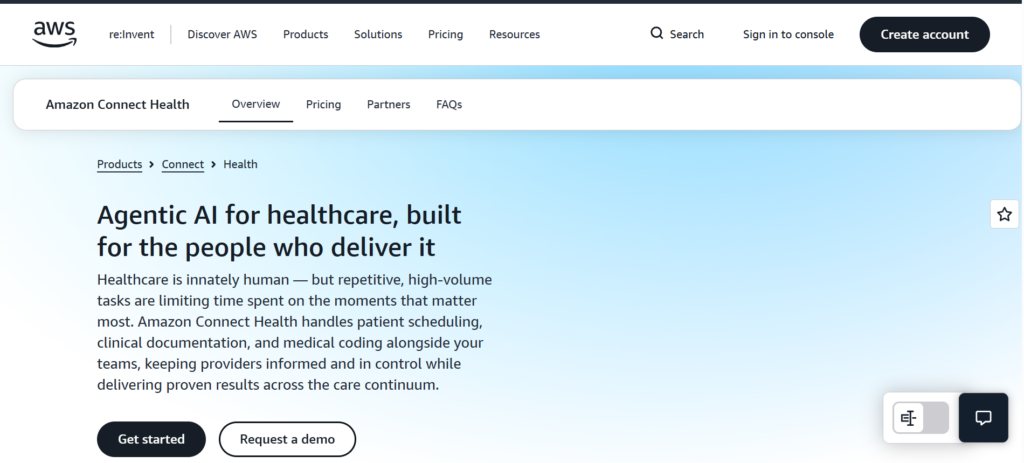
6. Amazon Connect Health
Best for AWS-native health systems with engineering resources
Amazon Connect Health is AWS’s first healthcare offering. It’s a HIPAA-eligible agentic solution that handles tasks across patient engagement, point of care, and revenue cycle alongside healthcare teams.
It automates patient verification, appointment scheduling, documentation, and medical coding. AWS says it uses supervised fine-tuning and reinforcement learning on healthcare-specific data sets and guidelines, and the AI can recognize when a situation needs a human and escalate to staff.
Useful features for healthcare call centers:
- Patient engagement agents and a unified patient profile within the Amazon Connect Agent Workspace
- Visit-specific insights including patient summaries, health events since the last visit, and HCC recapture
- Medical code suggestions for billing
- A dedicated app in the Epic App Market
- Option to link to an existing Amazon Connect instance, or have setup create one for you
Pros:
- AWS says deployment takes days instead of months with native EHR and Amazon Connect integrations
- Inherits AWS’s elastic scale for seasonal spikes
Cons:
- EHR compatibility is currently limited to Epic, and patient engagement capabilities support English only
- Getting the most from it requires AWS expertise and ownership of the build
User rating: 4.4/5 (G2), 4.5 (Capterra)
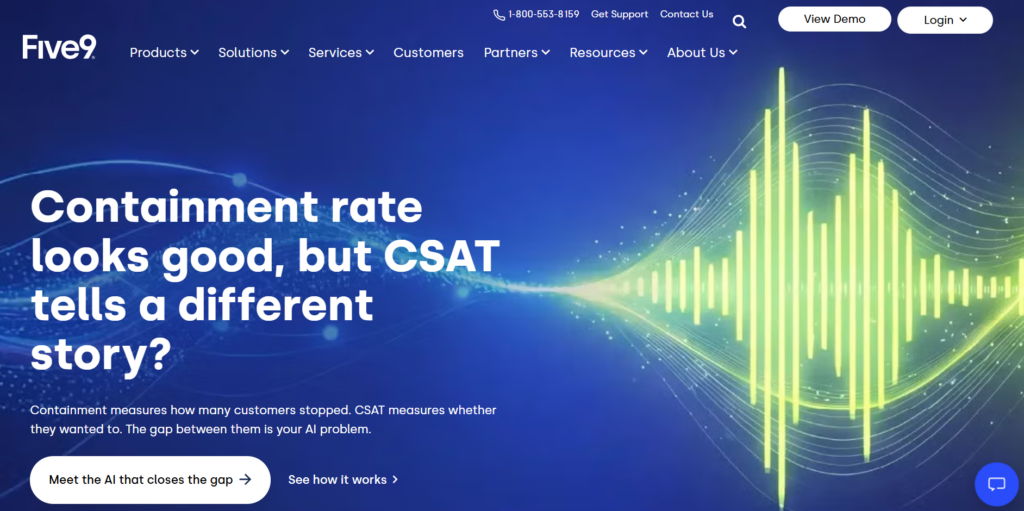
7. Five9
Best for health systems that want native Epic integration with built-in virtual agents
Five9 is an established enterprise CCaaS platform with a strong healthcare push centered on Epic. Its Five9 Fusion for Epic integration is Epic Toolbox-approved and embeds the Five9 agent desktop inside Epic modules like Cheers, Cadence, EpicCare Ambulatory, and Hyperdrive, putting telephony controls and patient records on one screen.
Five9 also offers Intelligent Virtual Agents that handle high-volume requests like appointment scheduling, reminders, referral follow-ups, prescription inquiries, and billing questions.
Useful features for healthcare call centers:
- Real-time access to patient details as calls arrive, with no system toggling
- One-click outbound calling from Epic modules like Cheers, Cadence, or Resolute
- Smooth handoffs from automation to live agents with full context preserved
- Proactive outreach and self-service managed from within Epic workflows
- AI Agent Connect program for plugging accredited third-party AI agents into the platform
Pros:
- Standards-based, API-driven integration built to Epic’s recommended practices for healthcare CCaaS products
- Proven enterprise scale for high-volume patient access centers
- Open partner ecosystem lets health systems add specialized healthcare AI on top
Cons:
- Unlocking the platform’s full potential typically requires technical resources
- Enterprise pricing and implementation scope may be more than smaller practices need
User rating: 4.1/5 (G2), 4.2 (Capterra)
8. Hyro

Best for adding healthcare-native AI agents to an existing contact center
Hyro isn’t a full contact center platform, but a healthcare-specific AI agent layer that sits on top of the systems you already run. Hyro automates phone, chat, and SMS for hospitals and health systems, covering scheduling, patient access, and call-center deflection. Its conversational AI uses a knowledge graph, which helps in large health systems where information changes often.
Useful features for healthcare call centers:
- End-to-end scheduling, cancellations, physician search, and prescription refills
- Automated billing inquiries, claim status updates, and self-service registration
- Smart routing, call-to-text deflection, and proactive patient re-engagement campaigns
- Caller identification and intent mapping before routing complex requests to staff
- Visibility into each conversation and the knowledge sources behind every response
- Integrations with Twilio Flex, NICE, Genesys, Five9, Cisco, and Epic
Pros:
- Built exclusively for healthcare
- Epic integration listed in the Epic Showroom
Cons:
- It augments existing contact center infrastructure, so you still need a separate CCaaS vendor
- It’s geared toward large health systems with multi-quarter enterprise procurement, which may not suit smaller practices
User rating: 4.9/5 (G2)
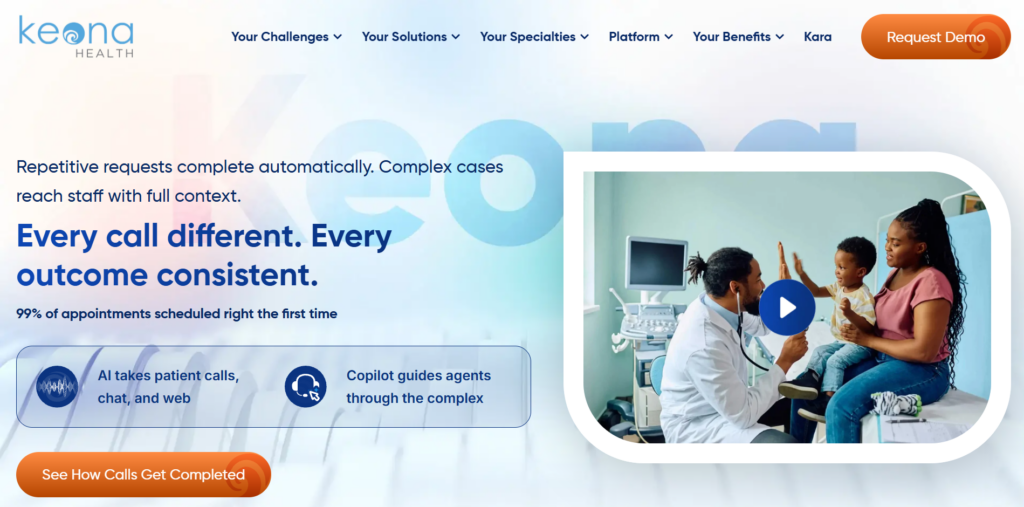
9. Keona Health
Best for nurse triage and clinical patient access workflows
Keona Health focuses on clinical triage. Its CareDesk platform unifies scheduling, nurse triage, queue management, and agent guidance for patient access teams. CareDesk uses an AI-powered workflow and rules engine to guide agents and nurses from scheduling through clinical triage, using Schmitt-Thompson telephone triage protocols. Its AI call agent can autonomously schedule appointments, triage symptoms using those protocols, and handle after-hours inquiries.
Useful features for healthcare call centers:
- AI-guided branching protocols that walk nurses through complex triage
- Intelligent scheduling that factors in provider preferences, patient data, and multi-resource requirements
- Automatic call prioritization and routing to the right queue
- AI-to-human handoff that passes full call context into the agent console
- Safety controls including intent checks, fallback, and human review
- Practice Intelligence 360 analytics for call volumes, agent utilization, and patient satisfaction
Pros:
- Built for clinical call types
- Covers both AI automation and agent-assisted workflows in one healthcare CRM
- Integrates with existing EHRs and call center software through standard APIs
Cons:
- Pricing is quote-only, and public reviews are limited
- Its strengths are triage and scheduling, so organizations wanting a broad enterprise CCaaS suite may need to pair it with another platform
User rating: 5/5 (G2)
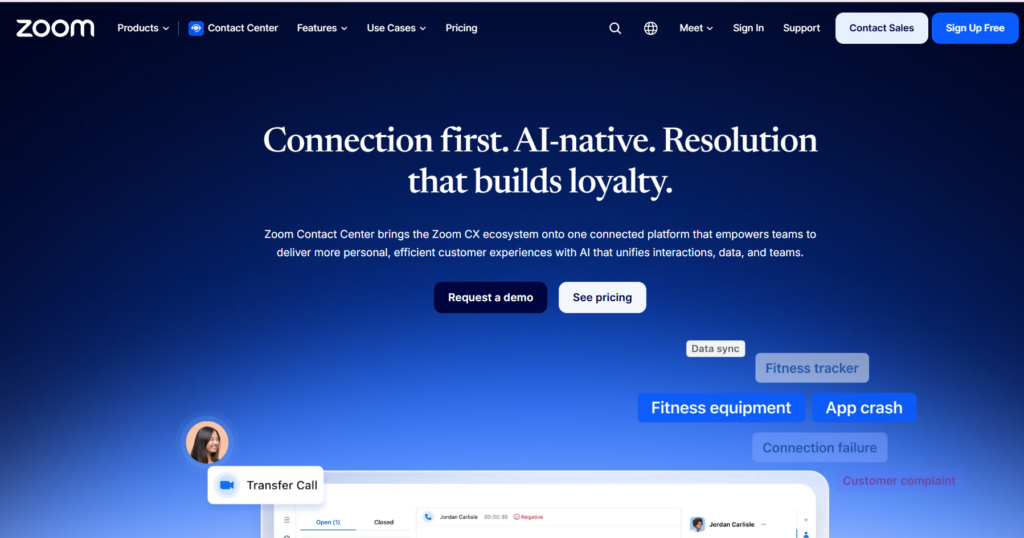
10. Zoom Contact Center
Best for organizations already using Zoom for telehealth and internal communications
Zoom Contact Center extends Zoom’s platform into patient access, and it has recently deepened its healthcare capabilities. The Epic integration delivers real-time caller identification, contextual screen pops, click-to-call, and advanced call controls inside Epic Hyperspace, with routing informed by patient context and Epic data. Zoom Virtual Agent now integrates with Epic to handle routine patient inquiries over voice and chat.
Useful features for healthcare call centers:
- Embedded call bar within Epic for managing calls without app switching
- Auto pause and resume of call recording to support compliance
- Interaction data that flows between Zoom Contact Center and Epic for documentation and reporting
- Support for scheduling, billing inquiries, medication requests, and general patient communication
- Epic integration for Zoom Clinical Note to simplify clinical documentation
Pros:
- One vendor for contact center, telehealth video, phone, and team collaboration
- Zoom executes a BAA to support customers’ HIPAA compliance
Cons:
- Epic integration is still new
- Third-party apps aren’t covered under Zoom’s BAA, so add-ons need separate compliance review
User rating: 4.3/5 (G2), 5 (Capterra)
11. Dialpad
Best for midsize healthcare organizations that want an AI-native phone and contact center in one app
Dialpad is a cloud communications platform that has evolved into a full AI contact center. It combines business phone, contact center, sales dialer, messaging, meetings, and agentic AI in one application. Its AI agents streamline scheduling, triage, and follow-up while handling patient records under HIPAA safeguards. Teams build those agents in Agent Studio, a no-code builder for deploying AI agents across voice and digital channels.
Useful features for healthcare call centers:
- Real-time transcription with automatic post-call summaries and action items
- Live agent assist with real-time coaching prompts and automated call scoring
- Speech analytics that flag keywords, sentiment, and compliance issues for QA
- Guardian, a built-in governance layer that monitors AI agent interactions in real time
- AI agent handoffs to human agents with context
- Secure call recording and customizable data retention
Pros:
- AI features fall under the same BAA as the rest of the platform, and customers can sign it with one click
- Holds GDPR, HIPAA, and SOC 2 Type II compliance and runs on Google Cloud
Cons:
- Reviewers note that AI customization and detailed reporting can feel limited compared to some competitors
User rating: 4.4/5 (G2), 4.2 (Capterra)
Checklist: How to choose the right healthcare call center software
To choose the right healthcare call center software, you need to do a bit of preparation. You want tools that serve your business and patients long-term, so it’s best not to complicate your processes with one-off or short-term solutions. Here are healthcare call center best practices to find the right AI call center solution for your healthcare business.
- Define your top call drivers. Pull call reason data from the last three to six months and identify what patients call about most, such as scheduling, prescription refills, billing, or test results. Knowing the main reasons tells you which automation features will have the biggest impact and keeps you from paying for capabilities you won’t use.
- Assess HIPAA and BAA requirements. Confirm that every vendor on your shortlist will sign a Business Associate Agreement, and ask exactly which products and features it covers. AI tools like transcription, agent assist, and virtual agents are sometimes excluded from a vendor’s compliance scope, so get coverage confirmed in writing before you sign.
- Evaluate EHR integration needs. Map out which EHR and practice management systems your agents use daily and what they need to do in them, like viewing schedules, booking appointments, or updating records. Then ask vendors whether their integration is native or relies on middleware, whether it can both read data and write it back, and whether agents can work without switching screens. EHR-integrated call center software is much easier to adopt as information moves seamlessly between systems without losing important details or context.
- Make sure PCI protection is in place. If at any point your customers need to use their credit cards, the software of your choice must have strong PCI protection. This means that every piece of highly sensitive data, like credit card numbers, Social Security numbers, and any other private details, has to be hidden so people and systems only see the data they need.
- Know how AI is handled. Most healthcare call center tools use AI, so you need to know how the provider governs AI agents and the patient data they touch. Ask whether the vendor signs a BAA that covers its AI subprocessors, whether call recordings and transcripts are used to train models, and how PHI is redacted or masked in logs. Confirm that AI agents operate within defined guardrails, such as never giving clinical advice, and escalate to a live agent when a request is urgent, complex, or outside their scope.
- Pilot on one high-volume workflow. Start with a single high-volume, low-complexity workflow like appointment scheduling or refill requests (read our guide on how to automate patient appointment scheduling). Set clear success metrics up front, such as containment rate, average handle time, and abandonment rate, so you can measure results against your baseline.
- Optimize with analytics, then scale. Use reporting dashboards and post-call QA to find where AI agents hand off too often, where patients drop off, and where staff needs coaching. Once the pilot hits its targets, expand to additional workflows, channels, and service lines, using what you learned to shorten each rollout.
Healthcare call center software that drives your business forward
The right healthcare call center software can transform your contact center services and your patient experience. With automation and personalization, clinics, hospitals, and healthcare contact centers are cutting millions in operational costs, improving patient satisfaction scores, and bringing in new revenue.
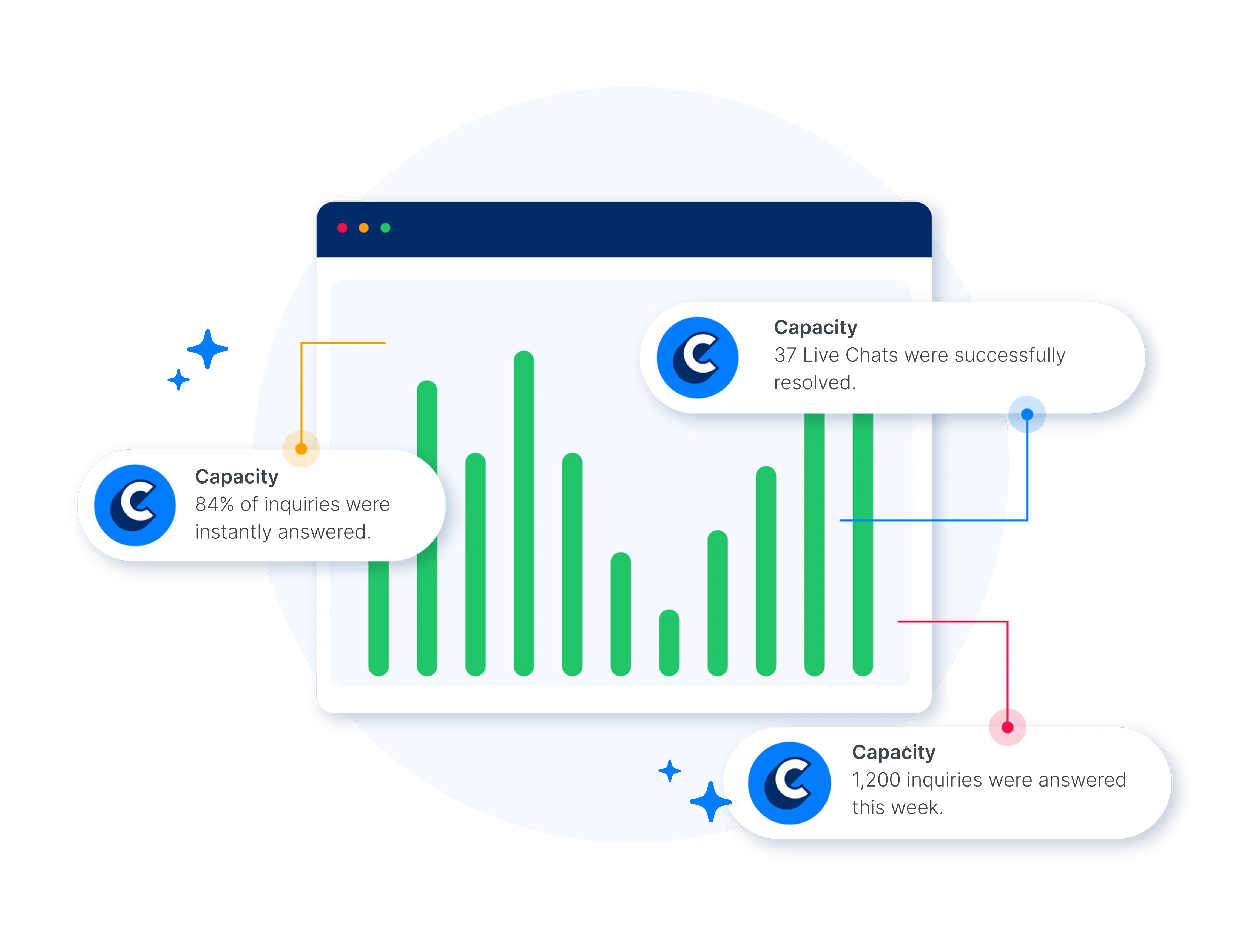
Capacity, a patient experience automation platform, helps you do all of that across multiple levels. Its AI Knowledge Orchestration Layer brings healthcare-focused AI agents, agent assist, auto QA, conversation intelligence, and outbound automation in one place.
By using a single, continuously updated source of truth, it powers patient scheduling, collections, reminders, patient inquiries, waitlist management, and more without you lifting a finger.
Major healthcare organizations have used Capacity’s solution. For example, the UK’s National Health Service (NHS) used Capacity to onboard more than 20,000 new contact center agents in under a month for its COVID-19 Test & Trace program during one of its most challenging periods. With Agent Guidance, those agents ran 241,000 guided scripts a day while meeting strict government compliance requirements every time.
patient support?
FAQs
The best call center software for healthcare depends on your organization’s size, EHR, and top call drivers. For example, Capacity stands out for omnichannel AI self-service with live agent guidance and auto QA, Talkdesk and Genesys offer deep Epic integration, while Amazon Connect Health fits AWS-native systems with engineering resources.
Yes, any software that creates, stores, or transmits protected health information must support HIPAA requirements, and the vendor must sign a Business Associate Agreement.
Key healthcare contact center features include HIPAA compliance with a BAA, EHR integration, AI-powered patient self-service, omnichannel support, and secure patient authentication. Post-call auto QA, healthcare-specific reporting dashboards, and the ability to scale with seasonal demand are also essential.
AI helps healthcare call centers by automating routine requests like scheduling, refills, and billing questions, which shortens hold times and frees staff for complex calls. AI also assists live agents with real-time guidance, automates call summaries, and reviews 100% of interactions for compliance and quality.
The main difference between general CCaaS and healthcare-specific call center software is that CCaaS platforms offer broad contact center capabilities across industries, while healthcare-specific software adds features like EHR integration, clinical routing, nurse triage protocols, and pre-built patient access workflows.
Yes, many platforms integrate with EHRs like Epic, Oracle Health, and athenahealth, often through FHIR APIs or embedded agent tools. The depth varies widely, from simple screen pops to full read and write-back workflows inside the EHR, so ask vendors exactly what their integration supports.