


 Customer Support
 HR & Ops
 IT Support
 Sales & Marketing

- AI for healthcare billing and collections automates revenue cycle management from catching coding errors before claims go out to sending reminders, setting up payment plans, and taking payments.
- AI handles billing questions, payment reminders, payment plans, eligibility checks, claim status updates, escalations, and secure payments.
- HIPAA compliance, a signed BAA, SOC 2 Type II, and PCI DSS for any platform that processes payments are required for any platform that touches patient data.
- AI for patient collections best practices include starting with simple, high-volume tasks, connecting AI to your EHR, using SMS, timing reminders around when patients pay, making it easy to reach a human, and tracking cost-to-collect.
AI for healthcare billing and collections is a smart way for clinics, healthcare contact centers, medical billing companies, hospitals, and other healthcare institutions to automate revenue cycle management (RCM). AI systems reduce manual work and its associated risks, like coding mistakes, and provide your patients with fast and convenient self-service options.
However, it’s not as simple as sending an invoice after an appointment. Healthcare billing and collections come with strict compliance requirements and patient expectations.
In this guide on how to automate billing and collections for your company, we’ll explain:
- Why current healthcare billing isn’t effective and how AI can help
- 7 tasks AI can automate
- How AI in revenue cycle management works
- 6 Best practices for automating healthcare billing and collections
Why healthcare billing is broken and how AI can help
Healthcare billing in the U.S. and many other countries still lags behind. Between outdated coding systems, fragmented payer rules, and manual data entry across disconnected systems, billing errors have become a regular part of doing business.
For example, out of all insurance claim denials, 32% are due to inaccuracies in coding (Healthcare Finance, 2021). On top of that, resubmitting a claim can cost anywhere between $25 and $181 per claim (Training Magazine, 2024).
Denied claims, duplicate billing, coding mistakes, and fraud cost tens of billions of dollars every year. This money gets absorbed by providers, passed on to patients, or lost in an overburdened system.
Ineffective collections are usually the root of the problem. Once a claim is denied or a patient balance goes unpaid, most healthcare organizations still rely on manual phone calls, paper statements, and staff working through spreadsheets to chase down payments.
It’s slow, inconsistent, expensive, and makes revenue cycle management inefficient. AI in medical billing and coding is starting to change that by catching billing errors before they happen without any human involvement. Healthcare revenue cycle automation makes billing, automated claims processing, and collections outreach faster, more personalized, and far less dependent on manual work.
What is AI in healthcare billing and collections?
AI in healthcare billing and collections uses machine learning and automation to handle everything from claims generation to final payment. Agentic contact center AI can flag coding errors before claims go out, answer routine patient billing questions through text and voice, automate collections outreach and payment plans, and match incoming payments to accounts.
Back-end AI for healthcare billing and collections integrates with electronic health record (EHR) systems so information moves seamlessly between systems. Patient-facing contact center automation, like AI web agents, AI voice agents, or AI text agents, answers billing questions, sends reminders, and manages collections outreach in conversational language, speeding up and making automated claims processing in healthcare faster.
What billing and collections tasks can AI automate?
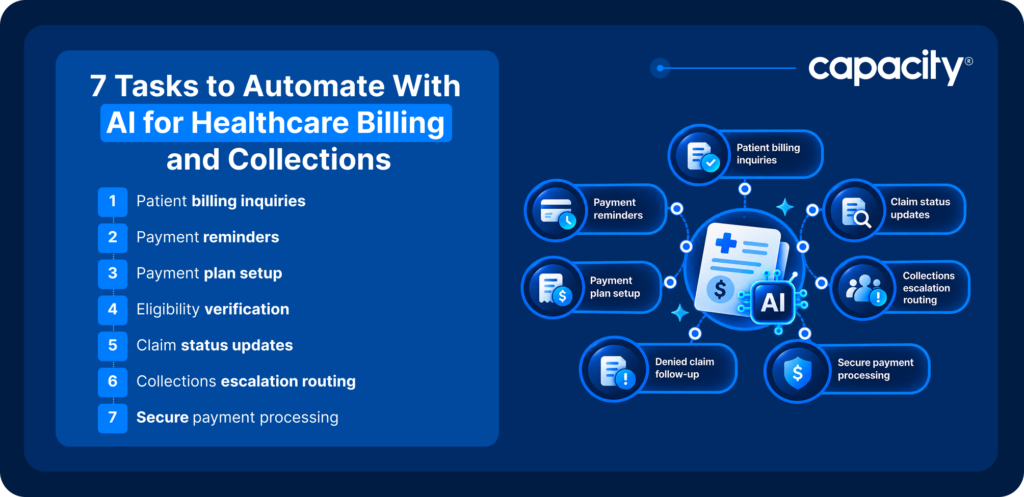
AI in medical billing and coding can automate multiple revenue cycle management tasks, such as payment reminders, plan setup, claim status updates, and more. A seamless digital experience is key because 89% of patients agree that being able to book appointments online is important (Experian, 2024). But there’s more to what healthcare AI can automate.
- Patient billing inquiries – AI assistants can answer common questions like “Why was I charged this?” or “Has my insurance paid yet?” without patients having to wait on hold for a live agent.
- Payment reminders – Automated reminders go out via text, email, or voice at the right intervals, nudging patients toward payment without staff having to manually track due dates.
- Payment plan setup – AI can walk patients through available payment plan options and get them enrolled on the spot without endless back-and-forth.
- Eligibility verification – AI can check insurance eligibility and coverage details in real time, reducing surprise denials tied to lapsed or inaccurate coverage. Manual eligibility can often be inaccurate. For example, in its 2025 report, Experian found that 20% of patients have to deal with administrative issues before they even see a doctor and 22% don’t get the care they need in time due to slow insurance verification.
- Claim status updates – Patients and staff can get instant answers on where a claim stands — whether it’s submitted, pending, or denied.
- Collections escalation routing – AI can triage past-due accounts, handling straightforward cases automatically and routing complex or sensitive ones to a human collector.
- Secure payment processing – AI-driven systems can take payments directly during a chat or call, matching them to the right account and confirming each transaction instantly.
Every Patient Touchpoint
How does AI collections outreach work?
AI collections outreach works by using automated chat, voice, or text to contact patients with past-due balances, verify their identity, and offer payment options. It follows compliance rules for timing and messaging and escalates to a live agent whenever a patient disputes a charge, asks for a human, or the situation falls outside set parameters. Let’s go over the four main functions of AI collections outreach.
Proactive balance reminders across channels
AI systems send reminders the moment a balance is due or overdue via text, email, or an automated voice call. A patient might get a text saying their $85 balance is due in three days, with a link to pay right there. The right timing is key because in 2025, J.P. Morgan Payments found that patient collections were the top revenue issue and that they increased by 133% from 2011 to 2024.
AI-powered omnichannel call center outreach reaches people who’d otherwise ignore a paper bill sitting on the counter, and it can be timed to avoid overwhelming patients with repeated contact.
Conversational AI for billing inquiries and payment plans
People don’t follow a script, so when a patient texts back “Why is this so much?” or “Can I pay this over time?” conversational healthcare AI can hold that conversation. It pulls up the charge breakdown, explains what insurance covered, and walks the patient through payment plan options like three interest-free installments. AI for healthcare billing and collections can handle follow-up questions and get the patient enrolled in a plan on the spot, the same way a billing rep would, just without the hold time.
Brightree, a medical technology provider, offers a great example of how conversational AI for billing can help recover millions. The company used Capacity’s AI voice agents to call customers about overdue payments. With this level of automation, Brightree collected $4.7M in late-stage debt and $6.5M from inbound and outbound calls transferred to agents.

Secure payment processing via voice, SMS, or chat
Patient billing automation should include secure payment options. Once a patient decides to pay, with AI, they don’t need to be routed to a separate portal or given a phone number to call. They can read a card number aloud to a voice assistant, tap a secure link in a text, or enter payment details in a chat window.
The AI for patient collections processes the payment immediately, applies it to the right account, and sends a confirmation—closing the loop in one interaction.
Smart escalation to live agents for complex disputes
Not everything belongs in an automated flow. If a patient insists they already paid, disputes a charge, or asks for a human, the AI recognizes that and hands the conversation off to a live agent. The patient arrives to the agent with the account details and conversation history already gathered, so they don’t have to repeat themselves.
What compliance and security requirements are necessary for AI billing automation?
Any AI platform touching healthcare billing or any private patient information has to start with HIPAA compliance. Balances, payment history, insurance details, and even the fact that a patient owes money are all protected health information (PHI), and processing that data through an AI billing for contact center services requires the same safeguards as any other PHI. HIPAA-compliant contact center must provide encryption, access controls, audit logs, and a signed business associate agreement with the vendor.
Beyond HIPAA, the AI for patient collections of your choice should have SOC 2 Type II certification. This means an independent auditor has verified the vendor’s security controls are operating effectively over time. And for any platform that processes payments directly, PCI DSS compliance is essential, ensuring cardholder data is handled, transmitted, and stored according to industry security standards.
Non-compliance with HIPAA can result in fines ranging from $100 to $50,000 (sometimes more) per violation, and certain violations can carry criminal penalties. On top of that, breaching patient trust damages a brand’s reputation, which can be difficult to rebuild.
6 Best practices for automating healthcare billing and collections
Most companies that run successful healthcare billing and collections automation start small. They automate the tasks that consume the most time but require the least effort, for example, payment reminders. This builds momentum and creates success stories to move forward and get used to the process. Then follows patient experience optimization so patients leave feeling heard and with their issues resolved. Let’s take a look at the best healthcare contact center automation practices.
- Start with the highest-volume, lowest-complexity interactions – Begin automation with balance inquiries and payment reminders, the tasks that happen constantly and require little judgment. For example, a clinic might automate “What’s my balance?” and “Did my insurance pay?” questions first, then layer in more complex flows like payment disputes later.
- Connect AI to the EHR and billing system – Agents need to pull live data, so if a patient pays their balance in the EHR at 2 p.m., medical billing AI software should know that by 2:05 instead of still sending a reminder for a balance that’s already zero.
- Use patient-preferred channels – Meeting patients where they already are increases response and payment rates. A text reading “Your $120 balance is due Friday—reply PAY to settle it now” tends to get faster action than a mailed statement sitting unopened for two weeks.
- Time reminders around payment behavior – Instead of using a fixed schedule, look at patterns in when patients tend to pay. If data shows a patient typically pays a few days after payday, timing the reminder for the 1st or 15th of the month can improve response rates.
- Make it easy to reach a human agent – No automated flow should feel like a dead end. A simple “text HUMAN anytime” option, or a healthcare chatbot that automatically escalates after a patient types “this is wrong” twice, keeps trust intact.
- Track cost-to-collect – Measuring cost per dollar collected before and after automation proves ROI. A practice might find that automating reminders drops cost-to-collect from $8 per resolved account to $3, freeing staff to focus on complex, high-dollar disputes.
How Capacity automates patient billing and collections at scale
Capacity brings together voice, text, email, and WhatsApp agents that can handle the full range of billing and collections conversations. They can answer balance questions, walk patients through payment plans, send reminders, and take payments directly. Plus, it can automate other healthcare call center operations like appointment scheduling or insurance claims verification. Its omnichannel approach allows patients to start a conversation over text and finish it on a call without losing context, which mirrors how people actually communicate.
Most importantly, you don’t need to worry about compliance because it’s built into every conversation. Capacity’s healthcare call center software provides the highest level of security and is fully compliant with HIPAA, CCPA, FERPA, GDPR, and SOC 2 TYPE II.
Underneath the conversation layer, Capacity’s medical billing AI software connects directly to a health system’s EHR, healthcare RCM, and billing systems, so agents are working from live data, meaning a payment posted five minutes ago is already reflected the next time a patient asks about their balance.
And when a conversation needs a human, real-time agent assist helps your team find account history, understand what’s already been discussed so patients don’t have to repeat themselves and agents can resolve issues faster.
Stress-free healthcare billing and collections
When the US spends approximately $35 billion each year on administrative tasks related to prior healthcare authorizations, automation becomes a number one solution (Oxford University Press, 2024).
Capacity’s AI for healthcare RCM automation lifts the burden of manual outreach and missed opportunities, allowing you to focus on providing an excellent patient experience and running your business without administrative obstacles.
With AI agents, you can provide 24/7 support, handling patient scheduling automation, medical inquiries, billing and collections, claim verification, and prescription refills via voice, chat, SMS, and email. And most importantly, they never compromise your patients’ data security and privacy.
Want to reduce revenue leaks and start patient billing automation?
Healthcare Contact Centers
FAQs
The benefits of AI for healthcare billing include reduced billing errors, faster claim resolution, and lower cost of collections.
Medical billing tasks like balance inquiries, payment reminders, payment plan setup, eligibility verification, claim status updates, collections escalation, and payment processing can all be automated.
AI helps with patient collection outreach by automating timely reminders across channels like SMS and voice, answering billing questions, setting up payment plans, and processing payments directly.
HIPAA compliance depends on the vendor. When you’re looking for AI billing software, look for a signed business associate agreement, proper encryption and access controls, and ideally SOC 2 Type II certification as evidence that the platform’s security practices are independently verified.