


 Customer Support
 HR & Ops
 IT Support
 Sales & Marketing
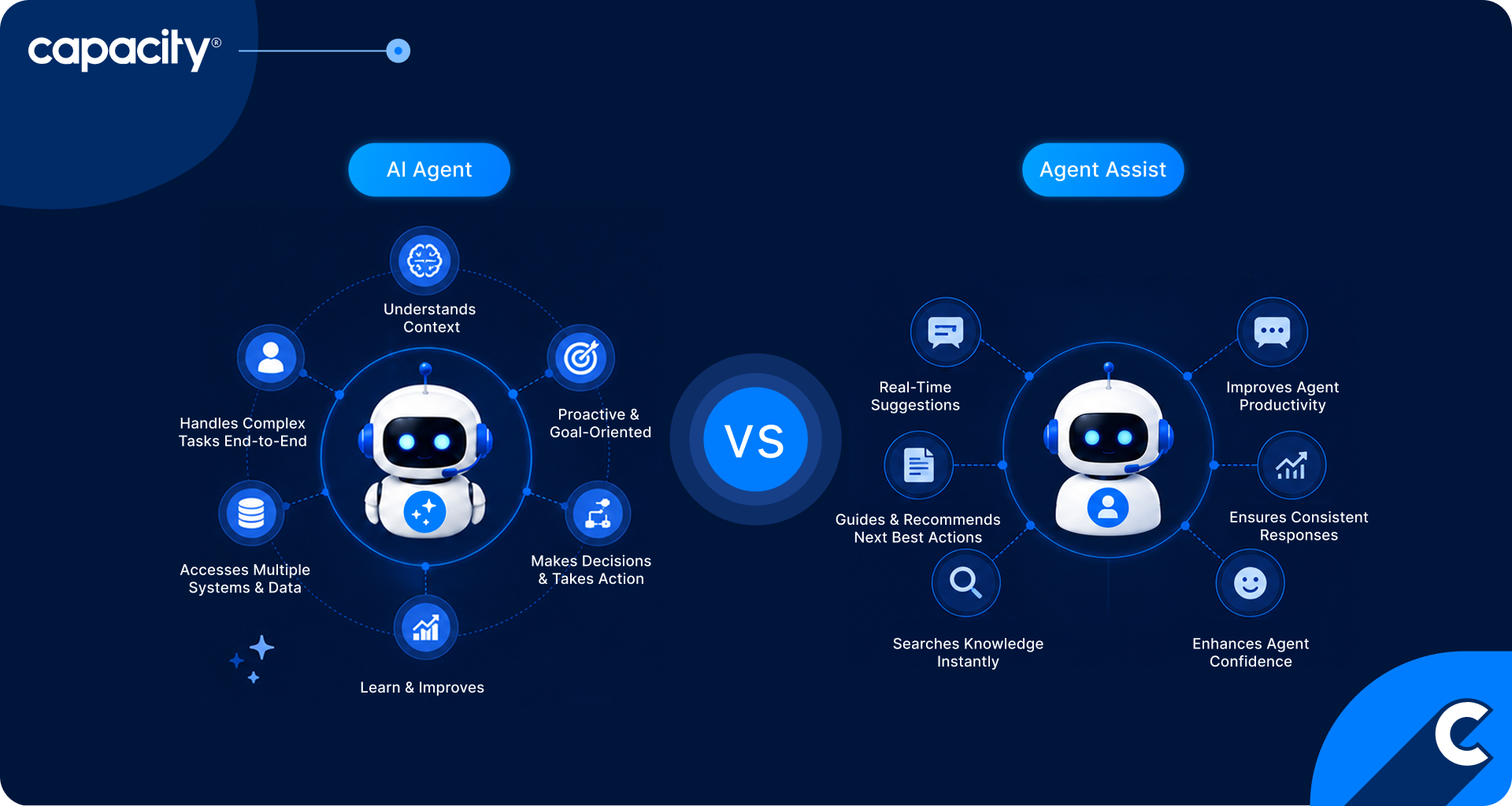
- AI agents handle customer interactions autonomously, without a human in the conversation. Agent assist supports human agents during live interactions as an assistant that surfaces real-time guidance and insight.
- The decision of which to deploy and scale first should be informed by your contacts, volume, types of interactions and current tech stack.
- Most contact centers now need and use both AI agents and agent assist. The ones that see the best results run them on the same platform, so the data from AI agent interactions informs how agent assist and auto QA perform.
Still trying to figure out how and when to invest in AI agent vs agent assist tools for contact center support? You’re not alone. A whopping 88% of contact centers are using AI at scale…but only 25% of that have actually leveraged its full potential (CMSWire 2026).
Understanding the difference, and the relationship, between AI agents and agent assist is where a scalable AI strategy starts—one that lays the groundwork for real ROI. AI agents handle routine customer interactions end-to-end. Agent assist supports human agents in real time, giving them the information they need to resolve complex calls faster.
Both improve contact center performance and both belong in a mature AI strategy. But they do completely different jobs, and most contact centers don’t have the clarity on which one to prioritize first, or what it costs to run them on separate platforms.
This post breaks down the difference between AI agents vs agent assist, when and how to deploy them in contact center or support context and why many CX leaders are seeing the strongest results from running both tools on a single platform.
AI agents vs agent assist: a quick comparison
| AI agents | Agent assist | |
|---|---|---|
| Who it serves | Customers directly | Human agents during live calls |
| Autonomous | Yes — handles interaction end-to-end | No — augments human judgment |
| Replaces headcount | Can reduce volume handled by humans | Does not — humans still take every call |
| Best for | High-volume, routine, structured interactions | Complex calls where agents need real-time support |
| ROI shape | Higher ceiling, longer deployment curve | Faster to ROI, visible within weeks |
| Escalation role | Hands off to humans when needed | Is the layer that supports those humans |
AI agents are customer-facing. When a customer calls, chats, texts or emails, an AI agent handles that interaction. Backed by natural language processing, AI agents understand customer requests, take actions to resolve them across connected systems, and either close the issue or decide when to pass to a human.
Agent assist is agent-facing. It operates alongside a human agent during a live interaction, listening to the conversation and pushing relevant information to the agent’s screen in real time: the right knowledge article, a suggested response, a compliance prompt, a sentiment alert that tells them the customer is getting frustrated. Agent assist actively helps to improve customer experiences and agent performance.
The simplest way to remember the distinction: AI agents talk to your customers. Agent assist talks to your agents.
When and how to start with AI agents
CX and contact center leaders should prioritize AI agents for when:
Your highest-volume interactions follow a predictable pattern. Order status, account balance, password resets, appointment scheduling, basic troubleshooting: these call types are high frequency, low complexity and don’t require human judgment. AI agents can handle these types of inquiries and deflect them from human agents.
You have documented call types and clean system integrations. AI agents need to connect to your CRM, order management and knowledge base to be effective. If your data is organized and your APIs are accessible, deployment can happen quickly and the agent can reach high resolution rates within weeks.
Containment rate and cost-per-contact are your primary metrics. AI agents directly move these numbers. Every interaction resolved autonomously is one your agents didn’t have to handle. At scale, that’s a meaningful cost reduction with measurable ROI.
Your team is ready for the change management. Deflecting more routine inquiries means that more complex calls reach agents more often—and they need to be trained for it. Communicate the shift to your team and adjust coaching accordingly.
👉 Read our blog on best practices for implementing AI agents in a contact center
When and how to start with real time agent assist
Contact center and CX leaders should prioritize real time agent assist deployment when:
Your contact mix is too complex for full automation. If most of your calls require judgment, policy interpretation, empathy or multi-system reasoning beyond what AI can reliably handle today, AI agents will underperform. Agent assist improves performance of the human agents handling those calls without requiring the same level of automation readiness.
You prioritize ROI sooner rather than later. Real time agent assist deployments typically show measurable improvements in average handle time (AHT) within weeks, not months. Human agents stop hunting across systems, responses are more consistent and after-call work shrinks with Auto QA and auto-summaries. AI agent deployments take longer to train, integrate and iterate.
New agent ramp time is a problem. If you’re struggling with high turnover or long ramp periods, agent assist is one of the fastest, most effective ways to shift agent experience. A new agent empowered with coaching, real-time guidance and Auto QA performs faster and much more confidently.
You’re in a compliance-heavy environment. Industries like financial services or healthcare, where agents must follow specific scripts, deliver required disclosures and avoid certain language, benefit significantly from agent assist. The system can be deterministic or conversational, catch misses before they happen and automatically flag any potential risks.
Into a Performance Win
What to look for in an AI agent or agent assist platform for customer support
If you’re planning to run AI agents and real time agent assist alongside each other, both eventually (which is the right long-term model for most contact centers) it’s best to invest in a CX automation platform. According to Puzzel’s State of Contact Centres 2026 report, only 3% of contact centers are using a single platform for CX, while the average support org has nearly 4 separate tools.
This leads to fragmented experiences for customers, who want to resolve their issues quickly, and frustrating experiences for agents, who want to find the right information fast. Here are some examples:
- An AI agent from one vendor escalates to a human agent, but the agent assist tool isn’t connected to the AI agent and doesn’t know what happened in the previous chat. The human agent has to re-gather context, the customer becomes more frustrated, and it becomes harder to resolve the interaction well.
- Human QA teams have to score calls manually, leaving 95-98% of support calls unreviewed and most performance, customer and optimization insights uncovered.
- When the conversation intelligence platform surfaces a coaching insight or a knowledge gap, it doesn’t update knowledge across your channels and tools. Teams have to manually update each AI agent, agent assist tool, coaching program, QA rubrics and knowledge base.
On a unified platform, all of that connects. The AI agent’s conversation history is available to the human agent before they pick up. The same knowledge layer powering the AI agent is what agent assist draws from in real time. QA scoring covers the full interaction, both the AI agent and human agent’s performance. And insights feed back into the knowledge layer, improving both the AI agent’s future performance and the agent assist prompts for the next similar interaction.
👉 Check out the best AI agents for contact centers in 2026 here
3 questions to ask before investing in AI agents vs agent assist
Before deciding which to deploy first, answer these honestly:
- What percentage of your current inbound volume is genuinely routine? These are predictable request types that follow a pattern and don’t require judgment.
- How organized is your knowledge and how accessible are your system integrations? AI agents need clean data and API access to perform. Agent assist is less dependent on integration depth at the outset.
- What’s your timeline pressure? If you need to show results in 60 days, agent assist is the safer bet. If you’re building toward a 12-month transformation, AI agents are worth the deployment investment.
There’s no universally correct answer. But the contact centers that get the sequencing right tend to deploy faster, see ROI sooner and build toward the full hybrid model more sustainably than the ones that try to solve everything at once.
To talk through the right starting point for your environment, request a demo and we’ll walk through your contact mix together.
Capacity AI agents.
FAQs
AI agents are customer-facing. They handle interactions autonomously, from understanding the request to resolving it, without a human in the conversation. Agent assist is agent-facing. It runs alongside a human agent during a live call, pushing relevant knowledge, suggested responses and compliance prompts to their screen in real time.
It depends on your contact mix. If over 40% of your inbound volume is routine and predictable (order status, account balance, appointment scheduling), AI agents have a strong case. If most of your calls require judgment, policy interpretation or empathy, start with agent assist.
No. Agent assist tools support the humans already taking calls. Real time agent assist helps agents find the right answer faster, stay compliant and handle more complex interactions with less effort.
When they run on separate platforms, you get data gaps. The human agent receiving an AI escalation doesn’t have context from the AI conversation. QA teams can score each portion separately but can’t see the full interaction as one event. And coaching insights from conversation intelligence don’t connect to what agent assist is surfacing in real time. On a unified platform, the AI agent’s conversation history carries over to the human agent before they pick up, the same knowledge layer powers both tools, and QA scoring covers the full interaction arc without a break in the middle.
Agent assist is the stronger first deployment for contact centers with complex, judgment-heavy call mixes; compliance-heavy industries like financial services, healthcare or debt collection where real-time scripting and disclosure prompts reduce regulatory risk; operations with high agent turnover or long ramp periods; and organizations where change management is a concern and building internal trust in AI before introducing more disruptive automation is the right move.


